Budget & Financing
Engagement Ring Financing Options: What to Know Before You Sign
Jeweler cards, Affirm, Klarna, and layaway explained — including the deferred-interest trap that can quietly double your cost.
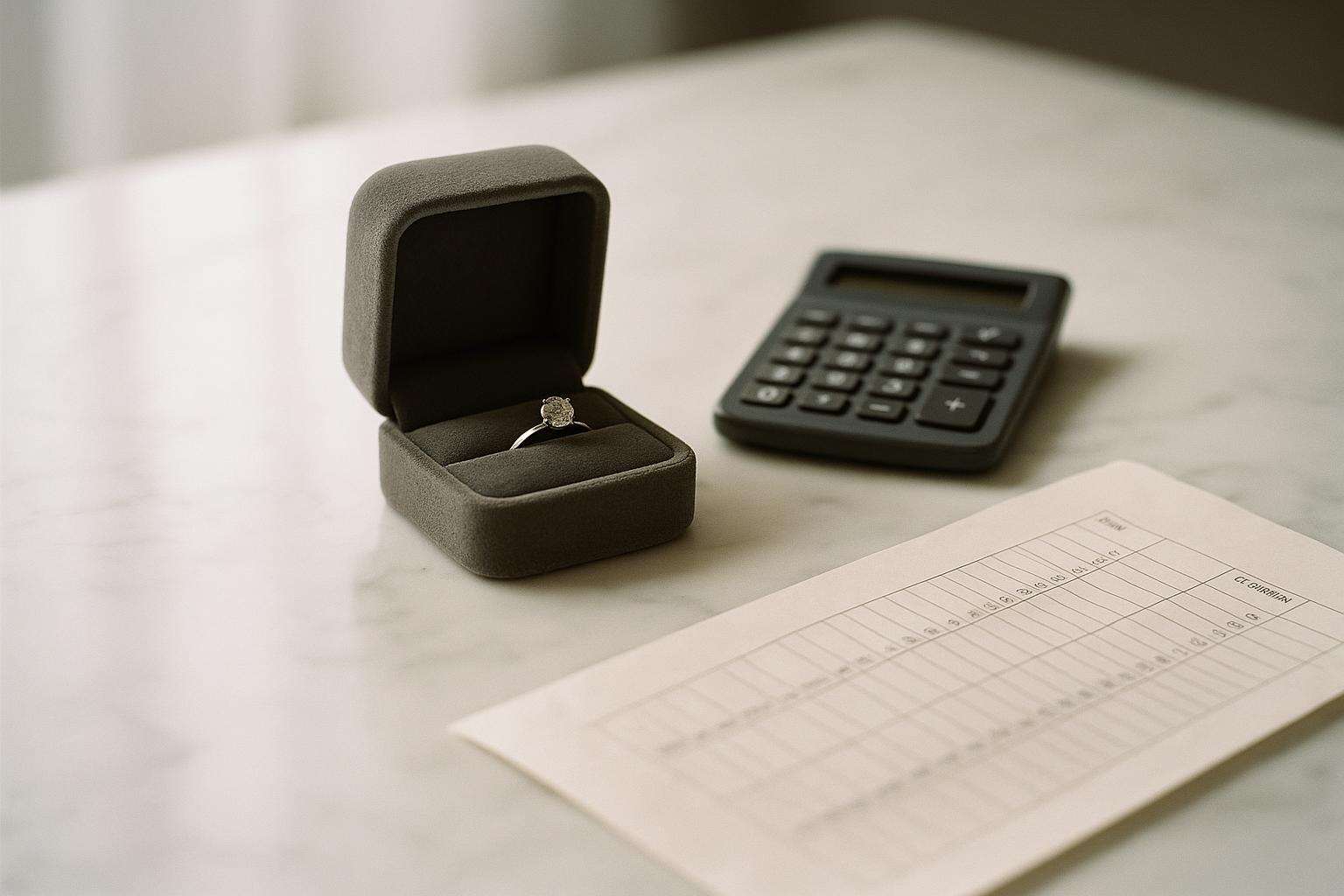
Most jeweler financing is deferred interest, not true 0% APR — a crucial distinction that can add thousands of dollars to your ring's cost if the balance is not paid in full before the promotional deadline. Kay, Zales, and Jared cards charge 35.99% APR retroactively from the purchase date. Affirm and Klarna offer transparent BNPL alternatives with disclosed interest. A personal loan from a credit union or a zero-interest layaway plan are often the safest routes for buyers who cannot pay off a store card in full within the promotional window.
What is deferred interest, and why does it matter more than the promotional period length?
Walk into a Kay, Zales, or Jared store — all owned by Signet Jewelers — and a sales associate will almost certainly mention the store credit card. The pitch sounds simple: no interest for 6, 12, or 18 months. What is rarely explained at the point of sale is the mechanism behind that offer.
These cards, all issued by Comenity Bank (a Bread Financial company), use deferred interest rather than a true 0% APR promotion. The difference is legally significant. Under a true 0% APR plan, interest is waived during the promotional period — nothing accrues. Under a deferred-interest plan, interest accrues from the day of purchase at the card's full rate, but sits in a suspense account. If you pay the promotional balance in full before the deadline, the deferred interest is forgiven and you pay nothing extra. If even a single dollar of the promotional balance remains on the last day, the entire accumulated interest — computed at the full APR from the original purchase date — is posted to your account at once.
As of 2026, the standard purchase APR on Kay Jewelers, Zales, and Jared credit cards is 35.99% variable, with a penalty APR that can reach 39.99%, according to the Comenity Bank credit card agreements. The CFPB has explicitly warned consumers that deferred interest is not the same as a 0% interest loan, and that minimum monthly payments are typically not sufficient to retire the promotional balance within the promotional window.
The math is stark. On a $4,500 ring financed on an 18-month deferred-interest plan at 35.99%, interest accruing from the purchase date through month 18 would total roughly $1,800 — all added to your balance if you miss the payoff date by even one day. The card agreements themselves state, in required disclosures: “Minimum payments are NOT guaranteed to pay the promotional plan balance within the promotional period.”
There are fixed-rate alternatives on these same cards. The Comenity agreement for Kay, Zales, and Jared offers true installment plans at 9.99% APR (36 or 60 months), 14.99% APR (36 or 48 months), or 16.99% APR (36, 48, or 60 months). These are genuine fixed-rate plans with no retroactive interest risk. They do carry a 2% promotional plan transaction fee and a $2.99 monthly paper-statement fee (waivable via paperless billing), but they are structurally safer than the deferred-interest track. If you do use a Signet store card, the fixed-rate installment plans are the responsible choice for any buyer with uncertainty about their payoff timeline.
How do Affirm, Klarna, and Afterpay compare for engagement ring purchases?
Buy Now, Pay Later (BNPL) services have become standard checkout options at Brilliant Earth, Kay, Jared, Zales, and dozens of independent online jewelers. The three major providers differ meaningfully in cost, term length, credit transparency, and suitability for the high-ticket ring purchase.
Affirm
Affirm is the most versatile BNPL option for ring buyers. It offers financing up to $17,500 on terms from 3 to 60 months at 0% to 36% APR, depending on creditworthiness and the specific merchant agreement. The decisive transparency advantage over deferred-interest store cards: Affirm discloses the exact dollar amount of interest you will pay before you accept the loan. There are no deferred-interest traps, no late fees, and no prepayment penalties.
A representative example for a $5,000 ring: approximately $230/month over 24 months at 15% APR, with total interest around $525. At 0% APR on the same amount, the payment drops to roughly $208/month with zero interest cost.
On credit reporting: since April 2025, Affirm reports all pay-over-time loans — including Pay in 4 — to Experian and TransUnion. The tradelines are visible on your credit file but, as Experian confirmed, do not yet factor into traditional FICO 8 calculations. Late payments of 30 days or more on longer-term Affirm loans behave like any installment delinquency and can damage your score materially.
Klarna
Klarna's U.S. products include Pay in 4 (four biweekly payments, 0% interest), Pay in 30 days (a 30-day interest-free float), and monthly installment financing from 6 to 36 months at 0% to 35.99% APR. Pay in 4 and Pay in 30 use only a soft credit pull; longer-term financing may trigger a hard inquiry — the checkout screen discloses which type applies before you confirm. A $7 late fee applies per missed installment. Klarna does not currently report Pay in 4 activity to credit bureaus, meaning on-time short-term payments build no visible credit history, though a collection referral will appear on your report.
Afterpay
Afterpay's primary product is Pay in 4 at 0% interest with a soft credit pull only. It does not offer long-term installment financing, making it impractical for rings priced above its per-transaction spending limits. For a ring at the national average of roughly $5,200 (per The Knot's 2024 Jewelry & Engagement Study), Afterpay will often be insufficient on its own. Like Klarna, Afterpay does not currently report standard Pay in 4 activity to credit bureaus.
| Provider | APR Range | Max Term | Late Fee | Hard Pull? | Credit Reporting |
|---|---|---|---|---|---|
| Affirm | 0% – 36% | 60 months | None | Possible on longer terms | Experian + TransUnion (since Apr 2025) |
| Klarna | 0% – 35.99% | 36 months | $7/missed payment | Possible on longer terms | Limited; not Pay in 4 |
| Afterpay | 0% (Pay in 4 only) | 6 weeks | Yes | No | No |
When is a personal loan or layaway better than jeweler financing?
The best financing instrument depends entirely on your credit profile, your certainty about the payoff timeline, and whether a home purchase or major credit application is on the horizon.
Personal loans from banks and credit unions
An unsecured personal loan delivers a fixed monthly payment, a defined payoff date, and no deferred-interest trap. As of June 2026, borrowers with excellent credit (720+) received an average personal loan APR of 14.48%, according to NerdWallet's aggregate data. Federal credit unions cap personal loan APRs at 18%, and in December 2025 the National Credit Union Administration reported the average three-year credit union loan APR at 10.64% — substantially below both general-purpose and store card rates.
On a $5,200 ring financed over 24 months at 10.64%, total interest would be approximately $600, for a monthly payment of roughly $240. The trade-off: a hard inquiry, a new installment tradeline on your credit report, and a fixed monthly obligation that counts dollar-for-dollar against your debt-to-income ratio in any mortgage underwriting analysis. If a home purchase is within 12 months, weigh this carefully.
True 0% APR general-purpose credit cards
For buyers with a FICO score of 720 or above, a true introductory 0% APR general-purpose credit card — widely available from major issuers with 15 to 21-month intro windows — costs absolutely nothing in interest if the balance is cleared before the promotional period ends. This is fundamentally different from store-card deferred interest: under a true 0% card, interest is waived, not deferred. As of mid-2026, cards like the Wells Fargo Reflect and comparable offers provide up to 21 months at 0%, giving the buyer roughly 20 months to pay off the ring interest-free while keeping a billing-cycle buffer.
The critical discipline: treat the promotional end date as the hard payoff deadline, not the monthly minimum as a payment strategy. Divide the ring price by the number of months in the intro period and pay at least that amount each month — not the minimum.
Layaway: zero interest, no credit check
Layaway is the lowest-cost and lowest-risk option for buyers who have flexibility on timing. The jeweler holds the ring while you pay it off; you take possession only when the final payment clears. No interest, no credit inquiry, price locked at purchase.
Brilliant Earth's layaway plan requires a 20% deposit and minimum monthly payments of 5% of the total or $100 (whichever is lower), with items held up to 12 months at zero interest and no credit check. Beverly Diamonds offers timelines from 1 to 12 months with no interest on similar terms. The practical constraint is emotional and logistical: the ring is not yours to present until paid in full, which may not suit a buyer with a specific proposal date in mind.
For a deeper look at how these paths compare on total dollar cost, see our full breakdown at Layaway vs. Financing vs. Cash: Total-Cost Comparison.
| Option | Typical APR | Est. Total Interest | Deferred-Interest Risk | Credit Impact |
|---|---|---|---|---|
| True 0% APR card (paid in full on time) | 0% | $0 | None | Hard inquiry + utilization |
| Credit union personal loan | ~10.64% | ~$580 | None | Hard inquiry + installment tradeline |
| Affirm (longer-term, ~15% APR) | 15% | ~$800 | None | Possible hard inquiry; bureau reporting |
| Kay/Zales/Jared fixed-rate plan | 9.99% – 16.99% | $530 – $910 | None (fixed-rate track) | Hard inquiry + revolving tradeline |
| Kay/Zales/Jared deferred-interest (missed deadline) | 35.99% retroactive | Up to $1,800+ | HIGH | Hard inquiry + revolving tradeline |
| Layaway (Brilliant Earth, Beverly Diamonds) | 0% | $0 | None | None |
The right financing choice by credit profile
There is no single best financing instrument — the optimal path depends on your credit score, your certainty about the payoff timeline, and the proximity of any major credit events like a mortgage application.
- FICO 720+, certain you can pay in 15–21 months: Use a true 0% APR general-purpose credit card. Pay at least the ring price divided by the number of promotional months, every month. Never carry another balance on the same card during the promo period.
- FICO 720+, prefer a fixed monthly obligation: A credit union personal loan at 10%–15% APR gives you a defined payoff date and no utilization risk on a revolving account.
- FICO 640–719, comfortable with installments: Affirm's longer-term loans offer rate transparency and no late fees. Compare Affirm's disclosed total interest against a credit union loan before committing.
- FICO below 640, or home purchase within 12 months: Layaway is the safest path. No credit inquiry, no new debt obligation, zero interest. Time the proposal around a realistic savings timeline.
- Any credit profile, using a Signet store card: If you use the deferred-interest track, mark the promotional end date in your calendar, set up auto-pay at a monthly amount that clears the full balance one billing cycle early, and never carry non-promotional purchases on the same card during the window.
One more consideration that many buyers overlook: if you and your partner plan to buy a home within 12 to 24 months, a new ring loan — whether a store card, personal loan, or BNPL installment plan — adds to your debt-to-income ratio. Fannie Mae's conventional loan guidelines cap qualifying DTI at 45% for most borrowers. A $240/month ring payment can meaningfully reduce the mortgage amount for which you qualify. The full picture of how ring financing interacts with mortgage underwriting is covered in detail in our guide on how ring financing affects your credit and mortgage eligibility.
Understanding what the average ring actually costs in 2026 before you choose a financing method is also worth a few minutes — the $5,200 national average from The Knot has shifted with rising gold prices and the growing share of lab-grown diamonds, and the number you finance should reflect a ring you actually want, not the maximum a lender will approve.
Frequently asked
What is deferred interest and why is it dangerous on a jeweler credit card?
Deferred interest means interest accrues on your full purchase balance from day one at the card's standard APR — it is just held in a suspense account. If you pay every cent of the promotional balance before the deadline, that accumulated interest is forgiven. If even one dollar remains when the promotion expires, the entire accrued amount is immediately posted to your account.
On a Kay, Zales, or Jared card — all issued by Comenity Bank — the standard purchase APR is 35.99%. On a $4,000 ring with an 18-month deferred-interest promotion, unpaid interest at that rate would exceed $1,800, all hitting your balance at once. That is why the CFPB explicitly warns consumers that deferred interest is not the same as true 0% APR.
Does financing an engagement ring with Affirm hurt your credit score?
It depends on the plan. Affirm's Pay in 4 (four biweekly payments) uses only a soft credit pull that does not appear on your credit report. Longer-term monthly installment loans — 6 to 60 months — may trigger a hard inquiry, which typically reduces a FICO score by 2–5 points temporarily.
Since April 2025, Affirm reports all pay-over-time loans, including Pay in 4, to Experian and TransUnion. The tradelines are visible on your credit file but do not yet factor into traditional FICO 8 scoring. Late payments of 30 days or more on longer Affirm loans behave like any installment delinquency and can materially damage your score, so on-time payment is essential.
What is the difference between Affirm, Klarna, and Afterpay for a ring purchase?
Affirm is the most suitable for large ring purchases: it finances up to $17,500 across terms from 3 to 60 months at 0%–36% APR, discloses the exact dollar cost of interest before you accept the loan, and charges no late fees. For a $5,000 ring at 15% APR over 24 months, total interest would be approximately $800.
Klarna offers Pay in 4 (0% interest, soft pull) and monthly plans up to 36 months at up to 35.99% APR, plus a $7 late fee per missed installment. Afterpay is limited to Pay in 4 with a soft pull — it does not offer long-term installment financing, making it impractical for rings above a few hundred dollars. Both Klarna and Afterpay currently do not broadly report Pay in 4 activity to credit bureaus.
Is layaway a good way to pay for an engagement ring?
Layaway is an excellent option if you can wait. You make a deposit, then pay over weeks or months — the jeweler holds the ring until the final payment. Zero interest is charged, and there is no credit check. The trade-off is that you do not take the ring home until it is fully paid.
Brilliant Earth requires a 20% deposit, with minimum monthly payments of 5% of the total or $100 (whichever is lower), items held up to 12 months — all at no interest and no credit check. Beverly Diamonds offers timelines from 1 to 12 months on the same zero-interest terms. Compare layaway and financing total costs if you have flexibility on timing.
Will financing a ring affect my ability to get a mortgage?
Potentially, yes — especially if you apply for a mortgage within 12 months of ring financing. A new credit account adds a hard inquiry, reduces average account age, and — most importantly — increases your debt-to-income (DTI) ratio with a monthly payment obligation. Fannie Mae conventional loan guidelines set a maximum qualifying DTI of 45% for most borrowers; a $5,000 ring financed over 24 months at roughly $230/month could push a borderline borrower over that threshold.
If a home purchase is planned within the next year, pay cash, use a no-credit-check layaway plan, or wait until after the mortgage closes. If the ring purchase precedes the home search by more than 12 months and payments stay current, the hard inquiry impact will largely fade. See our guide on how ring financing affects your credit and mortgage for the full framework.
What APR do Kay Jewelers, Zales, and Jared cards charge if you miss the promotional deadline?
All three brands are owned by Signet Jewelers and use Comenity Bank as the card issuer. As of 2026, the standard purchase APR on all three cards is 35.99% variable — tied to the Prime Rate — with a penalty APR that can reach 39.99%. For context, the Federal Reserve reports the average U.S. credit card APR at approximately 21.52% as of early 2026, meaning these store cards run roughly 14 percentage points above the national average.
Each card also levies a 2% promotional plan transaction fee on every deferred-interest purchase at the time of the transaction (a $3,000 ring immediately incurs a $60 fee), plus a $2.99 monthly paper-statement fee avoidable only via paperless enrollment.