Owning & Protecting
How to Find Her Ring Size Without Her Knowing
Seven ranked methods for finding your partner's ring size secretly, plus the average-size hedge and the placeholder-ring tactic that eliminates guessing entirely.
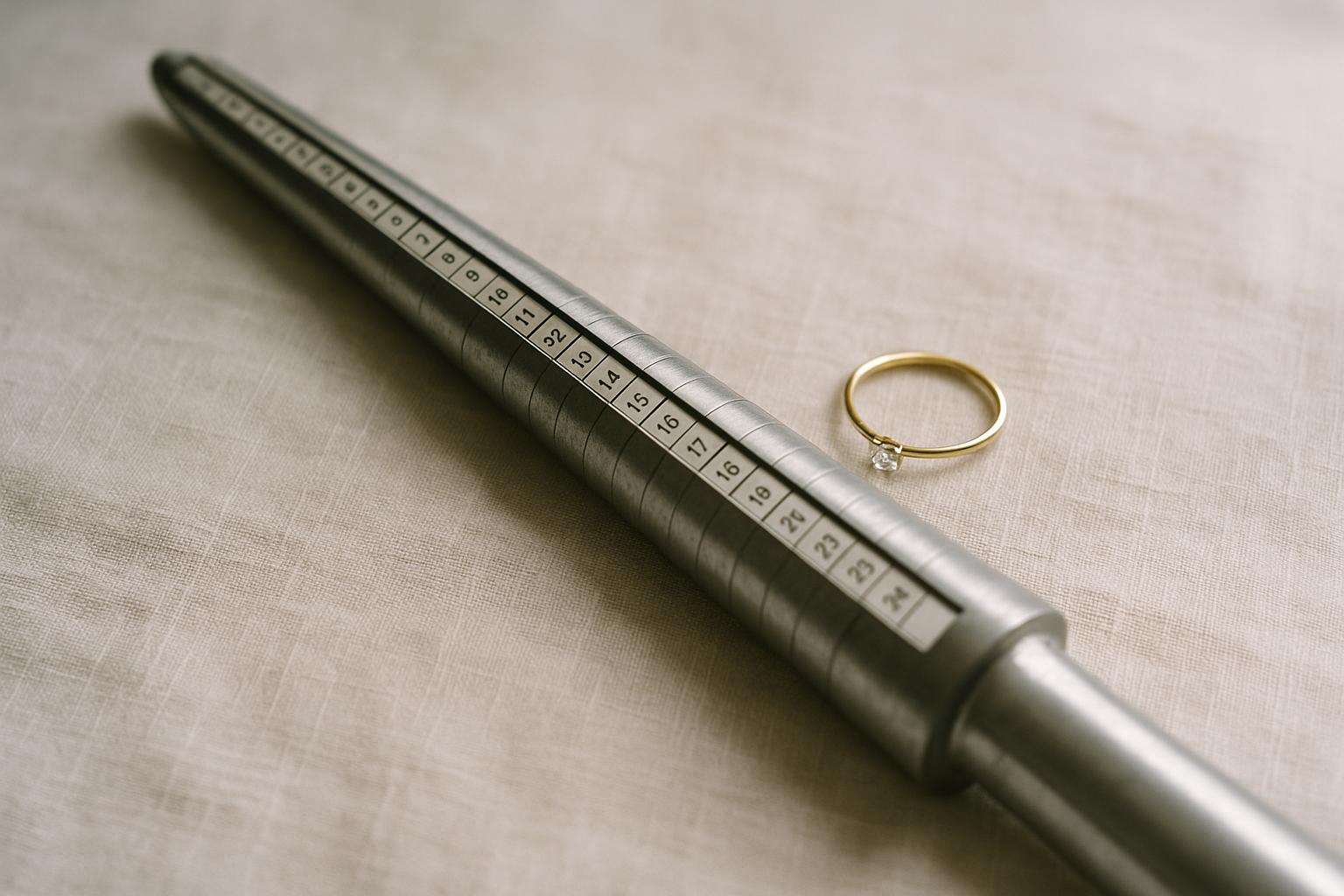
The most accurate secret method is borrowing a ring she already wears on her left ring finger and having a jeweler measure it on a mandrel. When that is not possible, size 6 or 6.5 is the statistically safest US guess for women — and ordering slightly large is always smarter than ordering slightly small. For stress-free perfection, consider the placeholder-ring approach: propose with a temporary setting, then pick the final ring together afterward.
The proposal is planned. The location is chosen. The speech is drafted. And then reality interrupts: what size ring do you actually buy?
Getting the size wrong is far more common than most people expect. Nearly every jeweler reports that resizing requests are among their most frequent post-proposal jobs. The goal of this guide is to make you one of the people who walks in knowing the right size — or who has a smart plan if you cannot.
Why Ring Size Is Harder to Guess Than It Looks
Ring sizing in the United States runs on a numerical scale where each whole number represents roughly 0.8 mm of inner circumference. A US size 5 has an inner diameter of approximately 15.7 mm; a size 8 measures 18.2 mm. That is a 2.5 mm spread across the most common range — enough that a ring ordered in the wrong size may not clear the knuckle, or may spin freely on the finger.
Several anatomical variables make guessing difficult even for attentive partners. The fingers of the dominant hand run approximately a half size larger than the non-dominant hand due to muscular development from daily use, according to Goodstone Inc.. Fingers also swell slightly in warm weather, during exercise, and at the end of the day versus first thing in the morning — a variation of up to a full size is not unusual. Knuckle width relative to the base of the finger adds another complication: a ring must clear the knuckle to go on but should sit snugly at the base so it does not spin off.
None of this is a reason to panic. It is simply a reason to use a reliable method rather than a visual guess.
Seven Methods Ranked by Accuracy
Tier 1: Jeweler-Verified (Most Accurate)
Method 1 — Borrow a ring and take it to a jeweler. This is the gold standard. Retrieve a ring she currently wears on her left ring finger — the fourth finger, the one where an engagement ring will live — and bring it to any jeweler. The jeweler slides it onto a calibrated mandrel and reads the size directly. Accuracy is as good as a professional measurement of her actual finger.
The critical detail, emphasized by Jewelers Mutual Group, is which finger the ring came from. A thumb ring can be two or three sizes larger than the left ring finger. A right-hand ring is often a half size larger. Borrowing from the wrong finger produces a misleading measurement. If you are unsure which ring came from which finger, ask a trusted mutual friend who may know her jewelry habits.
Method 2 — Trace or press the ring. If a jeweler visit is impractical before the proposal, place the borrowed ring flat on a piece of paper and trace the inner circumference carefully with a fine-point pen, or press the ring gently into a piece of modeling clay or a bar of soap to capture the inner diameter as an impression. Bring the paper tracing or the impression to a jeweler, who can measure it against sizing gauges with reasonable accuracy. This method is slightly less precise than a direct mandrel reading because the tracing or impression may distort by a fraction of a millimeter, but for a standard solitaire on a resizable precious-metal band, the result is good enough to order with confidence.
Tier 2: Trusted Confidant (High Accuracy, Social Risk)
Method 3 — Enlist her mother, sister, or closest girlfriend. A well-chosen confidant can raise the topic of ring sizing in casual conversation — perhaps while trying on their own rings or shopping for something unrelated — and get an accurate answer directly. Alternatively, if the confidant recently got engaged, she can ask your partner to try on her engagement ring “to see how it looks,” giving you a real size reference. According to Robinson's Jewelers, this method produces some of the most reliable results precisely because it involves a direct finger measurement, not inference.
The risk is purely social: an excited or imprecise confidant can unintentionally spoil the surprise. Choose someone with a demonstrated track record of keeping secrets, brief them thoroughly, and make clear that revealing nothing is more important than gathering any particular piece of information.
Tier 3: Covert In-Store Visit (Very High Accuracy, Requires Misdirection)
Method 4 — Visit a jewelry store together under a pretext. Bring her into a jeweler ostensibly to look at a gift for a family member, to pick up a watch battery, or to browse for something else entirely. A skilled sales associate can offer to size her finger as a casual aside — “we have a quick sizing gauge right here if you’re curious about your size” — and the number goes straight into your notes without her necessarily connecting it to an imminent proposal.
This approach provides professional-grade accuracy. Its chief limitation is the need for plausible misdirection and a partner who will not immediately interpret the sizing as a proposal signal.
Tier 4: At-Home Covert Measurement (Moderate Accuracy)
Method 5 — Paper-strip measurement while she is awake. Cut a narrow strip of thin paper (not string, which stretches under tension and can skew results by up to a full size) and wrap it snugly around her left ring finger at a moment when she is relaxed and distracted — watching television, reading. Mark where the strip overlaps, measure the length in millimeters, and convert using a standard ring-size chart. Fingers should be measured at the end of the day when they are at their natural daily maximum size, not first thing in the morning when they may be slightly slimmer.
Method 6 — Paper-strip measurement while she is asleep. The same paper-strip technique, applied while she sleeps. This is the most covert option but also the least accurate: fingers swell during sleep and nighttime readings routinely run larger than the true resting size. Treat a sleeping measurement as a rough upper bound rather than a purchase size, and if it produces, say, a 6.5, consider ordering a 6.
Tier 5: Digital Tools (Supplementary Check Only)
Method 7 — Ring-sizing apps. Several smartphone apps allow users to photograph a ring against a reference object (a coin or credit card of known dimensions) and overlay a circle to estimate diameter. These apps offer a useful cross-check when you already have an estimate from another method but want reassurance. Screen calibration inconsistencies introduce modest error — sufficient for a sanity check, insufficient for a sole data point. Brilliant Earth's ring-size guide includes a printable sizing gauge that works as a similar analog cross-check.
The Average-Size Hedge: What to Order When You Genuinely Have No Data
If every covert method is unavailable or has failed, the statistically grounded fallback is to order in size 6 or 6.5.
Data compiled by Diagaa from major US jeweler sales figures shows that the average women's ring size in the United States falls between 6 and 7, with size 6.5 the single most frequently purchased size and size 6 accounting for an estimated 25–30% of all women's ring purchases. A US size 6 has an inner diameter of 16.5 mm; size 7 measures 17.3 mm.
| US Size | Inner Diameter (mm) | Typical Fit Profile |
|---|---|---|
| 5 | 15.7 mm | Petite hands, slender fingers |
| 5.5 | 16.1 mm | Small-to-average frame |
| 6 | 16.5 mm | Most common single size (~25–30% of purchases) |
| 6.5 | 16.9 mm | Most frequent size overall; average US woman |
| 7 | 17.3 mm | Average-to-larger frame |
| 7.5 | 17.7 mm | Larger hands, pronounced knuckles |
| 8 | 18.2 mm | Larger or very muscular hands |
These averages are drawn from broad population data and will not match every individual. Petite women — say, under 5'3" and slight of build — often wear sizes 4.5–5.5. Taller or larger-framed women may need a 7.5 or 8. But if you have absolutely no other information, 6 or 6.5 gives you the highest statistical probability of a ring that fits or requires only a minor resize.
Always order slightly large rather than slightly small. A ring that is a half size too large can be worn on a different finger until the jeweler resizes it, and resizing is a routine service. A ring too small cannot be placed on the finger at all — which creates an avoidable awkward moment. Ring resizing on a standard gold solitaire typically costs $30–$100 and takes three to seven business days. Many jewelers, including Brilliant Earth, include one complimentary resize within the first year of purchase for most styles — so the cost of being slightly off is often zero.
The Placeholder-Ring Tactic: Eliminate the Problem Entirely
A growing number of buyers sidestep the sizing puzzle altogether with a strategy jewelers call the placeholder or temporary-setting approach.
Here is how it works: you select and purchase the center stone — the diamond or gemstone that matters most — in advance. The jeweler mounts it in a simple, inexpensive temporary solitaire setting, typically a four-prong yellow-gold or white-gold band available at most jewelers for well under $200. You propose with that ring. The moment is genuine: a real diamond, a real proposal, a real ring box.
Immediately afterward — ideally within a few days — the two of you visit the jeweler together. Her finger is professionally sized on a mandrel. She tries on settings, chooses the design she actually wants, and the final ring is fabricated or ordered in her exact size. The center stone is transferred from the temporary setting into the permanent one.
This approach is particularly well-suited to:
- Custom and halo settings, where size precision matters before the metalwork begins and adjustments after the fact are more costly or complicated.
- Eternity and pavé bands, which are difficult or impossible to resize after stones are set around the full circumference.
- Partners who have specific taste in design — the placeholder-ring approach turns the final setting into a shared experience rather than a guess.
- Buyers who found the stone first — a common sequence when purchasing a loose diamond from an online retailer or inheriting a family stone.
The placeholder tactic also dovetails naturally with the broader ring-buying strategy of separating stone selection from setting selection. Many jewelers and gemological advisors recommend this sequence anyway, since it allows independent quality evaluation of the diamond before committing to a mounting cost. For more on that purchasing sequence, see our guide to ring resizing options and what is possible after purchase, which covers what happens once the final ring is made.
Common Mistakes That Undermine Every Method
Borrowing from the wrong finger. This is the single most frequent error. A thumb ring on her right hand can be two or three full sizes larger than her left ring finger. Even a right-hand ring on the same fourth finger typically runs about a half size larger than the left. If you are not certain which finger the borrowed ring came from, treat the measurement as approximate and lean toward ordering smaller within the range.
Using string instead of paper for at-home measurement. String stretches under the slight tension required to wrap it snugly. Robinson's Jewelers notes this can produce a reading as much as a full size too large. A narrow strip of thin paper is the right tool for this method.
Measuring at the wrong time of day. Fingers are smallest first thing in the morning and largest in the evening after activity. A morning measurement may produce a size that is too small; a sleeping measurement may produce one that is too large. Measure at the end of a normal active day for the most representative wearable size.
Assuming shoe size, glove size, or height predicts ring size. There is no reliable correlation between any of these measurements and ring size. Individual hand anatomy varies too widely. Use only direct ring or finger measurements.
Ordering a comfort-fit ring in the same size as a standard-fit measurement. Comfort-fit rings have a domed interior profile that creates a slightly roomier feel at any given numeric size. If her measured standard-fit size is 6.5, she will likely need a size 6 in comfort fit. This is a detail worth confirming with the jeweler before ordering. For a deeper look at how interior band profile affects fit, see our guide on owning and protecting your ring.
What to Tell the Jeweler
When you arrive at the jeweler — whether with a borrowed ring, a tracing, a clay impression, or just a number from an at-home measurement — be straightforward about the method you used. A good jeweler will account for the inherent imprecision of at-home methods and may recommend ordering a half size up as a buffer. Ask explicitly whether the ring style you are purchasing is easily resizable: a plain solitaire on a standard gold shank is; a pavé eternity band may not be.
Also ask about the jeweler's resize policy before purchase. Many reputable jewelers include at least one complimentary resize within the first 30–90 days or the first year. Knowing that safety net exists takes meaningful pressure off the sizing decision.
The GIA (Gemological Institute of America) recommends that all fine jewelry — including engagement rings — be inspected by a qualified jeweler at least once a year after purchase, both to check prong security and to verify that the fit has not changed significantly due to weight fluctuation or other factors. Establishing that ongoing relationship with a trusted jeweler is one of the most useful things a new ring owner can do. The proposal is the beginning of that relationship, not the end of it.
Frequently asked
What is the most accurate way to find a ring size secretly?
Borrowing a ring she already wears on her left ring finger and bringing it to a jeweler for professional measurement is the single most accurate method. The jeweler slides the ring onto a calibrated mandrel and reads the size directly — no guesswork involved. If a physical visit is not possible, tracing the ring's inner circumference on paper and presenting that tracing to a jeweler is nearly as reliable. The critical detail is borrowing from the correct finger: a thumb ring or right-hand ring is typically a different size and will produce a misleading measurement.
What is the average ring size for women in the United States?
The average US women's ring size falls between 6 and 7, with size 6.5 cited as the single most frequent size among major jeweler sales data. Size 6 accounts for an estimated 25–30% of all women's ring purchases. A US size 6 has an inner diameter of 16.5 mm; size 7 measures 17.3 mm. That said, petite women often wear sizes 4–5, and taller or larger-framed women may need sizes 7–8 or above, so the average is a useful fallback hedge rather than a universal prediction. When in doubt, order in size 6 or 6.5 — resizing up or down by a half to full size is a straightforward, inexpensive adjustment most jewelers perform routinely.
Is it better to buy a ring slightly larger or slightly smaller if you are guessing?
Slightly larger is almost always the safer bet. A ring that is too large can be worn safely on a different finger until resizing, whereas a ring too small cannot be placed on the finger at all — which creates an awkward moment at the proposal. Most reputable jewelers resize rings within a full size in either direction on standard gold or platinum settings with minimal cost. Brilliant Earth, for example, offers one free resize within the first year for most styles. Ordering in size 6.5 rather than size 6 is generally the prudent choice if you are between guesses.
What is the placeholder-ring (temporary setting) tactic?
The placeholder approach involves selecting and purchasing the center diamond or gemstone before the proposal, mounting it in an inexpensive temporary solitaire setting — often a simple four-prong gold solitaire available from most jewelers for well under $200 — and presenting that for the proposal moment. Immediately afterward, the couple visits the jeweler together, gets her finger professionally measured, and selects the final setting they both love. The method eliminates sizing anxiety entirely and transforms ring selection into a shared experience. It is especially popular for couples who want a custom or halo setting, where precision sizing before fabrication is particularly important.
Does the dominant hand affect ring size?
Yes, meaningfully. The fingers of the dominant hand typically run about a half size larger than the non-dominant hand due to muscular development from daily use. This matters when borrowing a ring for covert measurement: a ring worn on her right hand will often yield a size that is too large for the left ring finger. Always try to borrow from the left ring finger specifically. If that is impossible and you must use a right-hand ring as your reference, mentally subtract a half size from whatever the jeweler reads.
Can I measure my partner's finger while they are asleep?
It is possible but produces the least reliable result of any method. Fingers swell during sleep, which means nighttime readings routinely run larger than the actual daytime resting size. If you do attempt a sleeping measurement, use a thin strip of paper rather than string — string stretches under slight tension and can skew the reading by as much as a full size. Jewelers generally recommend measuring at the end of the day, when finger size reflects its daily maximum from normal activity, if you want a number that represents true wearable comfort. A sleeping measurement is best treated as a rough upper bound, not a purchase size.