Owning & Protecting
How to Clean Your Engagement Ring Safely at Home
The universal soak method works for almost every ring — but your metal and stone type change how far you should push it.
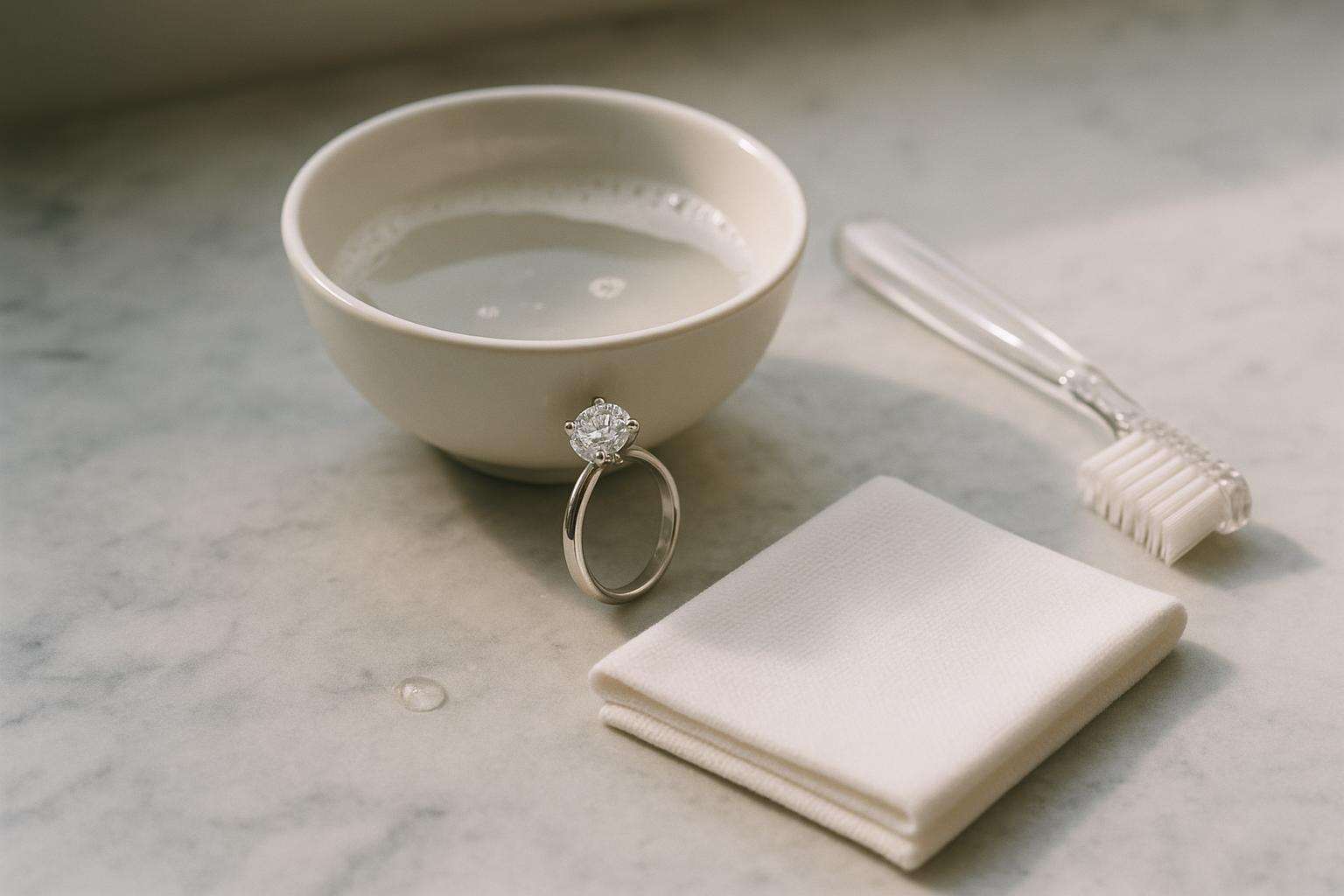
Soak your ring in lukewarm water with a few drops of mild dish soap for twenty to forty minutes, scrub gently with a soft toothbrush, rinse carefully, and pat dry. That method is safe for diamonds, rubies, sapphires, and all standard gold and platinum settings. The exceptions matter: emeralds, opals, pearls, and several other stones require a lighter touch, and chlorine, bleach, toothpaste, and home ultrasonic devices can cause lasting damage regardless of metal type.
Why Your Ring Gets Dull (and Why Cleaning Matters Beyond Sparkle)
An engagement ring worn daily accumulates a surprisingly tenacious film of skin oil, hand lotion, soap residue, and cooking splatter. Diamonds are naturally oleophilic — they attract and hold oils — which explains why a perfectly cut stone can look hazy within days of a professional polish. The film itself is harmless to the stone, but it reduces the amount of light entering and exiting the facets, measurably diminishing brilliance.
The more consequential reason to clean regularly is structural oversight. Each time you scrub the underside of the setting, you get close-up contact with the prongs, the girdle of the stone, and the shank. That brief visual inspection is your earliest warning system for a bent prong, a hairline crack in the metal, or a stone that has shifted. Catching these issues early costs far less than replacing a lost center stone.
The Knot's jewelry experts recommend a formal at-home cleaning at least once a week for daily-wear rings, paired with a quick lint-free cloth wipe each evening. That weekly rhythm, combined with a professional inspection every six months, is the standard-of-care benchmark in the industry.
The Universal Soak Method: Step by Step
This method is safe for diamonds, rubies, sapphires, tsavorite, spinel, alexandrite, and all gold and platinum settings. Read the stone-specific section below before using it on colored or organic stones.
What you need
- A small bowl (ceramic or glass — not metal, which can scratch)
- Lukewarm water (not hot; thermal shock can stress some stones and loosen certain adhesive-set pieces)
- Two to three drops of mild, fragrance-free dish soap — plain Dawn original formula is the benchmark. Avoid moisturizing variants, which deposit an oily residue
- A new, soft-bristled toothbrush, or an infant toothbrush (whose bristles are especially fine)
- A lint-free cloth (microfiber or a clean jeweler's polishing cloth)
- A fine-mesh drain strainer, or close the drain before rinsing
The method
- Soak. Place the ring in the bowl. Add lukewarm water and a few drops of soap. Let it sit for twenty to forty minutes. The soak loosens hardened residue from the prong gallery — the area directly beneath the stone — where a brush cannot easily reach.
- Scrub. Using the soft toothbrush, gently work the bristles around the underside of the stone, along each prong, between any pavé or side stones, and around the inner surface of the band. Use light pressure — you are dislodging loosened debris, not scouring.
- Rinse. Hold the ring under warm running water with the drain covered. Rinse thoroughly; residual soap film is itself a dulling agent.
- Dry. Pat the ring gently with the lint-free cloth. For enclosed prong galleries where moisture lingers, a hair dryer on its cool setting (not warm) directed briefly at the setting removes trapped water without thermal stress.
- Inspect. While the ring is clean and dry, hold it in good light and look at each prong tip. Any that appear thinned, bent, or rough-textured should be assessed by a jeweler — this is the practical payoff of weekly cleaning.
Cleaning by Metal Type: Where the Rules Diverge
| Metal | Safe Method | Key Caution |
|---|---|---|
| Yellow gold (14k / 18k) | Soak-and-scrub, lukewarm soapy water | Avoid abrasives; gold scratches easily. Soft cloth only. |
| White gold | Soak-and-scrub, cool-to-lukewarm water, mild soap | Chlorine, bleach, and ammonia strip rhodium plating. Keep away from pool/hot-tub water entirely. |
| Rose gold | Soak-and-scrub, mild soap | Higher copper content makes rose gold more reactive to harsh chemicals. Avoid acetone and acidic cleaners. |
| Platinum | Soak-and-scrub; tolerates slightly firmer brush pressure than gold | Develops a natural patina over time that only professional polishing removes. That patina is considered desirable by many wearers. |
| Sterling silver | Soak-and-scrub, mild soap | Silver tarnishes; a silver polishing cloth removes surface tarnish between soaks. Avoid ammonia-based products. |
According to Queensmith's engagement ring cleaning guide, the single most common cleaning error for white gold owners is using ammonia-based glass cleaners — a product category often recommended in older online guides. Ammonia does effectively cut grease on diamonds, but it progressively degrades the rhodium plating that keeps white gold looking distinctly white rather than warm yellow.
Cleaning by Stone Type: The Critical Distinctions
The GIA's guidance on gemstones and ultrasonic devices is the clearest framework available for understanding which stones tolerate aggressive cleaning and which do not. Stone hardness on the Mohs scale is a useful rough proxy, but it is not the whole story: a stone can be hard and still be chemically sensitive (emerald), or soft but structurally stable in soapy water (garnet).
Generally safe with the soak method
- Diamond: Safe for the soak-and-scrub method. Diamonds tolerate mild soap well, and regular cleaning is especially important because of their oil affinity. Home ultrasonic cleaners are a risk, however — vibration can loosen prongs or stress existing inclusions in lower-clarity stones.
- Ruby and sapphire (corundum family): Both are Mohs 9 and structurally robust. Untreated rubies and sapphires respond well to the standard soak method. Heated or fracture-filled stones should not go into any ultrasonic device; if you are uncertain whether your ruby or sapphire has been treated, ask your jeweler or check the stone's GIA or AGL report.
- Moissanite: Handles the soak method well. Mohs 9.25, chemically stable, safe for mild soap.
- Garnet, aquamarine, citrine, amethyst: Generally fine with lukewarm soapy water and a soft brush. Avoid temperature extremes and ultrasonic devices for fracture-filled variants.
Stones requiring modified care
- Emerald: Emeralds are Mohs 7.5–8 but almost universally treated — cedar oil, synthetic resin, or wax is injected into surface-reaching fractures (called jardin) to improve apparent clarity. Ultrasonic vibration and heat dissolve or displace these fillings, making existing fractures dramatically more visible and reducing the stone's commercial value. Clean emeralds only with a small, barely damp soft brush and a trace of mild soap. Do not soak for extended periods. Keep them away from heat, acetone, and ultrasonic devices.
- Opal: Opals contain 5–10% internal water. Ultrasonic vibration, sudden temperature changes, and prolonged immersion all risk crazing — a network of surface micro-cracks that permanently damage the stone's characteristic play of color. A dry or barely damp lint-free cloth is the safest at-home option. If you need slightly more cleaning action, a barely damp cloth with a tiny amount of mild soap and immediate drying is the limit.
- Pearl: Organic and porous. Pearls absorb chemicals readily; even mild soap can cause softening or discoloration over repeated exposures. Wipe with a dry soft cloth after every wearing. For heavier soil, a cloth barely dampened with plain water (no soap) is acceptable. Never soak pearls and never use commercial jewelry cleaners unless the label explicitly confirms pearl safety.
- Tanzanite: Mohs 6–7, heat-sensitive, and should not go into any ultrasonic cleaner. Lukewarm soapy water with a soft brush is appropriate; avoid temperature extremes.
- Turquoise, malachite, lapis lazuli: Porous stones that absorb chemicals. A barely damp soft cloth only; no soaking, no soap if possible, no ultrasonic.
- Moonstone, labradorite: Relatively soft feldspar family stones (Mohs 6–6.5). Avoid ultrasonic cleaning and thermal shock; use the soft brush and mild soapy water method briefly.
- Topaz: Despite high hardness (Mohs 8), topaz has perfect basal cleavage and can shatter under ultrasonic vibration or sharp blows. The soak method is fine; ultrasonic is not.
If your ring has an alternative or colored center stone and you are unsure of its treatment history, the safest default is the dry cloth or barely damp cloth approach. A professional cleaning at your jeweler's six-month inspection visit resolves the uncertainty without any risk to your stone.
What to Keep Away from Your Ring: A Definitive List
Several household products cause damage that is either irreversible or expensive to correct professionally:
- Bleach and chlorine: Cause stress corrosion cracking in gold alloys — prongs become brittle and can snap without warning. Strip rhodium from white gold. Remove your ring before cleaning bathrooms, swimming, or using a hot tub.
- Toothpaste: Contains silica or calcium carbonate abrasives that scratch gold, silver, and softer gemstone surfaces. A surprisingly persistent myth labels toothpaste as a home remedy; it will dull your ring over time.
- Baking soda: Same problem — mildly abrasive and unnecessarily harsh when mild soap works better with zero downside.
- Acetone (nail polish remover): Dissolves the organic fillings in emeralds and can dull matte or treated metal finishes.
- Ammonia-based cleaners: Strip white gold's rhodium plating. Safe for bare diamonds on their own but not worth the tradeoff for a ring.
- Sharp implements: Using a pin, toothpick, or knife tip to pick debris from prong galleries risks scratching metal and displacing prongs.
- Moisturizing dish soap: Leaves an oily film that defeats the purpose of cleaning. Use plain, fragrance-free formula only.
- Hot water: The soak should be lukewarm, not hot. Thermal shock stresses certain stones and can loosen adhesive in epoxy-set gems.
Several commercial jewelry cleaning solutions sold at mass-market retailers contain ammonia or harsh detergents. With Clarity's cleaning guidance advises always checking a product's listed stone compatibility before use — a solution marketed for diamonds may be actively harmful to a colored stone sharing the same ring.
When to See a Jeweler Instead of Cleaning at Home
At-home cleaning maintains brilliance between professional visits; it does not replace them. Book a professional cleaning and inspection if:
- You can feel the center stone move even slightly when pressed — this is a prong issue that needs immediate attention before the stone is lost.
- A prong tip looks visibly thinner, flattened, or bent. Prong re-tipping on a standard four-prong gold solitaire costs roughly $30–$60 per prong; a lost stone of any quality costs many times more.
- Your white gold ring has developed a noticeably warmer or yellowish tone at the edges — the rhodium plating is worn and needs re-application.
- The ring has not been professionally cleaned in more than six months of daily wear.
- You inherited or acquired the ring secondhand and do not know its maintenance history.
Most reputable jewelers — national chains and independent shops alike — provide professional cleaning and basic inspection at no charge, regardless of where the ring was purchased. Jewelers Mutual Group endorses biannual professional visits as the standard of care for high-value everyday-wear pieces. Some retailers, including Helzberg Diamonds, offer lifetime care plans that bundle these services for a one-time fee — worth asking about if you purchased from a participating retailer.
For the broader picture of protecting your ring's long-term value — including insurance, appraisals, and the resizing decisions that come with life changes — see our guide to owning and protecting your engagement ring.
Frequently asked
How often should I clean my engagement ring at home?
Most jewelers and jewelry care experts recommend a thorough at-home soak-and-scrub once a week for rings worn daily. Between full cleanings, a quick wipe with a lint-free cloth each evening removes the day's accumulated skin oil and product residue before it hardens in the setting. Professional cleanings and inspections should happen every six months at a minimum — The Knot's graduate gemologist contributors suggest visiting a jeweler three to four times per year if one is convenient. That cadence lets your jeweler catch worn prongs and loose stones before they become costly repairs.
Can I use toothpaste or baking soda to clean my engagement ring?
No. Both toothpaste and baking soda contain abrasive particles — silica or calcium carbonate in toothpaste, sodium bicarbonate crystals in baking soda — that are calibrated for tooth enamel, which is far harder than gold, silver, or most gemstone surfaces. Using either on an engagement ring leaves fine scratches on metal shanks and softer colored stones that dull their finish permanently. The only safe household cleaning agent is a few drops of mild, fragrance-free dish soap (plain Dawn is the industry standard) mixed into lukewarm water. Avoid moisturizing dish soap variants, which leave an oily film. See the full list of products to avoid below.
Is it safe to use a home ultrasonic cleaner on my engagement ring?
It depends on the stone. Diamonds in secure prong settings generally tolerate professional ultrasonic cleaning well, but home ultrasonic cleaners are a different proposition. Their vibration frequency is not calibrated for fine jewelry settings, and the mechanical agitation can loosen prongs or accelerate micro-fractures in a stone — risks a trained jeweler avoids by inspecting the setting before treatment. More critically, several common gemstones must never go near any ultrasonic device: emeralds (routinely treated with resins that the vibration dissolves), opals (porous and prone to crazing), tanzanite, moonstone, turquoise, and pearls are all vulnerable. The GIA's guidance on ultrasonic cleaning is the authoritative reference here.
Can chlorine or bleach damage a gold engagement ring?
Yes — more seriously than most people expect. Chlorine causes stress corrosion cracking in gold alloys, making prongs brittle and prone to sudden failure under everyday pressure. This is why swimming pools, hot tubs, and chlorinated tap water (in high doses) are genuine risks. Bleach compounds this: they strip the rhodium plating from white gold, exposing the slightly yellowish base alloy underneath. The damage is cumulative and not reversible at home — a jeweler can re-plate white gold and re-tip prongs, but repeated exposure shortens the intervals between those services significantly. Remove your ring before swimming, cleaning with household products, or soaking in a hot tub.
How do I clean an engagement ring with an emerald, opal, or pearl center stone?
Emeralds: Use a small, barely damp soft brush and a tiny amount of plain mild soap. Do not soak — extended immersion risks dissolving the cedar oil or resin fillings that most natural emeralds receive to improve apparent clarity. Avoid temperature extremes and keep the stone away from ultrasonic devices entirely.
Opals: A dry or barely damp lint-free cloth is the safest option. Opals contain 5–10% internal water and are highly sensitive to vibration, sudden heat changes, and prolonged immersion, all of which can cause crazing — a network of surface cracks that permanently damages the stone's play of color.
Pearls: Wipe gently with a dry soft cloth after every wearing. A very light application of mild soap on a barely damp cloth is acceptable for periodic cleaning. Never soak pearls — they are porous and organic, absorbing chemicals that cause discoloration and softening. Store pearls flat or in a soft pouch away from harder gemstones to prevent surface scratches.
What is the best professional cleaning schedule for an engagement ring?
The professional consensus, endorsed by Jewelers Mutual Group and echoed by independent bench jewelers, is a full inspection and professional cleaning every six months for rings worn daily. This interval is not arbitrary: prong wear and micro-loosening in settings are typically detectable at six-month intervals before a stone is lost, whereas annual-only visits allow minor issues to escalate. Most national jewelers — including chains like Jared — offer professional cleaning and basic inspection at no charge, regardless of where the ring was purchased. Some retailers, such as Helzberg, provide lifetime care plans covering cleanings, inspections, and minor repairs for a one-time fee.