Owning & Protecting
Common Ring Scams and How to Verify a Diamond
Certificate switching, fake grading reports, grade bumping, and inflated appraisals are documented and recurring. Here is how each scheme works and how to protect yourself at every step.
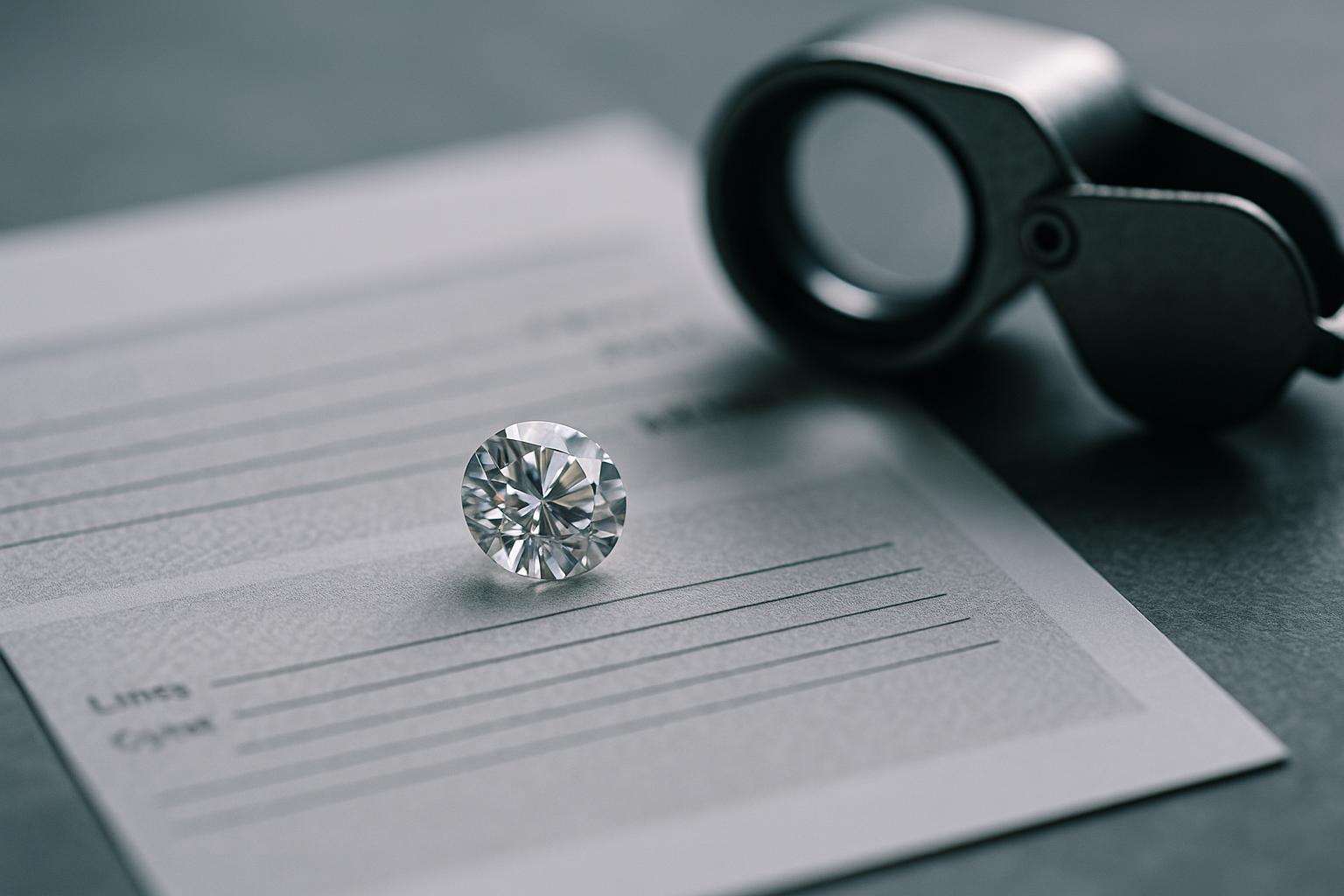
The engagement ring market combines high spend, low buyer expertise, and one-time urgency — a combination that attracts documented fraud. The four main schemes are certificate switching (stone swap during repair), fraudulent grading reports (forged or fake-lab certificates), grade bumping (overstated grades from non-credible labs), and inflated appraisals (engineered valuations). Every scheme is preventable with the same core protocol: require a GIA or AGS grading report, verify it online before purchase, record the girdle inscription number before any service, and use an independent appraiser who charges a flat fee.
Spending several months' salary on a product you have never learned to evaluate — under emotional pressure, on a timeline set by a proposal — is close to a textbook definition of high-fraud risk. The engagement ring industry knows this. So do the regulators: the Federal Trade Commission's Guides for the Jewelry Industry impose mandatory disclosure obligations on sellers precisely because the information asymmetry between buyer and jeweler is substantial. Yet the Guides govern what sellers must disclose, not whether they will. Documented fraud in the diamond market ranges from petty stone-switching at the repair counter to industrial-scale certificate forgery operations uncovered by international police investigations.
None of this requires fatalism. The four most common schemes share a common weakness: they depend on the buyer not doing a handful of specific verification steps. This article names each scheme, explains how it works in practice, and gives you a protocol that closes each vulnerability before you complete a purchase or leave your ring for service.
What Is Certificate Switching — and How Common Is It?
Certificate switching — referred to in the trade as "the switcheroo" — is the act of returning a different stone than the one a customer brought in for a service. The replacement is typically a lower-quality diamond that matches the original's approximate appearance to an untrained eye, or in the most egregious cases, a moissanite simulant: a near-colorless silicon carbide material that is visually indistinguishable from diamond without a dedicated testing instrument.
High-profile documented allegations have been leveled at major national chains. Kay Jewelers, a brand under Signet Jewelers, faced a wave of consumer complaints — tracked and published by Jewelry Claims & Risk Specialists (JCRS), an industry monitoring firm — in which customers alleged their diamonds were returned as moissanite after repair services. Signet operates Kay, Zales, and Jared, collectively representing one of the largest shares of U.S. retail jewelry sales. In a separate consumer protection matter, Signet's subsidiary Sterling Jewelers paid $11 million in a 2019 settlement with the New York Attorney General and the Consumer Financial Protection Bureau over unauthorized credit card enrollment practices targeting consumers — demonstrating that enforcement exposure at major chains is real, not theoretical.
The practical defense against certificate switching requires two steps, both of which must happen before you leave the ring. First, locate the girdle inscription number on your GIA grading report. Nearly all certified diamonds above a certain threshold are laser-inscribed on the girdle — the narrow band around the widest point of the stone — with a unique identifier that matches the report number. Ask the jeweler to read that number back to you at drop-off. Write it down. At pick-up, ask them to read it again, and independently verify it at GIA's publicly accessible Report Check database. If the numbers do not match, do not accept the ring and do not leave without the stone. Second, if your diamond does not yet have a GIA or AGS grading report — possible for older rings, estate pieces, or stones graded by less rigorous labs — request a new report before authorizing any repair service.
Are Fake GIA Certificates a Real Threat?
Yes — and the documented scale of the problem is larger than most retail buyers imagine. In 2021, a police operation in India uncovered an industrial-scale certificate fraud ring in which a diamond trader possessed both genuine and counterfeit GIA grading reports, along with a laser inscribing machine capable of stamping fraudulent GIA report numbers onto lab-grown diamonds and treated stones — then passing them into the trade as untreated natural stones. The scheme exploited a critical gap: most jewelers and consumers verify that a report number exists in the GIA database, but do not check that the recorded characteristics actually match the physical stone.
According to GIA's own guidance, a genuine report includes three layers of security: a hologram, microprint lines embedded through the document, and a security screen visible under UV light. These are difficult to replicate at scale, but the fraudulent scheme described above sidestepped document forgery entirely by using real stolen or purchased report numbers. The countermeasure is the same in both cases: go to the GIA Report Check, enter the number, and compare every recorded field — carat weight, color grade, clarity grade, and physical measurements — against the stone. A one-point discrepancy in carat weight, a measurement that is off by 0.2 mm, or a clarity grade that does not align with what you can observe under a loupe is a basis for halting the transaction and requesting independent gemological verification.
| Red Flag | What It May Indicate | Verification Step |
|---|---|---|
| Report from an unfamiliar lab (not GIA, AGS, or IGI) | Grade bumping; sham certificate | Decline purchase or request re-grade by GIA at buyer's expense before finalizing |
| Report number not on GIA database | Forged or fabricated report | Refuse transaction; report to FTC and local law enforcement |
| Report number in database but measurements do not match stone | Genuine report applied to wrong stone | Require independent gemological verification of physical stone |
| No girdle inscription on a GIA-certified stone | Inscription was removed, or certificate was not issued for this stone | Ask for explanation; verify measurements match before accepting |
| Appraisal value is two or more times the purchase price | Inflated appraisal used to manufacture perceived value | Obtain independent flat-fee appraisal from a NAJA or AGS-credentialed appraiser |
| Seller resists report verification or independent appraisal | Fraud or significant quality misrepresentation | Walk away; buyer should never feel pressure to skip verification |
What Is Grade Bumping — and Why Do Some Labs Enable It?
Grade bumping pairs a real diamond with a grading certificate from a laboratory that applies more generous standards than GIA or AGS — awarding the stone a color or clarity grade one to three levels higher than it would receive from a credible lab. The diamond is real. The certificate is real. The grades are simply inaccurate relative to the standards the market trusts.
Consumer education resources including Beyond4Cs have documented this practice extensively: stores advertise stones certified by non-GIA, non-AGS labs at seemingly compelling discounts; the discount evaporates once the overstated grade is corrected. A stone marketed as VS1/F by an unknown lab may be a genuine VS2/H — a combination worth 25–40% less at identical carat weight. The buyer perceives value; they receive a lower-quality stone at a normal or above-market price.
The defense is blunt: for any natural diamond intended as an engagement ring center stone, accept only GIA or AGS grading reports. For lab-grown diamonds, IGI is the accepted market standard and is carried by all major online retailers including Blue Nile, Brilliant Earth, and James Allen. No other laboratories should be treated as adequate for a purchase of this size. If you encounter a seller who pushes back on this standard — who argues that their in-house certification or an alternative lab is equivalent — that resistance is itself informative.
It is worth understanding why grade inflation exists in the lab ecosystem. Labs that issue more generous grades attract more business from sellers who prefer that their inventory look better on paper. There is no independent regulatory body that enforces uniform grading standards across all laboratories; the reputations of GIA and AGS rest on decades of third-party validation and industry trust, not on any government license. The practical implication for buyers: the lab name on the certificate is not a formality. It is the entire basis for trusting the grades written on it.
How Do Inflated Appraisals Create a False Sense of Value?
An inflated appraisal is a document, not a physical scam — which makes it both harder to detect and easier to rationalize. The scheme works as follows: at or after the point of sale, a buyer receives an appraisal — often prepared by an appraiser with a commercial relationship to the selling jeweler — showing a replacement value two or three times the purchase price. The buyer concludes they have secured an extraordinary deal. In reality, they have received a document calibrated to make the purchase price look like a discount.
Insurance replacement value is supposed to represent what it would cost to purchase a comparable item in the open market today. It is not supposed to be a number chosen to flatter the sale. The mechanism that enables inflated appraisals is the percentage-of-value fee structure: an appraiser who earns a higher fee by appraising higher has a direct financial incentive to be generous. This is why the National Association of Jewelry Appraisers (NAJA), the American Society of Appraisers (ASA), and the American Gem Society all prohibit percentage fees for appraisal work — and why a flat fee, quoted in advance and provided in writing, is the baseline standard for ethical practice.
An inflated appraisal can also create downstream financial risk at the insurance claim stage: if you insure a ring for $15,000 based on a manufactured appraisal and your carrier determines the actual replacement cost is $7,000, you may find your claim disputed or your coverage adjustment triggering a premium recalculation. The solution is to obtain your own independent appraisal from a credentialed professional — GIA Graduate Gemologist, AGS Certified Gemologist Appraiser, or a NAJA-certified member — who has no commercial relationship with the selling jeweler. For guidance on what credentials to look for and what a legitimate appraisal costs, see our ring appraisal guide. And once you have a reliable appraisal, protecting the ring formally is the next step — our insurance rider vs. standalone policy comparison explains your coverage options.
Your Diamond Verification Protocol: Five Steps Before Any Purchase
The four schemes described above — certificate switching, fraudulent reports, grade bumping, and inflated appraisals — each exploit a different gap in the typical buyer's process. The protocol below closes all four gaps systematically. None of these steps requires gemological training. All of them can be completed before you sign a purchase agreement.
- Require a GIA or AGS grading report (or IGI for lab-grown) before purchase. Do not accept any substitute. If a seller cannot or will not provide one, the transaction ends there.
- Verify the report online before paying. Go to gia.edu/report-check-landing and enter the report number. Compare every recorded field — carat weight, color, clarity, measurements — against the physical stone and the paper document. Discrepancies in any field are a stop signal.
- Get all 4C descriptions in writing on the sales receipt. The receipt should state cut, color, clarity, and carat weight explicitly. If a future dispute arises — a misrepresented diamond, a switched stone — this document is your evidence of what "like kind and quality" means.
- Use an independent appraiser for any purchase above $3,000. Choose someone with no commercial relationship to the selling jeweler. Confirm they charge a flat fee (typically $50–$200 for a single item). Ask for their credential: GIA GG, AGS CGA, ASA-accredited, or NAJA-certified are the recognized standards. The FTC prohibits intentional over-valuation; an appraiser who produces an inflated document is not just unhelpful — they may be exposing themselves to regulatory and civil liability.
- Record the girdle inscription number before any service. Every time you leave your ring for sizing, repair, or cleaning, record the number and verify it at pick-up. This step costs two minutes and closes the certificate-switching vulnerability entirely.
If something goes wrong despite these precautions, you have three parallel paths: file a complaint with the FTC at reportfraud.ftc.gov, file with your state attorney general's consumer protection division, and consider small claims court for disputes below your state's threshold (commonly $5,000–$10,000). Keep every document — the receipt, grading report, appraisal, and all correspondence. A fraud or misrepresentation claim, unlike a warranty claim, allows you to seek rescission of the entire contract and full return of the purchase price regardless of disclaimer language in the fine print, because warranty disclaimers provide no shield where a seller's false representation was intentional.
The engagement ring market has legitimate, trustworthy sellers — the majority of transactions are completed honestly. The protocol above is not an expression of distrust; it is the same documentation discipline that protects a buyer in any large-ticket purchase. A good jeweler will not object to any of these steps. That fact alone is a useful filter.
Frequently asked
What is certificate switching and how do I prevent it?
Certificate switching — also called "the switcheroo" in the trade — happens when a jeweler returns a stone different from the one a customer brought in for repair, resizing, or cleaning. The replacement is typically a lower-quality natural diamond or, in the most egregious documented cases, a moissanite simulant that is visually indistinguishable without testing equipment. Prevention is straightforward: before handing over your ring, ask the jeweler to read back the girdle inscription number on your GIA grading report. Record it yourself. At pick-up, ask them to read it again and cross-check the number at gia.edu/report-check-landing. If the stone has not yet been inscribed — a situation that applies to older purchases or rings graded by a lab other than GIA or AGS — request an independent appraisal with a new GIA report before leaving the ring for any service.
How do I verify a GIA grading report is genuine?
A genuine GIA report includes three built-in security features: a hologram sticker, microprint lines running through the document that are difficult to replicate, and a security screen visible under UV light. The most reliable verification step, however, is digital: go to gia.edu/report-check-landing and enter the report number. The database will return the stone's recorded carat weight, color grade, clarity grade, and measurements. The critical check is not just that the number exists — a fraudulent operation in India was found to possess both genuine and counterfeit GIA reports — but that every recorded characteristic matches the physical stone in front of you. If the reported weight or measurements diverge by more than the standard tolerance, treat the discrepancy as a red flag and stop the transaction until it is resolved by an independent gemologist.
What is grade bumping, and which grading labs should I trust?
Grade bumping means pairing a diamond with a certificate from a little-known or fictitious grading laboratory that assigns the stone a color or clarity grade one to three levels better than it would earn from GIA or AGS. The inflated grade is used to justify a higher asking price, or to create the appearance of a bargain. A VS1/F stone from an unknown lab may be a genuine VS2/H — worth considerably less. The defense: accept only GIA (Gemological Institute of America) or AGS (American Gem Society) grading reports for any natural diamond you intend to use as an engagement ring center stone. Both labs apply consistent, internationally recognized grading standards. IGI is the accepted standard for lab-grown diamonds and is carried by all major online retailers. No other labs should be considered adequate for a purchase of this magnitude.
Can an inflated retail appraisal mislead me?
Yes, and it is one of the most common forms of deception that does not require any physical tampering. Some retailers present buyers with in-house appraisals showing a value two or three times the actual purchase price, manufacturing the impression of an exceptional deal. These documents are commercially worthless: insurance replacement value is supposed to reflect what a comparable stone would actually cost to replace in the open market, not a number engineered to flatter the sale. The mechanism that enables this scheme is the percentage-of-value fee structure — appraisers who earn a higher fee for a higher appraisal have a direct financial incentive to inflate. Industry ethics bodies including NAJA and ASA prohibit percentage fees for exactly this reason. Obtain your own independent appraisal from a credentialed professional (GIA Graduate Gemologist, AGS Certified Gemologist Appraiser, or a NAJA-certified member) who charges a flat fee quoted in advance and has no commercial relationship with the selling jeweler. See our ring appraisal guide for a full credential breakdown and cost expectations.
What should I do if I think I have been defrauded by a jeweler?
Start by documenting everything: the original receipt and any itemized description of the 4Cs, the grading report, any appraisals, and all written and electronic communications with the retailer. Then take three parallel steps. First, file a complaint with the FTC at reportfraud.ftc.gov — this creates a federal record and may prompt retailer response. Second, file with your state attorney general's consumer protection division; many states have stronger enforcement tools than the FTC for individual cases. Third, if the amount is within your state's small claims threshold (commonly $5,000–$10,000), small claims court is a low-cost, attorney-optional venue. If the purchase agreement includes a mandatory arbitration clause — read the fine print — that routes your dispute to a private arbitrator rather than a court. A misrepresentation or fraud claim (as opposed to a warranty claim) allows you to seek rescission of the contract and full return of the purchase price regardless of any disclaimer language the retailer may have in their terms.
Does Kay Jewelers have a history of diamond switching allegations?
Yes. Kay Jewelers, a brand owned by Signet Jewelers, faced a documented pattern of consumer complaints alleging that diamonds left for repair were returned as moissanite — a near-colorless silicon carbide simulant that a trained eye alone cannot distinguish from diamond. These allegations received significant trade-press coverage and were tracked by Jewelry Claims & Risk Specialists (JCRS), an industry monitoring firm. Signet Jewelers, which also owns Zales and Jared, paid $11 million in a 2019 settlement with the New York Attorney General and the Consumer Financial Protection Bureau over a separate matter involving unauthorized credit card enrollment — a reminder that consumer-protection exposure at major chains is not hypothetical. None of this means chain jewelers are categorically untrustworthy, but it does reinforce the practical protocol: require GIA or AGS certification, record the girdle inscription number before and after any service, and do not leave a ring for repair without those steps in place.