Ring Styles & Settings
Solitaire vs. Halo vs. Pavé vs. Three-Stone Settings
How the four dominant engagement ring setting families compare on cost, perceived stone size, maintenance demand, and long-term wearability.
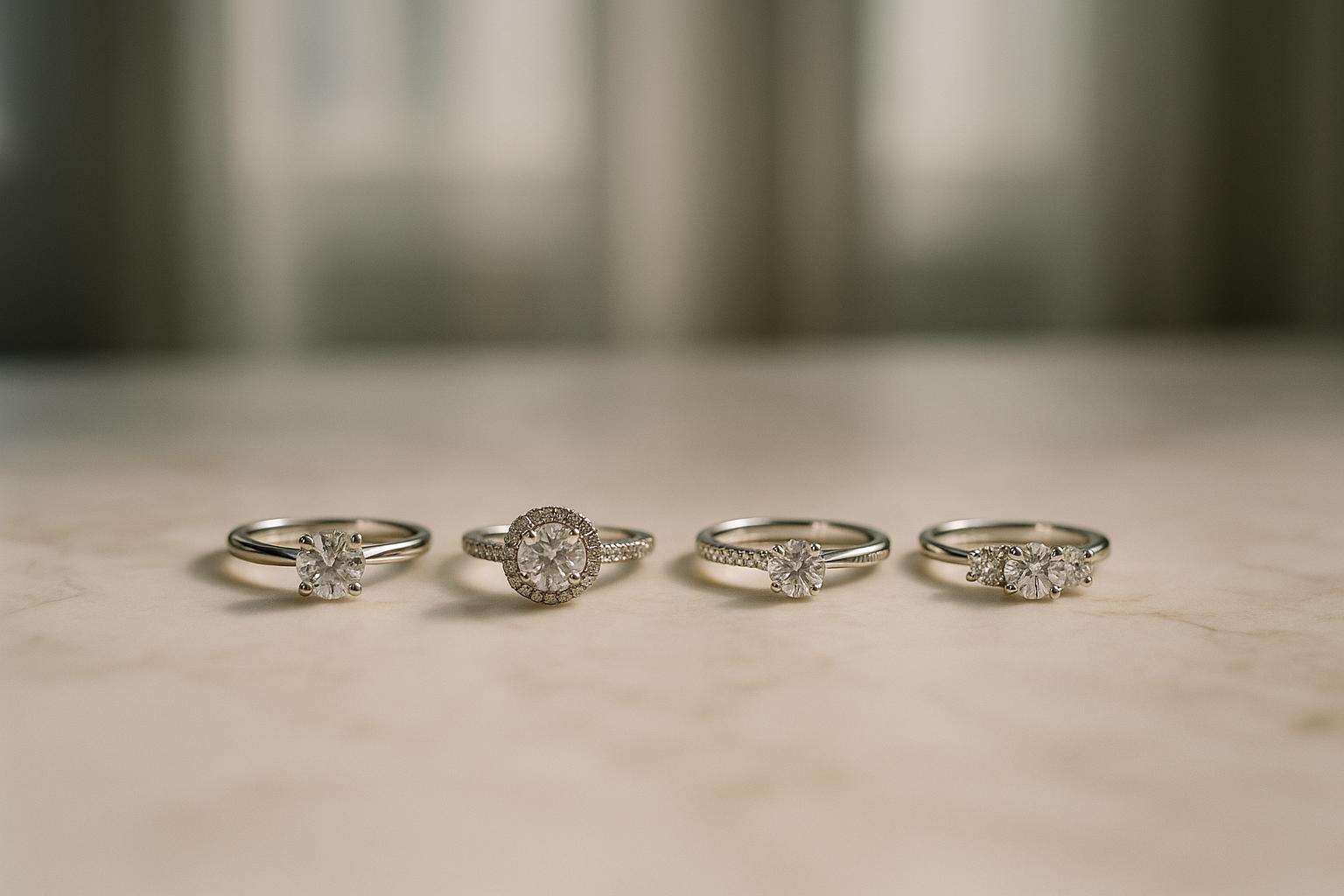
A solitaire setting costs the least and shows your stone at true size. A halo adds the most perceived size — up to half a carat of visual weight — at a $900–$3,000 premium and higher maintenance. A pavé band layers sparkle along the finger without enlarging the center stone, but complicates future resizing. A three-stone ring maximizes total carat presence on a fixed budget and carries the deepest symbolic weight. Every setting family involves real trade-offs; knowing them before you shop is the only way to spend wisely.
Walk into any jewelry counter — or scroll through Blue Nile's catalog, which as of April 2026 now includes the former James Allen inventory following Signet Jewelers' consolidation of the two brands — and you'll find hundreds of ring styles. But nearly every engagement ring on the market belongs to one of four setting families: solitaire, halo, pavé, or three-stone. These four frameworks account for the vast majority of what couples actually buy, and they differ in three ways that matter to almost every buyer: how much the setting itself costs, how large the center stone appears, and how much upkeep the ring will require over a lifetime of daily wear.
This guide gives you the honest comparison across all four, with real mid-2026 price data and the trade-offs that ring descriptions rarely mention.
What does each setting family actually cost in 2026?
According to The Knot's 2024 Jewelry & Engagement Study, couples spent an average of $5,200 on an engagement ring nationwide — down from $6,000 in 2021 as lab-grown diamonds lowered center-stone costs. But that average hides an enormous spread driven largely by setting choice. Here is what the setting itself costs, separate from the diamond, at major retailers in mid-2026.
| Setting family | Typical range (14K white gold) | Platinum premium | Primary cost driver |
|---|---|---|---|
| Solitaire (plain prong) | $275–$660 | +$400–$800 | Metal weight only |
| Pavé shank (partial) | $640–$1,200 | +$400–$800 | Setting labor + melee stones |
| Halo (standard) | $1,200–$3,500 | +$400–$800 | Accent stone count + labor |
| Hidden halo + pavé | $1,070–$1,504 | +$400–$800 | Two-tier setting labor |
| Three-stone (with pavé shank) | $1,000–$3,000+ | +$400–$800 | Side-stone quality + shank complexity |
Two context points matter here. First, gold reached approximately $4,700 per troy ounce in mid-2026 — up roughly 70% from early 2025 — which pushed setting prices industry-wide up an estimated 40–50% over two years, according to trade pricing data. A ring that cost $800 in a 14K white gold solitaire setting in 2024 is closer to $1,100–$1,200 today. Second, the cost difference between settings is primarily a labor story, not a materials story. The melee diamonds in a full pavé band wholesale for $500–$700 per carat; a typical band adds 0.20–0.35 carats total, meaning the raw stone cost is roughly $100–$245. The rest of the retail premium is setting time — drilling holes, seating each stone under magnification, pressing metal beads over each girdle. Micropavé demands more bench skill than standard pavé, and prices reflect that.
How much larger does each setting make the center stone appear?
This is where buyers most often misread the trade-off. More setting complexity does not always mean a bigger-looking ring — it depends on where the extra diamonds sit relative to the center stone.
Solitaire: true to size, no illusion
A four- or six-prong solitaire shows the center diamond exactly as it is. There is no optical illusion, no borrowed visual mass. This is a feature, not a flaw: if you want the diamond you paid for to be the whole story, a solitaire delivers that with nothing subtracted. The style has remained the most popular setting choice for decades — a 2022 industry study found 33.6% of buyers choosing solitaires, more than any other family. The exposed prong design also maximizes light entering from the sides and pavilion, which means a well-cut diamond in a solitaire will outperform the same stone in a bezel or flush setting for raw brilliance.
The size-illusion trade-off runs in reverse: because a solitaire leaves the stone's profile fully visible, any weakness in cut, a slightly small spread for the carat weight, or a shallow depth will be apparent. Shapes that face up small for their carat weight — princess and Asscher cuts in particular — are less forgiving in a solitaire than in a halo.
Halo: the most effective size amplifier
A standard halo places a continuous ring of pavé-set accent diamonds directly adjacent to the center stone's girdle at the crown level. The visual effect is substantial: the accent ring merges optically with the center stone, and the eye reads the entire cluster as a single larger diamond. The GIA notes that melee diamonds set adjacent to a center stone reflect light back into it and create a larger perceived sparkle surface. Real-world estimates from multiple bench jewelers place the typical size gain at the equivalent of 0.3–0.5 carats of additional apparent weight: a 1.00-carat center in a well-designed halo can read closer to 1.30–1.40 carats. Some halos, particularly those with thicker accent rows, can increase perceived face-up surface area by as much as 50%.
This arithmetic works directly in a buyer's favor on a fixed budget. If a 1.50-carat natural round brilliant exceeds your ceiling but a 1.00-carat halo reads the same size, you redirect roughly $3,000–$8,000 from the center stone to the setting and pocket the difference, or spend it on cut and color quality instead. The offset is real — but it only works if the halo is well-proportioned. A halo with accent stones that are too small relative to the center stone reads as a sparkle border rather than a size extender.
The hidden halo variant, popularized by brands including Brilliant Earth (whose Freesia and Versailles hidden halo designs are current bestsellers), places the accent ring below the crown level rather than at it. Viewed from above, the ring reads as a solitaire; from the side, a flash of diamonds is visible. This configuration adds perceived depth and profile shimmer without changing the top-view silhouette — the preferred choice for buyers who want halo economics without the halo aesthetic.
Pavé band: sparkle on the finger, not the stone
A pavé shank does not make the center stone look larger. What it does is extend the ring's visual presence across the full width of the finger — the eye follows the line of sparkle outward from the center stone in both directions, making the ring as a whole feel more elaborate and substantial. This is a genuinely different effect than a halo, and buyers sometimes conflate the two. A round brilliant in a plain solitaire setting sits at the center of a neutral band; the same stone in a micropavé shank sits at the center of a band that contributes its own sparkle, shifting the visual emphasis from the stone alone to the full ring composition.
The practical consequence: pavé bands tend to be most complementary to center stones with strong cut grades, since the accent diamonds draw visual attention and a mediocre center stone has nowhere to hide. They also work exceptionally well with lower-color-grade centers (H–I) because the accent diamonds, typically graded G–H, add neutral white sparkle that the eye blends into a cohesive look.
Three-stone: maximum carat weight on the finger
A three-stone ring does not make any individual stone look larger. What it does is put more total carat weight in the wearer's sight line simultaneously. A 1.00-carat center flanked by two 0.50-carat side stones delivers 2.00 carats total weight — and 2.00 carats of combined stone mass reads as significantly more substantial on the hand than a 1.00-carat solitaire, even though each individual stone is smaller than a 2.00-carat solitaire. This is the setting family for buyers who want maximum carat presence and who have a fixed budget: three stones purchased separately often cost less in aggregate than a single stone of equivalent total weight, because per-carat diamond prices increase non-linearly with size (a 2.00-carat round costs more than twice what two 1.00-carat rounds cost).
Proportion discipline matters. Side stones sized at 50–70% of the center stone's carat weight keep the center stone as the clear focal point. Side stones that are too large create a competing triumvirate; side stones that are too small read as accent fragments rather than meaningful flanking stones. In 2026, the most popular three-stone configurations pair an oval or cushion center with tapered pear or baguette side stones — a combination that reads as modern while retaining the setting's traditional symbolism.
The symbolic dimension is worth noting honestly. De Beers popularized the past-present-future narrative in the early 2000s, but the design itself predates the campaign by centuries. Some couples lean into the story; others simply prefer the architectural balance of three stones on a shank. Neither motivation is more valid than the other. Meghan Markle's ring — a center diamond from Botswana flanked by stones from Princess Diana's personal collection — is the most publicly recognized example of using the three-stone format for deeply personal meaning rather than pure symbolism.
What will each setting demand in ongoing care?
This is the question most buying guides underweight, and it is the one most likely to affect your relationship with the ring over a decade. Settings differ meaningfully in how often they need professional attention and how vulnerable they are to common wear patterns.
Solitaire
Baseline: annual professional inspection to check prong tips and girdle grip. Prongs can develop flat tips — particularly in six-prong settings where each prong is slightly smaller — and should be re-tipped before they lose their hold on the stone. Cleaning is simple: a soft brush, warm water with a drop of dish soap, and a five-minute soak once a week. The solitaire is the lowest-maintenance ring you can choose. If your lifestyle involves frequent handwashing, glove-wearing, or contact sports, the only meaningful upgrade from a solitaire is switching to a bezel setting, which eliminates exposed prong tips entirely.
Halo and hidden halo
Halo settings contain many more stones than a solitaire — typically 20–40 small accent diamonds in the halo ring alone, plus any pavé on the shank — and each stone is an additional point of potential loosening. Jewelers recommend six-month professional inspections for halo settings worn daily. Cleaning requires more attention: the undercarriage of a standard halo (the space between the accent ring and the center stone's pavilion) traps oils, hand cream, and debris efficiently, and the sparkle of a dirty halo degrades noticeably. Use a soft brush to clean under and around the accent ring specifically. Insurance claim data from providers including BriteCo consistently show halos among the most common settings for stone-loss claims, almost always from the accent ring rather than the center stone.
Pavé band
According to Washington Diamond's bench guide, micropavé is structurally the most fragile common setting type: the prongs are small enough that a jeweler attempting to tighten a loose stone can snap the prong rather than reset it. Yearly inspection is the minimum; six-month visits are advisable for micropavé. Resist the urge to remove your ring by pushing it from underneath — this direct pressure against the pavé rail is the most common cause of stone displacement in daily wear. Petite pavé (slightly larger prongs) is more repairable and resettable than true micropavé and is a sensible choice for buyers who prefer low jeweler visits. Also worth noting: if your shank is white gold, the rhodium plating that gives it its bright silver color wears off every 12–24 months and should be replated, at roughly $60–$120 per visit.
Three-stone
Three-stone rings have fewer stones than a pavé or halo setting but more than a plain solitaire, and each stone has its own prong arrangement to inspect. Annual inspection is appropriate for most wearers; six-month visits if you are hard on jewelry. The side stones, being smaller than the center stone, sit in lighter prong structures and are statistically more likely to loosen first. Unusual stone shape combinations — an emerald-cut center with trapezoid side stones, for example — require a jeweler familiar with the specific geometry of those cuts, since each shape distributes stress to its prongs differently.
Across all four families, the practical advice is the same: find a local jeweler whose bench skills you trust and build a consistent inspection relationship. The cost of a professional cleaning and stone-tightening check averages $30–$80. Replacing a lost melee stone from a halo or pavé band costs $80–$200 per stone depending on size. The preventive math is obvious.
For a deeper look at how to protect any ring you choose, see our guide to engagement ring insurance — particularly important if you are considering a halo or pavé design where the accent stones represent meaningful replacement value.
Frequently asked
Which engagement ring setting makes the center stone look the largest?
A standard halo setting produces the most dramatic perceived size increase: the ring of small accent diamonds surrounding the center stone can make it appear up to 0.3–0.5 carats larger than it is, and some well-designed halos increase the face-up surface area impression by as much as 50%, according to explanations from GIA's 4Cs blog. A pavé band does not enlarge the center stone itself but draws the eye along a line of sparkle that makes the whole ring read as more substantial. A three-stone setting maximizes total carat weight on the finger without necessarily making the center stone look bigger. A plain solitaire shows the stone at its true size — what you see is exactly what you bought.
How much more does a halo setting cost compared to a solitaire?
In mid-2026, a simple four- or six-prong solitaire setting in 14K white gold starts around $275–$600 at major online retailers such as Blue Nile (which now hosts the James Allen collection following Signet's April 2026 consolidation). A full halo setting in the same metal typically runs $1,200–$3,500 — a premium of roughly $900–$3,000 over the bare solitaire. The extra cost reflects the labor of micro-setting dozens of small accent diamonds, not the raw material value of those melee stones, which wholesale for only $500–$700 per carat. A partial offset exists: because the halo adds perceived size, buyers sometimes step down to a smaller center stone and recover the setting premium in stone savings.
Is a pavé band harder to resize than a plain solitaire shank?
Yes, substantially. A plain metal solitaire shank can be sized up two full sizes or down one and a half sizes with minimal risk. A continuous micropavé shank complicates every resize: the jeweler must remove and re-set individual stones in the altered section, and if those prongs are micro-scale they can snap rather than bend. A full-eternity pavé band — stones running the entire circumference — cannot reliably be resized at all, because sizing disrupts the stone sequence on both sides of the cut. Washington Diamond and other bench jewelers advise buyers to confirm their size precisely before ordering a full-pavé design. A half-pavé band (stones on the top third only) avoids this limitation entirely and is the safer practical choice for most wearers.
What does a three-stone engagement ring symbolize?
The three stones in a trilogy ring traditionally represent past, present, and future — the shared history that led to the proposal, the love that exists right now, and the life ahead together. De Beers popularized this specific narrative with its early 2000s marketing campaign, but the practice of wearing three stones together is far older; Brilliant Earth and other historians trace it to ancient Egyptian and Roman jewelry. In 2026, the symbolism has broadened: some couples use the three stones to represent friendship, love, and fidelity, others to honor a family connection such as a parent's heirloom stone at center, and others still simply for the design's balanced, architectural look with no specific narrative attached. Meghan Markle's ring — a center diamond from Botswana flanked by stones from Princess Diana's collection — is the most-cited modern example of the personal-meaning approach.
Which setting requires the least ongoing maintenance?
A plain solitaire on a smooth metal shank is the lowest-maintenance option by a significant margin. It has fewer stones to check, fewer crevices to trap debris, and the shank can survive bumps that would loosen melee in a pavé band. Annual professional inspection is still recommended — prong tips wear flat and should be re-tipped before they compromise stone security — but that cadence is lighter than what other styles demand. Pavé and halo settings benefit from professional cleaning every six months and inspection of each individual melee stone for movement. Three-stone rings sit in the middle: the side stones add inspection points, but the overall stone count is far lower than a full pavé band. If you work with your hands, wear tight-fitting gloves, or simply dislike jeweler visits, a plain solitaire or bezel-set solitaire is the practical first choice.
Can I add a halo to an existing solitaire ring?
In most cases, yes — but with meaningful caveats. A custom jeweler can fabricate a halo gallery that wraps the existing head, solders it in place, and pavé-sets it with accent stones. The result is structurally sound when done by an experienced bench jeweler. The practical limits are the stone shape (round centers accommodate halos most cleanly; unusual custom cuts may not fit standard gallery blanks), the head height (a very tall cathedral setting may need to be lowered for the halo to sit flush), and cost (expect $500–$1,500 for a retrograde halo addition, not counting any resetting of the center stone). This approach also permanently alters the ring, so it falls under GIA's guidance that any structural modification should be accompanied by an updated appraisal for insurance purposes.