After the Yes
Engagement Ring vs Wedding Ring: What's the Difference?
They look similar and live on the same finger, but an engagement ring and a wedding ring are distinct objects with different histories, meanings, and rules for how they are worn.
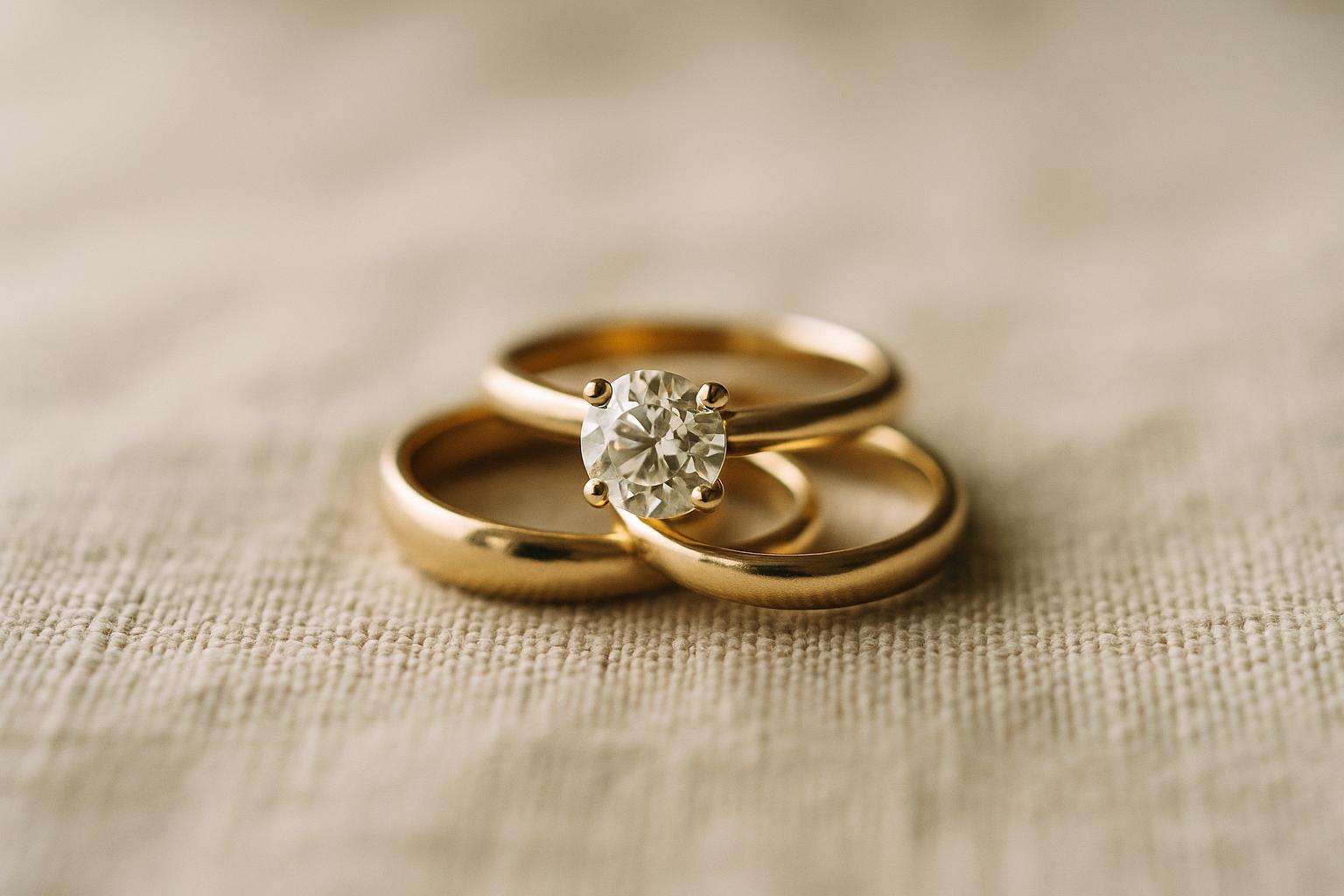
An engagement ring is given at the proposal and worn as a promise to marry; a wedding ring is exchanged at the ceremony and worn as the record of that marriage. In Western tradition both rings live on the fourth finger of the left hand, with the wedding band placed closest to the hand and the engagement ring stacked above it. The two pieces are distinct objects with different histories, different design conventions, and slightly different rules — but they are meant to work together, which makes choosing them in tandem one of the most rewarding decisions a newly engaged couple will make.
What exactly is an engagement ring — and how is it different from a wedding ring?
The simplest way to understand the distinction is by timing. An engagement ring enters the picture at or around the proposal — it is a tangible expression of the intention to marry, given before the wedding takes place. A wedding ring, also called a wedding band, is exchanged during the marriage ceremony itself, as part of the formal exchange of vows. The two rings mark different moments in the same story.
Design conventions reflect this difference. Engagement rings almost always feature a center stone — in 2025, the diamond remained by far the most common choice, though sapphires, moissanite, and colored gemstones have grown in popularity. The center stone is the focal point; the setting, metal, and shank all exist to showcase it. Wedding bands, by contrast, are typically lower-profile: a plain polished band, a pavé or channel-set row of diamonds, or a milgrain-edged metal band. They are designed to be worn continuously for decades, often through work, exercise, and sleep, which encourages simpler, more durable profiles.
Both partners exchange wedding bands during the ceremony. Only one partner — traditionally the person being proposed to — receives an engagement ring at the proposal, though engagement ring traditions vary widely by culture and couple. Some couples today choose a mutual exchange at the proposal, and some forgo the engagement ring entirely in favour of a single meaningful band. There is no rule that overrides a couple's own preferences.
Which hand and finger — and why does the tradition vary by country?
In the United States, Canada, the United Kingdom, Australia, France, Italy, and most of Western Europe, both the engagement ring and the wedding band are worn on the fourth finger of the left hand — universally called the ring finger. The Gemological Institute of America (GIA) traces this to the ancient Roman belief in the vena amoris, literally the "vein of love," thought to run from that finger directly to the heart. Anatomically, this is not accurate — all fingers share the same cardiovascular supply — but the symbolism proved durable enough to carry the tradition across two millennia.
The picture is different across much of Europe and Asia. In Germany, Russia, Greece, Norway, Poland, Spain, India, and several other countries, wedding rings are worn on the right hand, rooted in Orthodox Christian tradition or regional custom. In Brazil, engagement rings are typically worn on the right hand and then switched to the left at the wedding. Jewish wedding ceremonies traditionally use the right index finger for the ring exchange, though many couples move the ring afterward.
None of these traditions is more correct than another. Couples with ties to right-hand-wearing cultures are not breaking any rule by following their heritage, and increasingly couples mix traditions to honor both family backgrounds. The only thing that matters is that both partners know the plan before the ceremony begins.
| Country / Tradition | Engagement ring hand | Wedding band hand | Notes |
|---|---|---|---|
| United States, UK, Australia, France | Left, ring finger | Left, ring finger | Band worn below (closest to hand); engagement ring stacked above |
| Germany, Russia, Norway, Greece | Right, ring finger (often) | Right, ring finger | Orthodox Christian tradition; some individuals switch hand at wedding |
| India (Hindu tradition) | Right, ring finger | Right, ring finger (some regions left) | Regional variation is significant; consult family tradition |
| Brazil | Right, ring finger | Left, ring finger (switched at ceremony) | Engagement ring moved to left hand at the wedding |
| Jewish (traditional ceremony) | Varies | Right, index finger (ceremony); moved after | Halachic tradition requires the index finger; most move the ring post-ceremony |
How are the two rings worn together — and what happens on the wedding day?
The order that most jewelers and etiquette authorities recommend is: wedding band closest to the hand, engagement ring on top. According to the GIA's wearing guide, this arrangement places the band symbolically nearest to the heart and keeps the engagement ring — typically the more elaborate of the two — visible at the top of the stack.
Achieving this order requires a small ritual on the wedding day. The prevailing Western practice is to move the engagement ring to the right hand before the ceremony begins, leaving the left ring finger clear. During the exchange of vows, the wedding band is placed directly onto the bare left ring finger. After the ceremony concludes, the engagement ring is moved back to the left hand and stacked above the band. This is not a formal requirement — couples who find the logistics awkward sometimes simply wear both rings on their right hand during the ceremony and restack them after — but it is the most common approach, and the one most officiants expect.
Soldering and the permanent stack
Many couples, after the wedding, choose to have their two rings soldered together by a jeweler into a single unit. Soldering eliminates the spinning and shifting that a stacked pair is prone to, and it prevents the rings from rubbing against each other in a way that can gradually wear down the metal. The process typically costs $45 to $75 at a reputable jeweler and takes one to two weeks. The main trade-off is permanence: a soldered set cannot be easily separated for resizing, and if one ring ever needs significant repair, the other will need to be detached first. According to PriceScope's ring-wearing guide, soldering is most worthwhile when the two rings have been worn together long enough to confirm the pairing feels right.
Choosing a band that works with the engagement ring
The engagement ring and wedding band do not need to match, but they do need to coexist comfortably on the finger. A few considerations worth discussing with your jeweler before the band is ordered:
- Profile and height. A low-profile bezel-set engagement ring will sit comfortably against almost any band. A tall prong-set solitaire may benefit from a curved or contoured band that nestles beneath it rather than pressing against its setting.
- Metal compatibility. Harder metals wear more slowly; a platinum band paired with a 14k gold engagement ring will eventually cause the softer gold to show wear at the contact point. Using the same metal for both rings avoids this entirely.
- Band width. A width of 2.5 to 3.5 mm is a practical everyday range. Narrower than 2 mm can feel insubstantial; wider than 4 mm begins to crowd the finger when stacked with the engagement ring.
- Fit type. A comfort-fit band — with its slightly domed inner surface — is notably more comfortable for rings worn through the night or during physical activity, because it moves more fluidly over the knuckle.
The practical steps after you have both rings
Once you are wearing both rings, two practical steps should happen promptly: appraisal and insurance. These are not formalities — they are the mechanism by which two pieces of jewellery worth thousands of dollars are protected against loss, theft, or damage.
Appraisal
A professional ring appraisal is a signed document, prepared by a credentialed independent appraiser (look for the Gemological Institute of America's Graduate Gemologist designation, or a member of the American Society of Jewelry Appraisers), that records the ring's precise specifications — metal type and weight, stone grades, craftsmanship quality — and assigns a current replacement value. This is the cost to source an equivalent ring at today's market prices, which can differ significantly from what was paid. Replacement value is the figure insurance companies use to settle claims, so an outdated or low appraisal translates directly to under-compensation if something goes wrong.
Brilliant Earth offers complimentary appraisals on purchases over $2,000; independent appraisers typically charge $50 to $150 for a standard piece. Appraisals should be refreshed every two to three years, because precious metal prices and diamond values fluctuate — and an outdated document can leave you underinsured at exactly the wrong moment.
Insurance
Standard homeowners and renters insurance policies cap jewelry coverage at $1,000 to $2,500 — insufficient for most engagement rings purchased today. Specialized jewelry insurers such as Jewelers Mutual, BriteCo, and Lavalier offer standalone policies that cover loss, theft, mysterious disappearance, and accidental damage. Jewelers Mutual prices coverage at approximately 1 to 2 percent of the insured value annually: a $5,000 ring costs roughly $50 to $100 per year. Coverage typically begins the same day the application is submitted. For rings valued under $5,000, a sales receipt usually suffices to initiate a policy; above that threshold, a professional appraisal is required at claim time — another reason to get the appraisal done early rather than later.
The wedding band should be added to the same policy as the engagement ring immediately after the ceremony. Many people add the engagement ring to their insurance when they first receive it and forget the band entirely, leaving one of the two rings unprotected. A quick call or online update to your insurer the week after the wedding takes care of both.
For a deeper look at your coverage options, see our guide to owning and protecting your engagement ring, including a full breakdown of the three major specialized insurers.
Frequently asked questions
The questions couples ask most often about engagement rings and wedding bands tend to come up in the days immediately after the proposal — and again in the weeks before the ceremony. The FAQ section below addresses the most common ones directly.
Frequently asked
What is the difference between an engagement ring and a wedding ring?
An engagement ring is presented at or around the time of the marriage proposal, before the wedding. It typically features a prominent center stone — most often a diamond — and is worn by the person being proposed to as a public symbol of the couple's intention to marry. A wedding ring (also called a wedding band) is exchanged by both partners during the marriage ceremony itself, as part of the formal vows. Wedding bands are usually simpler in design — often a plain metal band, a pavé band, or a channel-set band — and are worn by both partners, not just one. The engagement ring is a pre-wedding symbol; the wedding band is the ceremony's physical keepsake.
Which finger does an engagement ring go on?
In most Western countries — including the United States, Canada, the United Kingdom, Australia, France, and Italy — both the engagement ring and the wedding band are worn on the fourth finger of the left hand, commonly called the ring finger. This tradition traces to the ancient Roman concept of the vena amoris, or "vein of love," believed to connect that finger directly to the heart. Anatomically this is not accurate — all fingers share the same circulatory system — but the tradition has endured for centuries. In Germany, Russia, India, Greece, Norway, Poland, and several other countries, wedding rings are worn on the right hand, reflecting Orthodox Christian custom or local convention. Couples with ties to those traditions should follow their own heritage; there is no single universal rule.
Which ring goes on first — the engagement ring or the wedding band?
The wedding band goes on the finger first, placed closest to the hand, and the engagement ring sits on top of it. This is the order that results after the wedding ceremony. On the wedding day, the prevailing Western practice is to temporarily move the engagement ring to the right hand before the ceremony begins. This keeps the left ring finger clear so the officiant or partner can slide the wedding band directly onto the finger — closest to the hand, and symbolically closest to the heart. After vows are exchanged, the engagement ring is moved back to the left hand, stacked above the band. Some couples later have the two rings soldered together by a jeweler to prevent spinning and preserve the stack's alignment.
Do you have to wear both rings at the same time?
No — there is no rule requiring both rings to be worn together at all times, and many people wear only one ring or alternate between them depending on activity, comfort, or preference. Some individuals wear only the wedding band daily and reserve the engagement ring for special occasions, particularly if it has a tall setting prone to snagging. Others solder the two rings permanently together and treat the combined piece as a single ring. A small number of people — especially in professions where jewelry poses a safety risk — wear neither ring on the job and wear both only off-duty. The choice is entirely personal. What matters is that both rings are stored safely and insured when not worn; specialized jewelry insurance covers loss, theft, and accidental damage for rings kept at home as much as rings worn daily.
Does a wedding band have to match the engagement ring?
No. Matching sets — where the engagement ring and wedding band are designed by the same jeweler as a coordinating pair — are popular and widely available, but they are not obligatory. Many couples intentionally choose a contrasting band: a yellow-gold band paired with a platinum engagement ring, a diamond-pavé band alongside a solitaire, or a simple comfort-fit band worn with an ornate halo. The practical consideration is wearability: if the two rings are worn daily as a stack, they should sit flush against each other without gaps or excessive height difference. A band width of 2.5 to 3.5 mm typically balances everyday comfort with visual presence. Curved or "notched" bands are designed to hug specific engagement ring profiles and are worth exploring if the engagement ring has a pronounced arched shank or a wide setting.
Should I get the engagement ring and wedding band appraised?
Yes, and the sooner the better. A professional appraisal — performed by a credentialed, independent appraiser, not the jeweler who sold the ring — establishes a signed document recording the ring's precise specifications and current replacement value. This differs from a GIA grading report (which describes the stone but assigns no dollar value) and from the purchase receipt (which records the negotiated sale price, not the cost to replace the ring at current market rates). According to Brilliant Earth's appraisal guide, independent appraisers typically charge $50 to $150 for a standard piece. Appraisals should be updated every two to three years because precious metal prices and diamond values fluctuate; an outdated appraisal can leave an insured ring undercompensated at claim time.