Diamonds & Stones
Sapphire, Ruby, Emerald & Colored Gemstone Engagement Rings
The durable colored-stone alternatives to diamond — what they cost, where they come from, how to buy them, and how to keep them beautiful for decades.
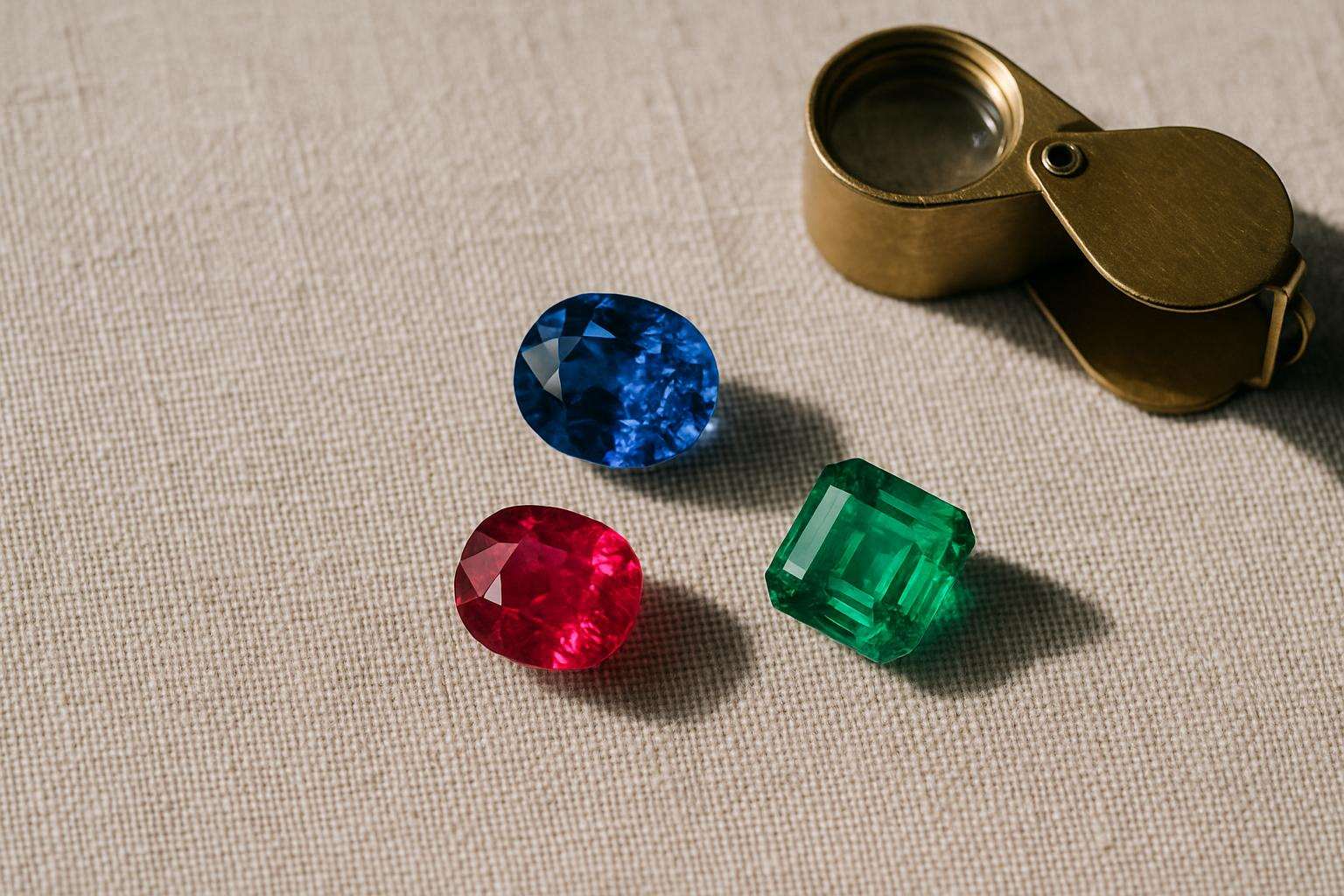
Sapphire and ruby sit at Mohs 9 with no cleavage — the most durable colored-stone choices for a ring worn daily. Emerald, aquamarine, and morganite work well in protective settings with sensible care habits. Every colored stone above roughly 0.50 carats should come with a GIA, AGL, or Gübelin report confirming origin and treatment status. Treatment disclosure, not origin alone, is what moves price: an unheated sapphire or ruby of fine quality can cost two to three times a comparable heated stone.
In 1981, Princess Diana chose a 12-carat oval Ceylon sapphire surrounded by fourteen round diamonds from the Garrard catalog — and in doing so permanently shifted how the Western engagement-ring market thinks about colored stones. Four decades later, that same ring sits on the finger of Catherine, Princess of Wales, having passed from Diana to Prince William as the most recognized piece of jewelry in the world. The ring's influence is measurable: sapphire is consistently among the top-searched engagement-ring stones in 2026, and the broader trend toward expressive color continues to accelerate.
But colored stones require a different kind of knowledge than diamonds. The GIA's 4Cs framework — the universal language for white diamonds — does not translate cleanly to colored gemstones. Origin, treatment status, and a stone-specific understanding of durability all matter more here, and they interact in ways that can surprise buyers unfamiliar with the colored-stone trade. This guide covers the five stones that belong in the conversation for an engagement ring: sapphire, ruby, emerald, aquamarine, and morganite. We begin with durability — the property most buyers underestimate — and then work through pricing, origins, treatments, and care for each stone in turn.
Which Colored Stones Are Actually Durable Enough for Daily Wear?
An engagement ring takes sustained, daily punishment. It contacts countertops, dish soap, hand lotion, garden soil, gym equipment, and every other surface its wearer touches. The standard durability framework uses the Mohs hardness scale as its primary axis: quartz, the mineral in household dust and grit, scores 7. Any gemstone rated below 7 will accumulate visible surface scratches from ordinary daily contact. But hardness alone is an incomplete picture — toughness (resistance to chipping and fracture) and stability (resistance to chemical and thermal attack) both matter equally for a ring worn continuously for decades.
| Stone | Mohs Hardness | Toughness | Daily-Wear Verdict | Setting Recommendation |
|---|---|---|---|---|
| Sapphire (corundum) | 9 | Excellent — no true cleavage | Excellent; best colored-stone choice | Any; bezel adds extra protection |
| Ruby (corundum) | 9 | Excellent — no true cleavage | Excellent; most care-friendly colored stone | Any; avoid minimal-prong settings on larger stones |
| Aquamarine (beryl) | 7.5–8 | Good — directional cleavage, minimal inclusions | Good with care; remove for heavy physical activity | Bezel or six-prong preferred |
| Morganite (beryl) | 7.5–8 | Good — same beryl cleavage; typically very clean | Good with care; same cautions as aquamarine | Bezel or six-prong preferred |
| Emerald (beryl) | 7.5–8 | Poor in practice — extensive natural fractures in virtually all stones | Acceptable only with disciplined removal for physical activity; re-oiling required every few years | Bezel or protective prong; avoid four-prong minimal settings |
Sapphire and ruby are the unambiguous leaders. Both are corundum — crystallized aluminum oxide — with a Mohs rating of 9 and, critically, no true cleavage planes. This combination of hardness and toughness is why corundum has served as a mainstream engagement-ring alternative for centuries. A sapphire or ruby will withstand the accumulated physical demands of daily wear across decades without the specialized care routines that emerald requires or the bezel-preference that prudent ownership of beryl demands. According to Jupiter Gem's durability analysis, sapphire and ruby are the most-recommended colored stones for continuous wear, and that assessment is consistent across every credible gemological source.
Emerald deserves an honest conversation of its own. Its Mohs rating of 7.5–8 matches aquamarine and morganite on the hardness scale, but it behaves far more like a fragile stone in practice. The near-universal presence of natural fractures — filled with cedar oil or synthetic resin in virtually all commercial stones — means that impact can propagate existing fissures, and both ultrasonic cleaners and steam will strip the oil treatment, causing clarity to visibly worsen. Emerald is a stone for engaged, attentive owners. If you love green and want something more forgiving, consider a fine tsavorite garnet: the same rich saturated green, Mohs 7.5, typically untreated, and zero fracture-filling maintenance.
How Are Colored Stones Graded and Certified — and Why Does That Change the Price?
Colored gemstones do not follow the GIA's 4Cs framework. Diamond grading is standardized, reproducible, and fully documented on a single certificate; colored stone grading is far more complex and less standardized, because color itself — the primary value driver — resists simple measurement. The GIA grades colored stones through a separate set of services that assess identity (species), treatment status, and, for select stones, country of origin. In January 2026, GIA launched redesigned colored stone reports with enhanced transparency and expanded origin-determination services for ruby, sapphire, emerald, alexandrite, and others, per the GIA's own announcement. This overhaul is directly relevant for buyers in the current market: the reports now highlight gemological data more clearly and make treatment disclosures easier to interpret.
The labs that matter for engagement-quality colored stones are GIA, AGL (American Gemological Laboratories), Gübelin, and SSEF. All four provide treatment disclosure and, for significant stones, origin determination. At major auction houses — Christie's, Sotheby's, Bonhams, and Phillips — important rubies, sapphires, and emeralds are routinely offered with reports from two of these labs simultaneously. For retail purchases, a single GIA or AGL report is the appropriate standard for any stone above roughly 0.50 carats or valued over $500.
Treatment disclosure moves price more than any other single variable in the colored-stone market. GIA classifies colored stones into three clarity types: Type I (stones that typically grow with few inclusions, such as aquamarine), Type II (stones that commonly contain inclusions, such as ruby and sapphire), and Type III (stones that almost always contain inclusions, such as emerald). Within each type, treatments that improve appearance are standard practice — but they must be disclosed and documented. For sapphire and ruby, the transformative treatment is heat treatment: exposure to high kiln temperatures that dissolves silky rutile inclusions and deepens color. Approximately 95% of the world's commercial sapphires have been heat-treated. A report noting "no indications of heating" — the critical "no heat" notation — can add 60–100% to a sapphire's price over a comparable heated stone. For ruby, an unheated stone commands roughly three times the price of a heated equivalent at comparable quality. These are not trivial differences; they explain why a $3,000 ruby and a $15,000 ruby of apparently similar appearance can look nearly identical to an untrained eye while representing vastly different market positions.
Stone-by-Stone Guide: Pricing, Origins, and What to Know Before You Buy
Sapphire
Sapphire is the gem variety of corundum in any color except red. Its price range spans an enormous spectrum — from $25 per carat for low-grade commercial material to over $15,000 per carat for fine Ceylon Royal Blue. For an engagement-quality stone, the practical range is $450–$1,600 per carat for a quality 1-carat blue sapphire, rising to $4,500–$15,500 per carat for Royal Blue Ceylon material and $2,300–$6,000+ per carat for Cornflower Blue. Sotheby's notes that color alone accounts for roughly 50–70% of a sapphire's value — saturation, hue, and tone together determine whether a stone is commercial or extraordinary.
Ceylon (Sri Lankan) sapphires are the benchmark for fine blue material: bright, vivid blue with strong transparency. Heat treatment is standard; unheated Ceylon stones with fine color carry a significant premium and should be accompanied by a GIA or AGL report confirming treatment status. Montana sapphires — particularly from Yogo Gulch in Judith Basin County — are notable for natural, untreated color and a distinctive cornflower blue. Yogo material cannot be improved by heat treatment; in fact, the jeweler's torch damages its color. General Montana Rock Creek and Missouri River stones retail at approximately $100–$1,500 per carat; Yogo commands 2–3× that range. In January 2026, GemGuide relaunched Montana sapphire pricing charts — the first standardized reference since 2014 — adding welcome price transparency to this American category.
Lab-grown sapphires are chemically, physically, and optically identical to natural corundum and share the same Mohs 9 hardness. They typically cost $50–$200 per carat — a 70–90% saving versus natural equivalents — and are widely available through retailers such as Brilliant Earth. They carry no resale value; buyers who prioritize size, budget, and responsible sourcing over provenance will find them practical. Those who want origin traceability and long-term value should select natural stones with documentation.
Ruby
Ruby is red corundum — the same mineral species as sapphire, with chromium providing the red color. It shares sapphire's Mohs 9 hardness and absence of cleavage, making it among the most durable colored stones available. Pricing is origin- and treatment-driven. Fine quality natural rubies displaying vivid red typically retail at $2,000–$10,000 per carat; commercial quality with visible inclusions runs $100–$500 per carat. The price gradient accelerates sharply above 2 carats, because high-quality large rubies are genuinely rare.
Burma (Myanmar) rubies with the "pigeon blood" designation — a vivid, pure red with a slight blue undertone — represent the apex of the market. Heated fine Burmese rubies trade at $5,000–$35,000 per carat; unheated Burmese examples reach $15,000–$100,000+ per carat. For buyers not seeking collector-level investment material, Mozambique rubies — from the Montepuez deposit discovered in 2009 — offer a more accessible entry: heated fine Mozambique stones retail at $1,500–$8,000 per carat, and fine examples can display pigeon-blood characteristics. SSEF and Gübelin certification is the market standard for authenticating pigeon-blood status; for retail-grade stones, a GIA colored stone report is sufficient. Ruby's care requirements are straightforward: safe in lukewarm soapy water, generally safe in ultrasonic cleaners unless the stone is heavily fracture-filled, and should be removed before exposure to harsh household chemicals.
Emerald
Emerald is green beryl, colored by chromium and vanadium. Colombia produces an estimated 70–80% of the world's emerald supply, with the Muzo and Chivor mines producing the most prized vivid "Colombian green" material. Fine 1-carat Colombian emeralds run $5,000–$18,000 per carat; Zambian stones in the 1–2 carat range typically fetch $3,000–$4,000 per carat and are often considered better value for their excellent transparency.
Care is the defining practical challenge. Over 99% of emeralds are fracture-filled — most commonly with cedar oil, sometimes with synthetic resin — and the oil migrates out of the stone over years of wear. Emeralds typically need re-oiling every several years by a qualified jeweler. They cannot be cleaned in ultrasonic or steam cleaners. A GIA, Gübelin, or AGL report specifying origin and treatment level (minor, moderate, or significant oiling) is essential for any meaningful purchase. Importantly, this article's scope covers emerald as a gemstone species; the emerald cut — a step-cut faceting style applied to diamonds and other stones — is covered separately in our step-cut diamonds guide, which also explains why that cut shape demands higher clarity grades than brilliant cuts.
Aquamarine
Aquamarine is blue-to-blue-green beryl, one of the cleanest gemstone species: eye-clean stones are the norm, not the exception, giving buyers a visual clarity advantage that emerald can almost never match. The most desirable color is a pure medium-intensity blue with minimal green or gray secondary tones. Pricing is accessible: quality 1-carat stones suitable for an engagement ring typically run $300–$800 per carat; a 5-carat quality stone reaches $1,500–$5,000. Brazil (particularly Minas Gerais) is the dominant source; Madagascar and Mozambique also produce significant material.
Aquamarine benefits from a bezel or six-prong setting to protect its beryl cleavage from direct impact. Home cleaning with mild dish soap, lukewarm water, and a soft toothbrush every two to three weeks maintains appearance effectively for a daily-wear piece. Avoid ultrasonic cleaners (vibration can loosen settings), chlorinated pool water, and products containing ammonia or bleach.
Morganite
Morganite is pink-to-peach-orange beryl, its color derived from manganese. It rose rapidly from a collector's specialty to one of the most searched engagement-ring gemstones through the 2010s, driven by a flattering warm hue that pairs exceptionally well with rose gold settings. It remains the most affordably priced of the beryl engagement stones: morganite typically retails at $50–$300 per carat, making it practical to source a visually substantial center stone within a modest budget. A completed morganite engagement ring in quality rose gold typically ranges from $600 to $2,500 for most retail configurations, with high-end custom pieces rising further.
Morganite and aquamarine share essentially identical care requirements: bezel or six-prong setting preferred, no ultrasonic or steam cleaning, remove before swimming in chlorinated pools or handling household cleaners. Exposure to prolonged direct sunlight may cause very gradual fading over many years, though most wearers do not observe this effect under normal daily conditions. For buyers who want the warm pink aesthetic at a lower budget than pink sapphire, morganite is a sound choice — provided setting and care guidance is followed.
How to Use a Budget Wisely When Buying a Colored Gemstone Ring
Colored stone pricing is more opaque than diamond pricing precisely because there is no single standardized grading axis. The same carat weight in sapphire can cost $200 or $12,000 depending on color quality, origin, and treatment status. This opacity cuts both ways: it creates risk for uninformed buyers, but it also creates real value opportunities for buyers who understand the market.
For sapphire: The single highest-leverage decision is treatment status. If your budget is modest, buy a well-documented heat-treated stone in a vivid, saturated hue — the treatment is standard, accepted, and fully disclosed. Chasing "no heat" documentation at the same budget will deliver a weaker stone in a less desirable color. If your budget is higher and you want an appreciating asset, unheated material with a GIA "no indications of heating" report is where the long-term value concentration lies. Montana sapphires offer an accessible entry point for buyers who want American-origin material and are willing to accept smaller sizes.
For ruby: The practical engagement-ring sweet spot is a fine-quality heated Mozambique ruby at $1,500–$8,000 per carat. Burmese unheated material above that range is investment-grade territory; the visual difference between a fine heated Mozambique and a fine heated Burmese ruby is not detectable by untrained eyes. Lab-grown rubies offer dramatic savings of 90–95% over natural equivalents and share identical chemical and physical properties — they are a practical choice for buyers prioritizing size and budget over natural provenance and resale value.
For beryl stones (emerald, aquamarine, morganite): Match your maintenance commitment to your stone choice. Morganite and aquamarine offer the best durability-to-price ratio within the beryl family, with minimal specialized care requirements. Emerald is the right choice only for buyers who genuinely love it and are prepared to own it attentively — periodic re-oiling is not optional for a ring worn daily. See our diamond 4Cs guide for context on how colored-stone value frameworks compare to the standardized diamond grading system, and our alternative stones guide for opal, moss agate, and lower-durability options that suit occasional-wear rings rather than daily-wear engagement rings.
One final principle applies across all colored stones: always buy with documentation. A GIA, AGL, or Gübelin report is not a luxury for a significant colored stone — it is the minimum standard of consumer protection. The report tells you what the stone actually is, where it came from, and what has been done to it. Without it, you are buying on trust rather than evidence. For any stone above 0.50 carats in an engagement ring, the cost of certification is a small fraction of the total purchase and an entirely reasonable requirement.
Frequently asked
Is sapphire a good choice for an engagement ring?
Yes — sapphire is one of the best colored stones you can choose for an engagement ring. It scores 9 on the Mohs hardness scale and has no true cleavage planes, giving it both excellent scratch resistance and strong toughness against impact. It is second only to diamond and moissanite in practical durability for daily wear. Sapphires also come in virtually every color — classic blue, teal, pink, yellow, peach, and orange padparadscha — so there is no shortage of expressive options. A quality 1-carat blue sapphire suitable for an engagement ring typically retails between $450 and $1,600, making it meaningfully more affordable than a diamond of comparable visual presence, though fine Ceylon or Kashmir material commands much higher prices.
What does 'heat treatment' mean for sapphires and rubies — and does it matter?
Heat treatment is a standard, widely accepted enhancement in which a gemstone is heated in a kiln to dissolve clarity-reducing inclusions and intensify color saturation. According to the GIA, approximately 95% of the world's commercial sapphires have been heat-treated. The treatment is considered legitimate and is fully disclosed on GIA and AGL reports. What matters for buyers is the disclosure itself: a stone should always come with a lab report that explicitly states its treatment status. An unheated sapphire or ruby of comparable quality commands a significant premium — typically 60–100% more for sapphire, and roughly three times more for ruby — because untreated material is genuinely rare. More invasive treatments such as beryllium diffusion in sapphire or glass fracture-filling in ruby are also disclosed on reports but carry far greater negative implications for value and durability, and should generally be avoided in a ring intended for daily wear.
How durable is an emerald engagement ring, really?
Emerald sits at Mohs 7.5–8, which clears the quartz threshold, but hardness is not the whole story. Nearly all emeralds contain extensive natural fractures and fissures — the trade calls this jardin — and virtually all commercial emeralds are fracture-filled with cedar oil or synthetic resin to improve their clarity. Repeated physical impact can propagate existing fractures, and ultrasonic or steam cleaning will accelerate oil loss. Emerald is not appropriate for a wearer who keeps the ring on during sports, heavy domestic work, or frequent exposure to cleaning chemicals. For someone who removes the ring for those activities and commits to periodic re-oiling every several years, emerald can work beautifully. A GIA, AGL, or Gübelin report specifying the oil treatment level (minor, moderate, or significant) is essential for any significant purchase. If you love the idea of a green stone but want lower maintenance, consider a tsavorite garnet instead: the same lush green, superior clarity, no routine re-oiling required.
What is the difference between a Ceylon sapphire and a Montana sapphire?
Both are natural corundum from geologically distinct sources, and both are excellent engagement-ring choices, but they differ considerably in character and price. Ceylon sapphires — the trade name for Sri Lankan material — are prized for bright, vivid blue with strong transparency; Royal Blue Ceylon sapphires retail at $4,500–$15,500 per carat, while Cornflower Blue runs $2,300–$6,000+. More than 95% of Ceylon sapphires on the market have been heat-treated. Montana sapphires come from several U.S. deposits including Yogo Gulch, Rock Creek, and the Missouri River. Yogo material is particularly notable for requiring no heat treatment — its color is stable without enhancement — and for a distinctive cornflower blue. General Montana Rock Creek and Missouri River stones retail at roughly $100–$1,500 per carat; Yogo material commands 2–3× that, with exceptional stones exceeding $10,000 per carat. In January 2026, GemGuide relaunched Montana sapphire pricing charts — the first standardized reference prices since 2014 — adding market structure to this previously opaque category.
Are morganite and aquamarine durable enough for everyday wear?
Both are beryl family stones with a Mohs hardness of 7.5–8 — above the quartz threshold and acceptable for daily wear with thoughtful setting choices. Neither stone has the structural fragility of emerald (also beryl): morganite and aquamarine typically form with far fewer natural inclusions and require no fracture-filling treatment. The practical care requirement is relatively simple: avoid ultrasonic and steam cleaners, remove the ring before handling household chemicals or swimming in chlorinated pools, and store separately from harder stones. The most important setting consideration for both is avoiding a minimal four-prong solitaire setting, which leaves the stone's girdle exposed to impact. A bezel setting or a six-prong head distributes any force around the stone's equator rather than concentrating it at exposed corners. Morganite's directional beryl cleavage means a direct sharp blow to a prong-held girdle edge — the kind of impact from hitting a hard surface at an oblique angle — carries real chip risk; a bezel eliminates it. Both stones are fully suitable for daily wear under these conditions.
What lab report should I ask for when buying a colored gemstone engagement ring?
For stones under roughly 0.50 carats or valued under $500, no lab report is strictly required — the cost of certification would approach or exceed the stone's value. For any significant colored stone — typically 1 carat and above for sapphire, ruby, or emerald — a report from GIA, AGL (American Gemological Laboratories), Gübelin, or SSEF is the appropriate standard. GIA relaunched redesigned colored stone reports in January 2026 with enhanced transparency and expanded origin-determination services covering ruby, sapphire, emerald, and alexandrite, among others. The most critical disclosures on any report are: country of origin (which directly affects value, especially for Burmese ruby or Ceylon sapphire designations), treatment status (particularly the critical "no indications of heating" notation, which commands a premium), and treatment type and extent if treatment is present. For emeralds, look specifically for the fracture-filling treatment level (minor/moderate/significant oiling). At major auction houses, important colored stones are typically accompanied by reports from two laboratories — for example, both GIA and Gübelin — for the highest-value material.