Diamonds & Stones
Diamond 4Cs Explained: Cut, Color, Clarity & Carat
Master the four properties that determine every diamond's beauty, rarity, and price — and learn exactly which trade-offs are worth making.
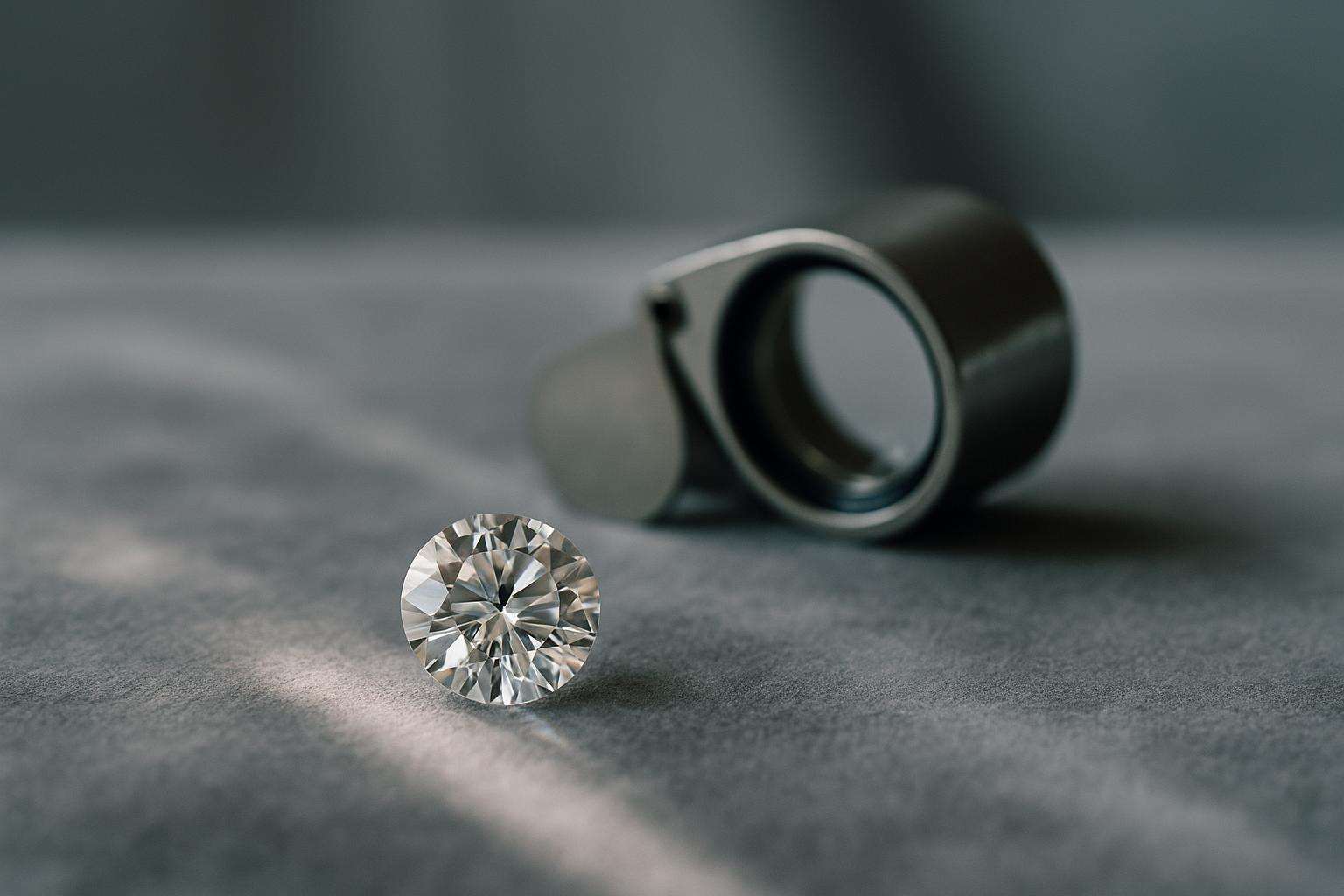
The GIA's 4Cs — Cut, Color, Clarity, and Carat — are the universal grading language for diamonds. Cut has the greatest impact on beauty; Color and Clarity are where most buyers find real value by choosing grades that look identical to higher grades in a finished ring; and Carat weight drives price non-linearly, with predictable savings available just below benchmark weights. When budget forces a trade-off, protect Cut first.
In 1953, a GIA researcher named Richard T. Liddicoat and his colleagues at the Gemological Institute of America formalized a grading system that turned a subjective, dealer-dependent process into a measurable, reproducible science. The result — the 4Cs of Cut, Color, Clarity, and Carat weight — became the foundation on which every diamond transaction in the modern market is built. Today, no other framework has displaced it. The FTC's Guides for the Jewelry, Precious Metals, and Pewter Industries explicitly require sellers to disclose material quality characteristics of diamonds, and the 4Cs vocabulary is the mechanism through which those disclosures are made.
Understanding the 4Cs does not require a gemology degree. It requires knowing what each grade actually means in a mounted ring under real lighting — and that is a significantly shorter list than jewelry marketing would have you believe. This guide explains each C in turn, translates grades into real visual and financial differences, and points you toward the spokes of our diamond hub where you can go deeper on any single C.
What Does Diamond Cut Grade Actually Measure?
Cut is the most misunderstood of the 4Cs because it sounds like it refers to shape — round, oval, princess. It does not. Cut grade measures how precisely a diamond's facets are proportioned, aligned, and polished to interact with light. GIA grades round brilliant diamonds on a five-point scale: Excellent, Very Good, Good, Fair, and Poor. Fancy shapes — ovals, cushions, emeralds, marquises — do not receive an official GIA cut grade on their reports, though some retailers apply proprietary ratings.
An Excellent cut diamond meets strict standards across seven attributes: brightness (white light return), fire (spectral color flashes), scintillation (the sparkle pattern as the stone moves), weight ratio, durability, polish, and symmetry. Table sizes, crown angles, pavilion depths, and facet alignments all fall within optimal ranges defined by decades of light-performance modeling. The result is approximately 90–95% of incoming light returned through the table. A Very Good cut returns roughly 85–90% — the difference is largely imperceptible to an unaided eye not making a direct side-by-side comparison, and at approximately $400–$900 less on a 1-carat round in G color and VS1 clarity, Very Good represents a defensible budget choice. Good cut introduces visible light leakage and dull zones; the 25–30% price discount does not offset the visual degradation, making it inadvisable as an engagement-ring center stone.
The single most important buying principle the 4Cs framework supports: sacrifice color or clarity before sacrificing cut. A well-cut G/VS2 diamond sparkles more vibrantly than a poorly cut D/Flawless stone in everyday conditions. For a deeper breakdown of cut grades with real per-grade price differences, see our diamond cut grades guide.
How Does the GIA Color Scale Work — and Where Is the Value?
The GIA D-to-Z color scale was deliberately anchored at D — a letter with no prior gemological associations — to avoid confusion with older, inconsistent industry systems. The scale measures the degree of yellow or brown body color present in a white diamond, with D representing complete absence of visible color and Z representing obvious yellow saturation. Five groups organize the 23 grades:
| Group | Grades | What You See Face-Up | Best Metal Pairing |
|---|---|---|---|
| Colorless | D, E, F | No color detectable even side-by-side; D–F differences require master-stone comparison | Platinum or white gold |
| Near-Colorless | G, H, I, J | G–H appear white face-up; I–J may show faint warmth in white metal settings | G–H: any metal; I–J: yellow or rose gold neutralizes warmth |
| Faint | K, L, M | Noticeable warmth face-up in most settings | Yellow gold; vintage/antique styles |
| Very Light | N–R | Clearly visible yellow tint | Yellow gold; intentional warm aesthetic only |
| Light | S–Z | Obvious yellow or light brown; approaches fancy-color territory | Yellow gold if budget-driven; consider fancy-color grade instead |
For the vast majority of engagement-ring buyers, the practical decision runs from D to approximately J. G is the widely recognized value gateway: visually indistinguishable from colorless D–F when the stone is mounted and viewed face-up under normal lighting, yet typically 25–30% less expensive than D of otherwise equivalent cut, clarity, and carat. A G-versus-D choice on a 1.5-carat purchase can save approximately $2,500 — money that could alternatively fund platinum settings, larger carat weight, or higher clarity.
H color offers a comfortable middle ground. In most lighting conditions and at typical viewing distances, H diamonds appear white and bright. The warmth of an H stone is most noticeable when placed table-down on a white background — not in a mounted ring. H is a particularly pragmatic choice in yellow gold settings, where the warm metal blends with any residual stone warmth, making tint essentially invisible.
One practical footnote on fluorescence: GIA reports a diamond's fluorescence independently of the color grade. For I and J color stones, Strong Blue fluorescence can make a slightly warm stone appear up to one grade whiter in natural daylight (which contains UV), delivering better face-up color at a lower price. For colorless D–F stones, strong fluorescence is viewed as a mild trade negative. For most buyers at G–H, it is a non-issue either way. Our full diamond color scale guide covers metal-pairing strategy and fluorescence in detail.
What Is the Eye-Clean Threshold, and How Does Shape Change It?
The GIA clarity scale descends from Flawless (FL) — no internal or external characteristics under 10x magnification — through Internally Flawless (IF), Very Very Slightly Included (VVS1–VVS2), Very Slightly Included (VS1–VS2), Slightly Included (SI1–SI2), to Included (I1–I3). The critical consumer question is not where a grade sits on paper but whether inclusions are visible to the unaided eye in a mounted ring under normal lighting — the practical definition of eye-clean.
FL and IF carry prices far above their visual value: a 1.00-carat FL costs roughly $8,000–$15,000; an IF runs $7,000–$13,000. Both look identical to VS1 to any unaided observer. The premium is a rarity premium, not a beauty premium — relevant for collectors, not for buyers prioritizing face-up appearance.
VS1 and VS2 are the performance sweet spot. VS1 inclusions are minor under 10x magnification; VS2 inclusions are noticeable under magnification but typically invisible to the naked eye in rings below roughly 2 carats. The VS2-to-VS1 savings on a 1.00-carat stone run $1,000–$1,500; the gap widens dramatically at larger sizes where VS2 at 3.00 carats may save $15,000–$25,000 versus VVS2.
SI1 is frequently eye-clean — more than 85% of SI1 round brilliants at 1.00 carat achieve it — but requires individual stone inspection rather than grade-based confidence. The inclusion type and position matter: a small, transparent pinpoint near the girdle is invisible in a finished ring; a dark crystal under the table is not. Always inspect the actual stone via a high-resolution video tool before purchasing SI1.
Shape changes everything here. Diamond cut geometry interacts with clarity more than any other 4C combination:
- Round brilliant cuts are the most forgiving. Their 58 precisely angled facets scatter light in multiple directions, breaking up and masking inclusions within the brilliance. Eye-clean target: VS2 at 1.00 carat; SI1 viable on individual inspection. At 2.00 carats and above, upgrade to VS1.
- Oval, cushion, pear, and radiant cuts are brilliant-cut shapes with similar inclusion-hiding ability. SI1 to VS2 work well under 1.50 carats, though brilliant-cut elongated shapes with bow-tie shadows require attention to center-table inclusions that a shadow can highlight.
- Emerald and Asscher cuts (step cuts) create the celebrated hall-of-mirrors optical effect via large, open parallel facets — but those same facets function essentially as windows into the stone's interior. Even small inclusions that would be invisible in a round brilliant can be clearly apparent in an emerald cut. Minimum practical grade: VS1; VVS2 for stones above 1.50 carats.
A carat-size rule of thumb: for every 0.50-carat increase above 1.50 carats, consider upgrading clarity by one grade to maintain the same eye-clean probability. See the clarity and eye-clean threshold guide for inclusion-type examples and shape-specific grade tables.
Carat Weight vs. Face-Up Size: Understanding the Difference
Carat is the most misunderstood of the 4Cs. One carat equals exactly 200 milligrams — it is a unit of mass, not a measurement of physical dimensions. The popular assumption that a 1.00-carat diamond is a specific physical size is incorrect. A 1.00-carat round brilliant with a deep pavilion can measure as little as 6.1 mm across; a shallowly cut stone of identical weight may measure 6.9 mm — a nearly 13% diameter difference that is unmistakable to the eye. Cut quality therefore determines not only sparkle but also how large a diamond appears face-up.
Shape amplifies this further. A 1.00-carat oval measures approximately 7.7 mm × 5.7 mm — an elongated footprint that distributes surface area across a wider span of the finger and creates the perception of a larger stone. Oval, marquise, and pear shapes appear 10–15% larger face-up than a round brilliant of identical weight because their elongated geometry places more surface area at the top of the stone rather than concealing mass in depth. Fancy shapes also typically cost 20–40% less per carat than round brilliants of comparable quality, because the round brilliant cutting process wastes the most rough diamond material.
Magic-Weight Pricing: The Benchmark Premium
Diamond prices jump non-linearly at benchmark weights — 0.50, 0.75, 1.00, 1.50, 2.00, and 3.00 carats — because consumer demand concentrates at round numbers and dealers price inventory accordingly. The price-per-carat increase at each benchmark is substantial:
| Carat Weight | Approx. Price Per Carat | Buy-Shy Alternative | Typical Saving |
|---|---|---|---|
| 0.50 ct | ~$2,200 | 0.46–0.48 ct | 8–12% |
| 1.00 ct | ~$4,400 | 0.90–0.95 ct | 10–17% |
| 1.50 ct | ~$6,300 | 1.40–1.45 ct | 10–15% |
| 2.00 ct | ~$9,700 | 1.90–1.95 ct | 12–18% |
| 3.00 ct | ~$13,400 | 2.85–2.95 ct | 10–15% |
The physical diameter difference between a 0.95-carat and a 1.00-carat round brilliant is approximately 0.15 mm — less than the thickness of two sheets of paper, and imperceptible in a mounted ring. The buy-shy strategy also correlates with better average cut quality: stones cut to exactly 1.00 or 2.00 carats are approximately 30% more likely to fall outside ideal cut proportion ranges because rough diamonds are sometimes stretched to reach a target weight rather than being optimized for light performance. Our dedicated carat vs. face-up size guide includes the full face-up size table by shape at each benchmark weight.
How to Prioritize the 4Cs When Budget Forces a Trade-Off
Every diamond purchase involves implicit trade-offs. The 4Cs framework is most useful not when budget is unlimited but when it is not — and most engagement-ring budgets are constrained. Here is the priority order the evidence supports:
- Cut first. Never reduce below Very Good for a center stone. The visual difference between Good and Very Good is noticeable; the difference between Excellent and Very Good typically is not. An Excellent-cut stone at G/VS2 outperforms a Good-cut D/IF stone in everyday visual appeal, and for considerably less money.
- Color second. G or H is the pragmatic sweet spot for white metal settings. H or I works well in yellow or rose gold. Only go below I if the metal choice fully compensates and you have inspected the specific stone face-up.
- Clarity third. VS2 is the defensible standard for brilliant cuts under 2 carats; VS1 for step cuts or stones above 2 carats. SI1 is viable on inspection for round brilliants. Never buy I1–I3 for an engagement-ring center stone — inclusions at I1 affect structural integrity, not just appearance.
- Carat strategically. Apply the buy-shy strategy. Combine it with a fancy shape (oval or cushion for a 20–30% shape discount) to maximize face-up size within budget. Lab-grown diamonds — which carry GIA or IGI certifications and are physically and chemically identical to natural stones — typically cost 70–85% less per carat at equivalent grades, effectively removing carat as a budget constraint for buyers who prioritize size over natural provenance.
The pages in our diamonds hub go deep on each of these decisions. The diamond shapes guide compares all ten major shapes by face-up size, price, and personality. If you are weighing natural versus lab-grown, our lab-grown vs. natural diamonds comparison covers price, resale, FTC disclosure requirements, and detection — everything you need to make that decision with full information. Every stone decision links back here, because the 4Cs are the vocabulary that makes every comparison possible.
Frequently asked
Which of the 4Cs matters most?
Cut is the most important of the 4Cs. It is the only variable entirely under human control after a diamond is mined, and it determines how efficiently the stone captures and returns light. A well-cut diamond with slightly warmer color or a minor invisible inclusion outperforms a poorly cut flawless stone in everyday visual appeal. When budget forces a trade-off, reduce color or clarity before reducing cut quality. See our full cut-grade comparison for Excellent vs. Very Good vs. Good with real price deltas.
What is the GIA D-to-Z color scale?
The GIA D-to-Z scale grades the degree of yellow or brown body color in a white diamond. D is completely colorless; Z shows obvious yellow saturation. The scale breaks into five groups: Colorless (D–F), Near-Colorless (G–J), Faint (K–M), Very Light (N–R), and Light (S–Z). For most engagement rings, the sweet spot is G or H — visually indistinguishable from colorless D–F when mounted and viewed face-up, but typically 25–35% less expensive than D of otherwise equal specifications.
What does 'eye-clean' mean in diamond clarity?
Eye-clean means a diamond has no inclusions or blemishes visible to the unaided eye at normal viewing distance (roughly 25–30 cm) in a finished, mounted ring under standard lighting. It is not an official GIA grade — it is a practical standard used by gemologists and retailers. For round brilliant cuts, VS2 or SI1 (with individual stone inspection) typically achieves eye-clean status at one carat. Step-cut shapes like emerald and Asscher require higher clarity — at minimum VS1 — because their open parallel facets act like windows into the stone's interior, making inclusions far more visible than in brilliant cuts.
Is a 1-carat diamond always the same size?
No. Carat is a unit of mass (one carat = 200 milligrams), not a physical dimension. Two 1.00-carat round brilliants from different cutters can measure anywhere from roughly 6.1 mm to 6.9 mm across the table depending on how the rough was cut — a nearly 13% diameter difference that is clearly visible. Cut quality therefore drives not only sparkle but also face-up size. Our carat-vs-size guide includes a full shape-by-shape table showing average millimeter spread at common carat weights.
What is the 'buy shy' strategy?
Diamond prices jump sharply at benchmark carat weights — 0.50, 0.75, 1.00, 1.50, 2.00, and 3.00 carats — because consumer demand concentrates at round numbers and dealers price inventory accordingly. The buy shy strategy targets stones just below these milestones: for example, a 0.93-carat stone instead of 1.00 carat, or 1.45 carats instead of 1.50. The physical diameter difference between a 0.95-carat and a 1.00-carat round brilliant is roughly 0.15 mm — imperceptible in a mounted ring — yet the price premium at the 1.00-carat boundary is typically 10–17%. Buying shy also correlates with better average cut quality, since cutters sometimes sacrifice optimal proportions to reach an exact benchmark weight.
Does fluorescence affect diamond value or appearance?
Fluorescence is a separate GIA observation — not a cut grade — describing how a diamond glows under ultraviolet light. For most buyers it is largely irrelevant, but it has one practical use: Strong Blue fluorescence at color grades I–J can make a slightly warm stone appear up to one grade whiter in natural daylight (which contains UV), effectively delivering better face-up color at a lower price. In colorless D–F diamonds, strong fluorescence is generally viewed as a mild negative by the trade and can slightly depress resale price. For G–H grades, fluorescence has a negligible effect either way. The GIA notes fluorescence affects fewer than 35% of diamonds they grade.
How do GIA and IGI grading reports differ?
GIA (founded 1931) created the 4Cs and D-to-Z color scale and is the industry's strictest and most widely trusted lab for natural diamonds; its reports command the highest resale confidence. IGI (founded 1975, headquartered in Antwerp) has become the dominant certifier for lab-grown diamonds and typically grades natural stones 1–2 grades more generously on color and/or clarity compared with GIA for the same stone. For natural diamonds above 1.5 carats held as long-term investments, GIA certification is the defensible choice. For lab-grown diamonds, IGI is the effective market standard and is accepted by all major online retailers including James Allen, Blue Nile, and Brilliant Earth.