Diamonds & Stones
Lab-Grown vs Natural Diamonds: The Definitive 2026 Guide
Price, resale value, detection, and FTC disclosure — an honest, data-driven verdict so you can choose with confidence.
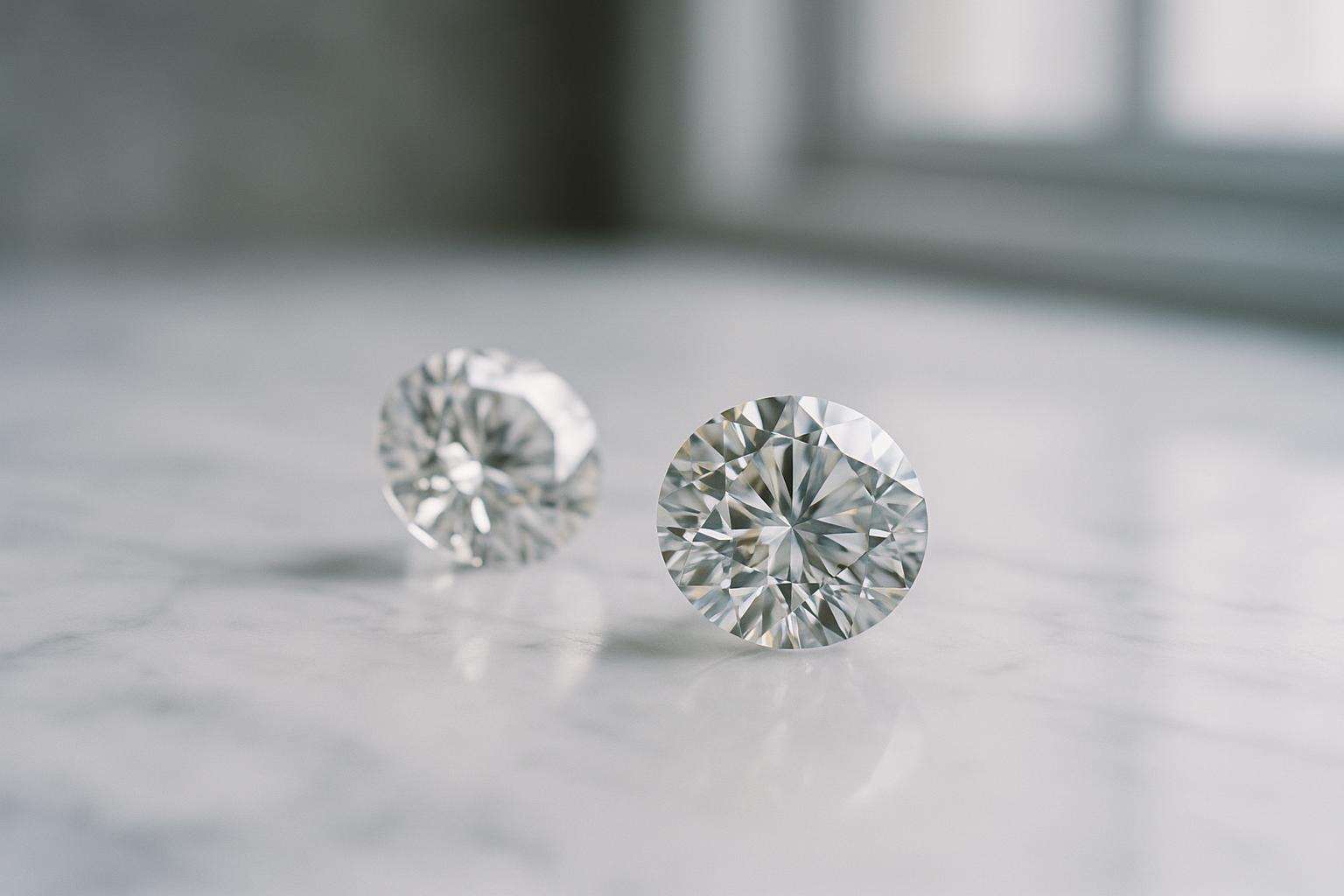
Lab-grown diamonds are chemically identical to natural diamonds and cost 75–86% less in 2026 — a 1-carat lab-grown in D/VVS2 runs around $700–$1,500 versus $4,200–$6,000 natural. The trade-offs are real: lab-grown stones retain only 20–40% of their purchase price on resale, while natural diamonds hold 50–60%. The FTC requires clear disclosure of “laboratory-grown” on every invoice, receipt, and listing. GIA now grades lab diamonds on a simplified Premium/Standard scale; IGI continues full 4Cs grading. Which is right for you depends on whether you prioritize size and value now, or long-term rarity and resale.
How much does a lab-grown diamond engagement ring actually cost in 2026?
The price gap between lab-grown and natural diamonds has never been wider. In mid-2026, a lab-grown diamond retails for 75 to 86 percent less than a natural diamond of equivalent grade — a spread that has widened continuously since 2018 and now defines the entire US engagement ring market.
To put concrete numbers on it: a natural 1-carat round brilliant in D/VVS2 grade typically retails for $4,200–$6,000 at mainstream US jewelers. An identical lab-grown stone at the same grade costs $700–$1,500. At 2 carats, a natural stone trades for $12,000–$20,000 depending on color and clarity; the lab-grown equivalent runs $2,500–$5,000. By 3 carats, the difference is almost incomprehensible — natural D/VVS2 rounds command $40,000–$70,000 at US retail, while comparable lab-grown 3-carat rings are available for under $10,000.
The downstream effect on consumer behavior has been dramatic. According to The Knot's 2026 Real Weddings Study — based on more than 10,000 US couples married in 2025 — 61% of engagement ring center stones were lab-grown, a 239% increase since 2020. The average lab-grown center stone has grown to 1.9 carats as buyers stretch budgets that previously bought a 1-carat natural into 2-plus-carat lab-grown territory. The average spend on a lab-grown engagement ring was $4,600 in 2025, versus $7,600 for a natural diamond ring at a smaller average carat weight.
It is also worth understanding why lab-grown prices fell so steeply, because the same forces that created the bargain also explain the resale problem discussed in the next section. Lab diamonds are manufactured goods: as China and India scaled CVD and HPHT production facilities rapidly after 2020, supply outpaced demand and prices collapsed. Wholesale lab-grown prices peaked near $4,000 per carat in 2018 and had fallen approximately 96% to a commercial floor of $100–$191 per carat by Q2 2025, according to data from Edahn Golan Diamond Research & Analytics. The pace of decline has decelerated — Golan's Q4 2025 data showed only a 4.7% quarterly drop, the smallest on record — and roughly 40% of manufacturers exited or cut capacity between 2023 and 2024. Prices in 2026 appear to be approaching a structural floor.
Natural diamond prices, by contrast, remained significantly more stable. De Beers' Diamond Report 2025 documented that consumers spent an average of $4,063 on a natural diamond in 2025, up 25% from $3,242 in 2023. Natural diamonds scale exponentially in value with carat weight because each large, high-quality crystal is genuinely scarce; lab-grown production can be scaled to any level of demand.
| Carat weight | Lab-grown (retail) | Natural (retail) | Approximate saving |
|---|---|---|---|
| 1.0 ct | $700–$1,500 | $4,200–$6,000 | ~80% |
| 1.5 ct | $1,200–$2,500 | $7,000–$12,000 | ~82% |
| 2.0 ct | $2,500–$5,000 | $12,000–$20,000 | ~80% |
| 3.0 ct | $4,500–$9,000 | $35,000–$70,000 | ~86% |
Note: Gold reached an all-time high of approximately $4,700 per ounce in May 2026, pushing setting costs up 40–50% industry-wide. The savings in the stone category are partly offset by elevated metal costs.
One practical implication: if your budget is fixed, a lab-grown diamond lets you meaningfully trade up on carat weight or quality grade without stretching finances. If you want to understand how carat weight and quality grade interact across different price tiers, our breakdown of what your ring budget actually buys maps out real specifications at $1K, $3K, $5K, and $10K.
Do lab-grown diamonds hold their value — and does it matter?
This is the question most engagement ring guides soft-pedal, so let's be direct: lab-grown diamonds do not hold resale value at the same rate as natural diamonds, and the gap is significant.
Natural diamonds typically retain 50–60% of retail price on the secondary market, sustained by a mature global resale infrastructure of auction houses, estate jewelers, and certified pre-owned programs. Lab-grown diamonds currently retain approximately 20–40% of their purchase price in the best secondary-market scenarios; many independent jewelers will not purchase lab-grown diamonds at all, citing the availability of brand-new, lower-cost stones and the absence of a robust resale channel.
The math becomes particularly stark when you account for wholesale price declines. A stone purchased for $3,410 in 2020 (the average IGI-certified 1-carat retail price at the time) now has a current market value of $700–$1,500. Even a generous 40% resale recovery of today's market value yields $280–$600 — an 82–92% loss relative to the original purchase price. This is not a failure of the secondary market; it is a structural consequence of a manufactured product whose production cost has collapsed.
GIA's October 2025 policy shift — replacing full 4Cs grading with a simplified Premium/Standard assessment and explicitly describing lab-grown diamonds as “a manufactured product” — is widely read by the trade as an institutional signal that the two categories are permanently distinct asset classes. IGI has stated it will continue full 4Cs grading for lab-grown diamonds, making IGI the dominant certification body for buyers who prioritize documentation and resale positioning. CVD-grown stones and IGI-certified stones consistently command the strongest secondary-market outcomes within the lab-grown category.
The honest verdict on resale: if an engagement ring is an heirloom to be worn for life and never sold, resale value is essentially irrelevant to the buying decision, and lab-grown's cost advantage is unambiguous. If there is any possibility the ring will enter the secondary market — through estate, upgrade, divorce, or financial need — natural diamonds offer meaningfully better capital recovery, particularly at higher carat weights.
Either way, make sure your ring is insured from day one. See our guide to engagement ring insurance options — the value question is exactly why specialized standalone jewelry insurance (rather than a homeowners rider) is worth considering.
Can anyone detect a lab-grown diamond — and what does the law require sellers to tell you?
Detection: what it takes and who does it
Lab-grown diamonds pass every standard retail test — a thermal conductivity probe reads them as diamond, a loupe reveals a diamond's optical properties, and visual inspection is conclusive only in distinguishing diamond from simulants like cubic zirconia or moissanite, not lab-grown from natural. Reliable identification requires purpose-built instrumentation.
At the trade level, the gold standard is instruments certified through the Natural Diamond Council's ASSURE Program, which independently benchmarks Diamond Verification Instruments using standardized sample sets containing a mix of natural diamonds, lab-grown diamonds, and simulants. Devices such as the De Beers DiamondProof, the GIA iD100, and Yehuda's Sherlock Holmes Detector (over 15,000 units in global circulation) can achieve near-100% identification accuracy on loose stones of 0.10 carats and above. Major manufacturers like Stuller operate 62 screening instruments and test every stone individually — screening over 5 million stones per year with roughly 50,000 forwarded annually for additional GIA melee lab analysis.
At the laboratory level, GIA, IGI, and GCAL employ multi-method protocols combining photoluminescence spectroscopy, Raman spectroscopy, infrared absorption, and DiamondView short-wave UV imaging. According to GIA's Gems & Gemology Summer 2024 research update, the detection signatures for both HPHT and CVD diamonds are stable, well-documented, and reliably identified by qualified laboratories. The rate of undisclosed lab-grown contamination in natural diamond parcels has dropped from roughly 95% of parcels ten years ago to approximately 0.5% today, with most incidents attributed to handling mix-ups rather than deliberate fraud.
The practical implication: any diamond submitted to GIA or IGI receives its origin noted on the certificate and laser-inscribed on the girdle. “Laboratory-Grown” is not a stigma — it is a disclosure. Unsigned, uncertified stones are the risk, not certified lab-grown diamonds.
FTC disclosure: your legal rights at the counter
The FTC's Jewelry Guides (codified at 16 CFR Part 23) set the mandatory disclosure framework for lab-grown diamond sales in the US, and the rules are unambiguous. Every seller of a lab-grown diamond must:
- Use a clear and conspicuous qualifying descriptor — laboratory-grown, laboratory-created, or [manufacturer]-created — placed directly before the word diamond in all marketing, listings, invoices, receipts, and verbal representations.
- Avoid terms like real, genuine, natural, or precious without explicit qualification that the stone is lab-grown.
- Not use cultured as a standalone descriptor — it must be accompanied by clear disclosure of non-mined origin.
- Ensure disclosure appears across all media: website listings, in-store signage, social media, invoices, receipts, and any verbal sale representation. An invoice that says “laboratory-grown” buried in fine print while a sales associate says “real diamond” is a violation.
- Substantiate any environmental or ethical claims — eco-friendly, green, sustainable — with documented evidence; unsubstantiated claims are cautioned against under the FTC's Green Guides.
India's Central Board of Indirect Taxes & Customs went further in December 2024, requiring explicit CVD/HPHT method disclosure in customs declarations, signaling that international regulatory pressure for granular origin transparency is increasing.
What this means as a buyer: if a seller will not put “laboratory-grown” on your invoice or receipt, or cannot produce an IGI or GIA report identifying the stone's origin, treat it as a red flag. A legitimate retailer — online or in-store — will have no reluctance to disclose what they are selling.
HPHT vs CVD: does the growth method matter for your ring?
All commercially sold lab-grown diamonds are produced by one of two processes: High Pressure High Temperature (HPHT), which replicates the geological conditions of natural diamond formation using pressures of 5–6 gigapascals and temperatures above 1,400°C; or Chemical Vapor Deposition (CVD), which grows diamond one atomic layer at a time from a carbon-rich gas plasma at lower pressure and 900–1,200°C.
HPHT dominates production of stones up to approximately 1.5 carats (primarily from Chinese factories); CVD dominates at 2 carats and above (primarily from Indian factories in Surat). The retail price difference between equivalent HPHT and CVD stones is typically less than 5% — the 4Cs of the finished stone drive over 95% of pricing. For buyers, the practical distinctions are:
- CVD stones tend toward higher average clarity and Type IIa purity (minimal nitrogen), making them well-suited to D–F colorless grades at VS clarity and above. They command approximately 5–8% higher resale retention than HPHT within the lab-grown category, attributed to fewer metallic inclusions.
- HPHT stones are the dominant choice for certain fancy colors (natural-looking yellow and blue) and have shown strong pricing stability in sub-1-carat sizes, where rough feedstock costs establish a production floor.
- Both methods can produce Flawless and VVS1 clarity stones. Both are fully detectable by lab-level instruments. The growth method is disclosed on GIA and IGI certificates.
For a deep technical comparison of the two processes — including gemological signatures, spectroscopic detection markers, and quality differences — see our companion guide to HPHT vs CVD lab diamonds explained.
The honest verdict: which should you choose?
There is no universally correct answer, but there is a framework that works for most buyers.
Choose a lab-grown diamond if: your priority is maximizing size and quality within a fixed budget; you view the ring as a sentimental object rather than a store of value; you want a certified, conflict-transparent, identically performing diamond; or the prospect of a 2-carat stone for the price of a 1-carat natural is genuinely compelling to you and your partner. At 61% of US engagement ring sales in 2025, lab-grown is now mainstream — there is nothing unconventional about this choice. If you are still weighing the decision alongside wedding-planning logistics, rosevow's guide to choosing a diamond for your engagement ring offers helpful broader context on timing and the shopping process.
Choose a natural diamond if: long-term value retention matters (you may someday sell, upgrade, or pass it down as an estate piece); you or your partner place personal significance on rarity and geological origin; or you are shopping at the higher end of the market, where natural stones' scarcity premium becomes more pronounced and the lab-grown price advantage per-carat, while still large, is less transformative relative to overall budget.
Whatever you choose, insist on a grading report from GIA or IGI, confirm the ring is laser-inscribed, verify “laboratory-grown” appears on your invoice if you buy lab-grown, and get the ring appraised and insured within 30 days of purchase. The stone choice is personal; the paperwork and protection are non-negotiable.
Frequently asked
Are lab-grown diamonds real diamonds?
Yes, completely. Lab-grown diamonds are chemically, physically, and optically identical to natural diamonds — both are pure crystalline carbon with a hardness of 10 on the Mohs scale and a refractive index of 2.42. The only difference is origin: one formed over billions of years under the earth, the other in a controlled reactor over weeks. No jeweler, no loupe, and no thermal tester can tell them apart without specialized gemological equipment. The FTC's own Jewelry Guides confirm that lab-grown diamonds qualify as real diamonds — they simply require a qualifying descriptor like laboratory-grown to distinguish them from mined stones.
How much cheaper is a lab-grown diamond engagement ring than a natural one?
In mid-2026, lab-grown diamonds retail for roughly 75–86% less than natural diamonds of identical cut, color, clarity, and carat weight. A natural 1-carat round brilliant in D/VVS2 typically costs $4,200–$6,000 at US retail; a lab-grown stone in the same grade runs $700–$1,500. At 2 carats, natural stones trade for $12,000–$20,000; the lab-grown equivalent costs $2,500–$5,000. The same budget that buys a 1-carat natural diamond will buy a 2.5-to-3-carat lab-grown stone — which is one reason The Knot's 2026 Real Weddings Study found the average lab-grown center stone had grown to 1.9 carats while the average spend on a lab-grown ring was $4,600.
Do lab-grown diamonds hold their resale value?
Significantly less than natural diamonds, and buyers should understand this before purchasing. Lab-grown diamonds currently retain approximately 20–40% of their purchase price on the secondary market, and many independent jewelers will not buy them back at all. Natural diamonds typically retain 50–60% of retail. The gap widened sharply after 2020 because wholesale lab-grown prices collapsed by roughly 96% from their 2018 peak — meaning a stone you bought for $3,410 in 2020 may fetch only $200–$400 today. If you view an engagement ring as an emotional heirloom rather than an investment, resale value may be irrelevant. If long-term financial value matters, natural diamonds maintain a far more liquid secondary market through auction houses, estate jewelers, and certified pre-owned dealers. IGI-certified CVD stones consistently command the highest resale recovery within the lab-grown category.
Can a jeweler tell if a diamond is lab-grown without equipment?
No. Lab-grown diamonds pass every standard retail test — thermal conductivity probes, loupes, and visual inspection cannot distinguish them from natural diamonds. Reliable detection requires purpose-built screening instruments. At the trade level, devices certified through the Natural Diamond Council's ASSURE Program can identify lab-grown stones with near-100% accuracy on loose stones of 0.10 carats and above. Laboratory-level analysis by GIA, IGI, or GCAL uses photoluminescence spectroscopy, DiamondView UV imaging, and infrared absorption to confirm origin definitively. Melee diamonds (very small pavé stones) remain the most operationally challenging to screen at retail volume. Any reputable retailer will have a grading report — GIA or IGI — that states the diamond's origin on the certificate and laser-inscribed on the girdle.
What does the FTC require jewelers to disclose about lab-grown diamonds?
Under the FTC's Jewelry Guides (16 CFR Part 23), retailers must provide a clear and conspicuous qualifying descriptor whenever selling a lab-grown diamond. Acceptable terms include laboratory-grown, laboratory-created, or [manufacturer]-created placed directly before the word diamond. Terms like real, genuine, natural, or precious are prohibited without qualification. Cultured is insufficient on its own. The disclosure must appear on invoices, receipts, websites, in-store signage, and even verbal sales representations — not just in fine print. Environmental claims like eco-friendly or green require documented substantiation. Sellers who fail to disclose face FTC enforcement and potential penalties. If a jeweler won't put laboratory-grown on the receipt, walk away.
What changed when GIA updated its lab-grown diamond grading system in October 2025?
Effective October 1, 2025, GIA replaced its traditional full 4Cs grading for lab-grown diamonds with a simplified two-tier quality assessment: Premium (D color, VVS or better clarity, Excellent cut) or Standard (E–J color, VS clarity, Very Good cut). GIA's reasoning was pragmatic: more than 95% of lab-grown diamonds cluster in a narrow D–F color, VVS–VS clarity range, making detailed color and clarity distinctions redundant for a manufactured product. GIA president Pritesh Patel stated explicitly: “GIA will no longer use the nomenclature created for natural diamonds to describe what is a manufactured product.” The practical implication for buyers is that IGI has become the dominant certification lab for lab-grown diamonds — IGI continues to use full 4Cs grading, and IGI-certified stones command measurably better resale outcomes than GIA-assessed ones in the current market.
Is a lab-grown diamond more ethical or eco-friendly than a mined diamond?
The answer is more nuanced than most marketing suggests. Lab-grown diamonds avoid the land disruption and community displacement concerns associated with some mining operations, and GIA laser-inscribes every certified lab-grown stone so it cannot be passed off as mined. However, the FTC's Green Guides require substantiated, specific evidence for any eco-friendly or sustainable claims — general assertions are cautioned against. Lab-grown diamonds are energy-intensive to produce: CVD reactors require sustained high-energy plasma generation; HPHT presses operate at extreme pressures and temperatures. The environmental footprint varies enormously depending on whether the facility runs on renewable or fossil-fuel energy. Some producers (notably VRAI, which uses renewable hydroelectric power) have documented carbon-neutral claims; most have not. For a full analysis see our guide to lab-grown diamonds and environmental impact.