Budget & Financing
What You Get at $1K, $3K, $5K & $10K Engagement Ring Budgets
Real spec breakdowns at every price point — lab-grown vs. natural diamonds, setting styles, and the 2026 market forces reshaping what each dollar actually buys.
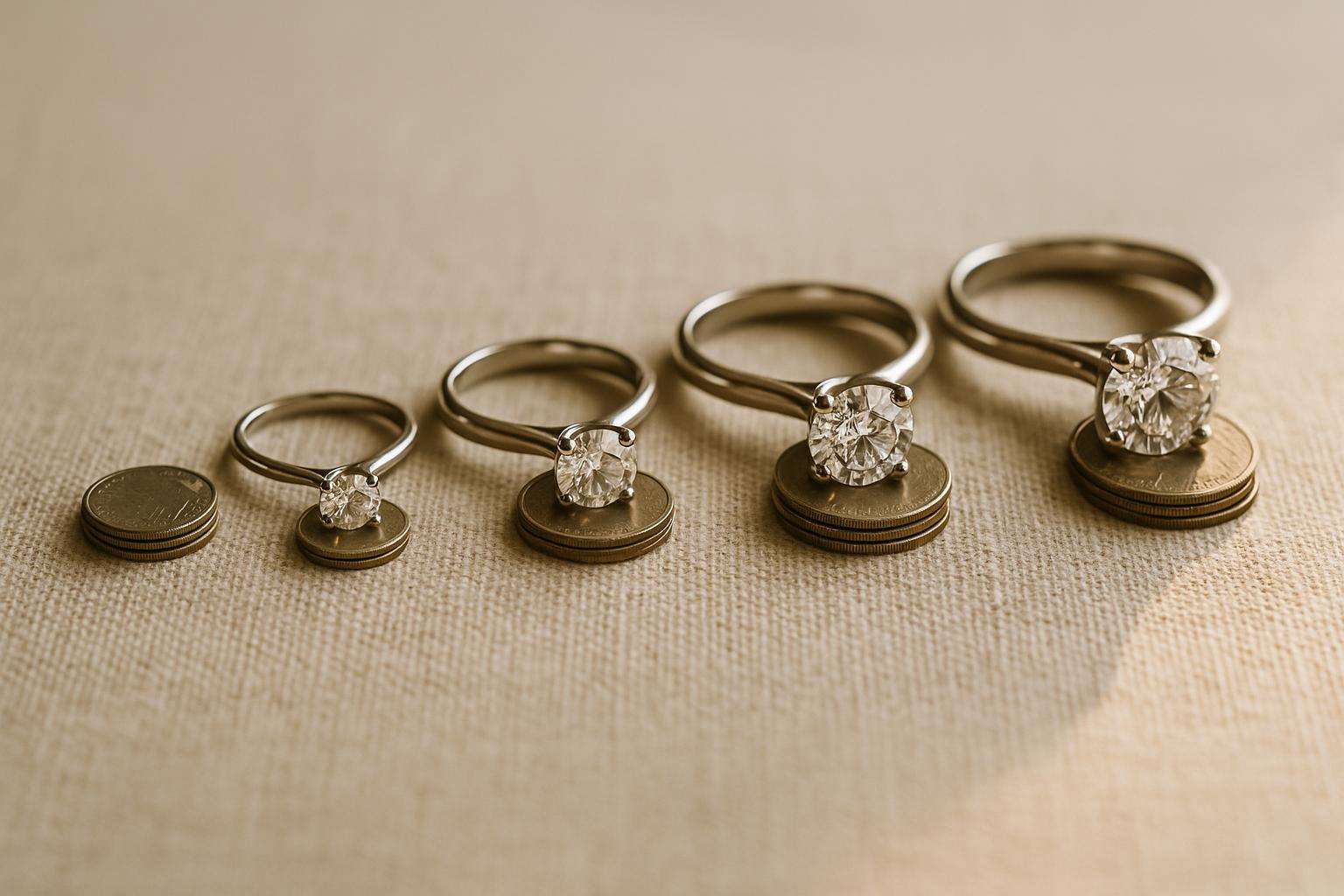
What your engagement ring budget actually buys has been restructured by two forces colliding in 2026: lab-grown diamond prices have fallen roughly 70–80% over five years (and are still declining), while gold prices have surged more than 70% since early 2025, pushing setting costs 40–50% higher. The net result is that center stones are dramatically more affordable — particularly lab-grown — but settings cost more than they have in years. The tier-by-tier breakdowns below reflect current real-retailer prices, not pre-2025 benchmarks.
The question isn't how much you spend. It's what you get for it. A $5,000 engagement ring in 2026 is a fundamentally different object than a $5,000 ring was three years ago — and understanding why requires looking at the two market forces running in opposite directions simultaneously. This guide maps each of four common budget tiers to their realistic specifications, using current pricing data from Goodstone, Brilliant Earth, Blue Nile, and Mark Schneider Fine Jewelry, cross-checked against BriteCo's 2025 appraisal dataset and live 2026 retailer searches.
One structural note before the tiers: as of June 2026, James Allen no longer operates as an independent website. Signet Jewelers announced in March 2026 that it would sunset JamesAllen.com and consolidate the brand into Blue Nile as a proprietary collection, citing a nearly 49% decline in James Allen's sales over two fiscal years. Blue Nile now carries a "By James Allen" collection. Any comparison shopping that previously included JamesAllen.com as a separate source should now route through Blue Nile directly.
What Does the 2026 Market Mean for Your Budget?
Two numbers set the 2026 context more clearly than any average engagement ring cost figure:
- Lab-grown diamond prices: down approximately 70–80% from 2021 levels, with wholesale continuing to fall in 2026 (though the quarterly rate of decline has slowed to roughly 4–5%). A 1.0-carat lab-grown diamond of excellent quality that cost $3,000–$4,000 loose in 2021 now runs $500–$1,500 depending on grades and retailer.
- Gold prices: approximately $4,700 per ounce as of May 2026, up from roughly $2,700 per ounce at the start of 2025 — a rise of more than 70% in 18 months. Setting prices across the industry have risen 40–50% over this period, with a standard 14K gold solitaire now running $1,000–$1,700 compared to $700–$1,100 in 2023.
The practical result: buyers who choose lab-grown stones have captured extraordinary center-stone value, but a meaningful portion of those savings has been offset by rising metal costs on the setting side. The strategy that maximizes ring for dollar in 2026 is to lean heavily on the lab-grown savings and accept a simpler setting — or to allocate the full budget to a natural diamond with minimal setting frills if provenance matters to you.
For the complete philosophy on how much to spend and how to allocate across stone and setting, see the Budget & Financing hub. For a focused breakdown of where the money goes inside a ring price — stone versus setting versus retailer markup — see where the money goes in a ring price.
What Does Under $1,500 Actually Buy?
This tier is more viable than it has ever been, but it requires a clear-eyed stone choice. A GIA-certified natural diamond of meaningful carat weight is essentially out of reach: a 0.50-carat natural round brilliant of passable quality (G–H color, VS2 clarity, Excellent cut) starts around $1,500–$2,000 for the loose stone alone, before a setting, making the $1,000–$1,500 all-in budget nearly impossible for natural stones.
The two viable paths are moissanite and lab-grown diamonds:
- Moissanite delivers the most visual presence per dollar at this tier. A 1.0-carat-equivalent Forever One moissanite from Charles & Colvard runs $300–$600 for the stone, and a complete 14K gold solitaire ring with a 1.0-carat round equivalent can be had under $1,000 from multiple retailers. Moissanite has a Mohs hardness of 9.25 (versus 10 for diamond), making it durable for daily wear. Its optical properties produce more colorful "fire" — rainbow flashes — than diamond, which some buyers love and others find less classically neutral. If the goal is maximum face-up size in a lifetime-wearable stone for under $1,000, moissanite in an elongated shape (oval or pear) on a simple 14K band is the defensible answer.
- Lab-grown diamonds at 0.40–0.60 carats are available for $200–$600 loose, leaving room for a setting within a $1,500 budget. The trade-off versus moissanite is carat weight: you'll get a smaller stone for the same money, but with the GIA or IGI certification and optical identity of a diamond.
The setting style at this tier is a solitaire — prong or bezel, in 14K gold. Halo and pavé designs add cost without room in the budget. A well-chosen prong solitaire in 14K white or yellow gold is not a compromise aesthetic; it is a timeless one.
| Stone Type | Typical Carat / Size | Approx. Stone Cost | Complete Ring (14K Gold Solitaire) | Key Trade-Off |
|---|---|---|---|---|
| Moissanite (Forever One, Charles & Colvard) | 1.0 ct equivalent | $300–$600 | $700–$1,100 | More fire than diamond; not a diamond |
| Lab-grown diamond (IGI-certified) | 0.40–0.60 ct | $150–$500 | $900–$1,500 | Smaller stone; diamond identity |
| Natural diamond (GIA-certified) | 0.25–0.35 ct | $400–$900 | $1,100–$1,800+ | Very small; natural provenance |
What Does a $3,000 Engagement Ring Look Like?
Three thousand dollars is where genuine choice opens up, and it is the rough midpoint of the real spending distribution: about one-third of U.S. buyers spend between $1,000 and $4,000, according to The Knot's 2024 Jewelry & Engagement Study. This tier supports a ring that is visually substantial, structurally excellent, and either lab-grown or natural depending on priorities.
Lab-grown path: A 1.00–1.20 carat lab-grown round brilliant in Excellent cut, G–H color, and VS2–SI1 clarity is available loose for $700–$1,400 from Blue Nile and Brilliant Earth, leaving $1,200–$2,000 for a 14K gold solitaire or simple pavé setting. The 4Cs priority order at this tier: Excellent cut first, always; G or H color (eye-white in any mounting); VS2 or an inspected eye-clean SI1 for clarity; use the setting budget to choose a design you love rather than upgrading clarity further, since VS2 is already beyond the eye-clean threshold for round brilliants under 2 carats.
Natural diamond path: $3,000 supports a GIA-certified 0.50–0.65 carat round brilliant of excellent quality in a 14K gold solitaire, or a 0.70–0.85 carat oval or pear shape — fancy shapes yield roughly 20–30% more face-up size per dollar than round brilliants because their elongated geometry covers more finger area and they command less of a demand premium in the cutting market. An oval at 0.75 carats in G/VS2/Excellent cut from Blue Nile runs approximately $2,200–$2,800 loose, leaving $200–$800 for a setting — tight but workable in a simple 14K prong solitaire.
Recommended 4C priorities at $3,000: never sacrifice cut; accept G–J color; target VS2 or inspected eye-clean SI1 for clarity. A $3,000 ring built around these priorities looks visually equivalent to rings costing significantly more.
What Does $5,000 Buy — and Why Is This the Sweet Spot?
The $5,000 tier is where the lab-grown diamond revolution has had its most dramatic effect. Goodstone's published 2026 price tables show a 1-carat natural diamond solitaire ring averaging approximately $6,307 and a 1-carat lab-grown equivalent at approximately $3,453 — putting the natural option just above this budget and the lab-grown option well within it, with room to spare for a better setting or a larger stone. BriteCo's 2025 appraisal data places the average lab-grown diamond ring at $5,187.55 versus $10,760.09 for a natural-diamond ring — a gap of $5,572, or 52%.
Lab-grown path at $5,000: A 1.50–2.00 carat lab-grown round brilliant in Excellent cut, D–H color, and VS2 clarity in a 14K or 18K gold setting. This combination would have cost $12,000–$18,000 five years ago with a natural diamond. Setting styles expand meaningfully at this tier: pavé bands, simple halo designs, and custom modifications are all viable. The 2.0-carat mark on a lab-grown stone in any decent setting is achievable for $4,000–$5,500 in 2026, making this a tier where buyers can have both substantial size and design complexity.
Natural diamond path at $5,000: A high-quality 0.80–1.00 carat round brilliant (GIA-certified, G–H color, VS2, Excellent cut) with room for a 14K gold solitaire or understated pavé setting. A 1.00-carat G/VS2/Excellent natural from Blue Nile's online marketplace runs approximately $4,000–$5,000 for the stone alone, putting simple setting options within reach. Alternatively, a 1.00–1.20 carat oval natural in G–H/VS2 delivers noticeably more face-up size and typically prices $500–$1,000 below a round of equivalent grade, fitting the $5,000 all-in budget more comfortably.
| Path | Typical Center Stone | Quality Grades | Setting Options | Resale Value |
|---|---|---|---|---|
| Lab-grown diamond | 1.50–2.00 ct round or fancy | Excellent cut, D–H color, VS2 | 14K/18K gold solitaire, pavé, or halo | 10–20% of purchase price |
| Natural diamond | 0.80–1.00 ct round or 1.00–1.20 ct oval | Excellent cut, G–H color, VS2 | 14K gold solitaire or simple pavé | 40–60% of purchase price |
What Does $10,000 Get You — and Is the Premium Justified?
Above $7,500–$8,000, buyers enter premium territory where the decisions shift from budget management to preference optimization. At $10,000, the realistic options are genuinely excellent — but the right choice depends entirely on what the buyer values most.
Natural diamond, maximum quality: A GIA-certified 1.00–1.25 carat round brilliant in E–F color and VS1 clarity — the top end of near-colorless and very slightly included — with a platinum solitaire setting runs approximately $7,000–$10,000 depending on source. Goodstone's 2026 pricing shows a 1.5-carat natural round diamond ranging $8,000–$13,000 loose; a $10,000 all-in budget therefore targets the lower-quality end of 1.5-carat natural or a high-quality 1.00–1.25-carat stone in a premium setting. Platinum adds approximately $800–$1,500 over 14K gold on a standard solitaire in 2026; at $10,000, platinum is a realistic choice.
Natural diamond, maximum size: A 1.25–1.50 carat oval or pear-shaped natural at G–H color and VS2 clarity in a 14K gold or platinum setting. Fancy shapes cost 20–30% less than equivalent round brilliants, allowing buyers to reach 1.5 carats naturally for $9,000–$12,000 all-in — squarely within or just above a $10,000 budget.
Lab-grown diamond, maximum impact: A 2.50–3.50 carat lab-grown in Excellent cut with top grades, in a premium platinum or 18K gold setting with design detail. At this tier, the visual statement is dramatic — stones that would register as genuinely large to any observer. A 3-carat lab-grown of excellent quality runs approximately $4,500–$9,000 loose in 2026, leaving ample budget for a complex setting.
Designer brand premium: At $10,000, buyers are also in the range where named designers — Tacori, Verragio, Gabriel & Co. — command premiums of 20–40% above equivalent independent jeweler work for the same stone and similar metalwork, reflecting brand design fees and marketing. The premium is aesthetic and reputational, not gemological. Buyers who purchase through high-volume online retailers at this price point capture that margin difference as additional stone quality or setting complexity. As a benchmark: Blue Nile and comparable online platforms price natural diamonds 20–40% below traditional brick-and-mortar stores, meaning a $10,000 online purchase often represents $13,000–$16,000 of ring at a conventional jeweler.
One note on certification at $10,000 and above: insist on GIA certification for natural diamonds in this range. IGI is the accepted standard for lab-grown stones and perfectly appropriate there; for natural diamonds above 1.0 carat, GIA's reputation for consistency and strictness directly protects resale value and buyer confidence. The GIA premium over an equivalent IGI-graded natural diamond is approximately 10–12% — a worthwhile expenditure when the stone costs thousands of dollars.
For guidance on financing any of these tiers responsibly, see engagement ring financing options compared. For a complete overview of the 4Cs framework that underpins every quality grade in this article, the diamond 4Cs guide is the place to start.
Frequently asked
What can you realistically get for a $3,000 engagement ring in 2026?
At $3,000, the most versatile choice is a lab-grown round brilliant of 1.00–1.20 carats in Excellent cut, G–H color, and VS2–SI1 clarity, set in a 14K gold solitaire or simple pavé band. Lab-grown diamonds at this quality grade are available from retailers including Brilliant Earth for under $2,000 loose, leaving $800–$1,000 for the setting. For buyers who prefer a natural diamond, $3,000 supports a high-quality GIA-certified 0.50–0.60 carat round brilliant, or a larger 0.70–0.80 carat fancy shape — oval or pear — that delivers more face-up visual presence per dollar. Prioritize Excellent cut above all else; a smaller, well-cut natural diamond will outperform a larger stone with poor light return. Roughly one-third of U.S. engagement ring buyers land in the $1,000–$4,000 range, making this the modal spend tier.
Is a $1,000 engagement ring too cheap?
No. A $1,000 budget is genuinely workable in 2026 with the right stone choice. A complete ring with a 1.0-carat equivalent moissanite center stone — silicon carbide with a Mohs hardness of 9.25, virtually indistinguishable from a diamond to the unaided eye, and rated with more optical fire — can be had from Charles & Colvard's Forever One collection or Brilliant Earth for well under $1,000 in 14K gold. A 0.40–0.50 carat lab-grown diamond in a simple solitaire also lands in this range. The design choice at this tier is straightforward: a clean prong or bezel solitaire in 14K gold puts the focus on the stone and avoids setting costs that would consume the entire budget. Elongated shapes — oval moissanite or oval lab-grown — maximize visual presence. What you cannot get at $1,000 is a GIA-certified natural diamond of meaningful carat weight; the minimum for a 0.5-carat natural in passable quality grades starts around $1,500–$2,000 loose. That said, the ring's symbolic meaning is independent of its material cost.
What does $5,000 buy in an engagement ring right now?
The $5,000 tier is widely cited by jewelers as the best-value window in the current market, and the data supports that reputation. With a lab-grown center stone, $5,000 funds a 1.50–2.00 carat diamond in Excellent cut, D–H color, and VS2 clarity in a 14K or 18K gold setting — a ring that would have cost $12,000–$18,000 five years ago with a natural diamond. Published price tables from Goodstone show a 1-carat lab-grown ring averaging $3,453 in 2026, leaving substantial room for an upgraded setting, a more complex design, or a push to 1.5–2 carats. On the natural diamond side, $5,000 supports a high-quality 0.80–1.00 carat round brilliant or a slightly larger fancy shape in a solitaire or understated pavé. Setting styles fully expand at this tier: wider bands, intricate pavé detailing, and hidden halo designs all become viable without forcing trade-offs on stone quality.
How much extra does gold's price surge add to ring costs in 2026?
Significantly. Gold surged from roughly $2,700 per ounce at the start of 2025 to approximately $4,700 per ounce by May 2026 — a rise of more than 70% in about 18 months. Because most engagement ring settings are made in 14K gold (58.3% pure gold), setting costs have climbed 40–50% across the industry over that span. A standard 14K gold solitaire setting that retailed for $800–$1,000 in 2023 now runs $1,200–$1,500 or more, depending on the design and jeweler. The practical implication: buyers at every tier are getting less setting for the same dollar, even as lab-grown diamond prices have continued falling. The combination — cheaper stones, costlier settings — means the best strategy is to allocate more of your budget to the center stone (where lab-grown offers 70–80% savings) and be willing to accept a simpler setting than you might have planned two years ago. Platinum adds a further $800–$1,500 over 14K gold on a standard setting in 2026; 14K is the pragmatic choice for budget-constrained buyers.
Does spending $10,000 on a ring mean you're getting a $10,000 diamond?
Not necessarily. The center stone typically accounts for 60–80% of total ring cost in a simple solitaire, but that percentage drops when settings become more elaborate. At $10,000, you might spend $6,000–$7,000 on a 1.50-carat natural diamond (GIA-certified, G color, VS1 clarity, Excellent cut) and $1,500–$2,000 on a platinum solitaire setting — which is an excellent allocation. Alternatively, the same $10,000 budget in a halo setting with pavé side diamonds could mean a smaller center stone (perhaps 0.80–1.00 carat natural) surrounded by a diamond-studded frame, where the setting consumes $3,000–$5,000. The spec breakdown that delivers the most visual impact at $10,000: a natural 1.25–1.50 carat round brilliant in Excellent cut, G–H color, VS2 clarity in a platinum solitaire or simple pavé setting. For buyers open to lab-grown, $10,000 supports a 2.50–3.50 carat center stone with a premium setting — a truly dramatic ring. Retailer markup also matters: Blue Nile and comparable online retailers price natural diamonds 20–40% below traditional brick-and-mortar stores, meaning $10,000 online often equals $14,000–$16,000 worth of ring at a mall jeweler.
Should I choose a lab-grown or natural diamond on a $5,000 budget?
It depends on what you prioritize. A lab-grown diamond at $5,000 delivers a significantly larger, higher-graded stone — roughly 1.5–2.0 carats at excellent quality — versus 0.80–1.00 carat natural for the same money. Lab-grown diamonds are physically and chemically identical to natural diamonds; they cannot be distinguished by sight or by a standard jeweler's loupe, only by specialized gemological equipment. The primary trade-off is resale value: natural diamonds retain approximately 40–60% of retail value on the secondary market, while lab-grown diamonds currently retain 10–20%. If you view the ring primarily as a personal symbol and not as a financial asset, the lab-grown stone represents extraordinary value. BriteCo appraisal data shows the average lab-grown diamond ring in 2025 cost $5,187 versus $10,760 for a natural-diamond ring — a saving of over $5,500 at the average market level, which could alternatively fund the honeymoon, wedding bands, or a down payment fund.