Diamonds & Stones
HPHT vs CVD Lab Diamonds: What the Difference Actually Means for You
Two growth methods, one identical chemical formula, and a handful of subtle differences that matter far less than the marketing suggests — a gemologist's plain-language breakdown.
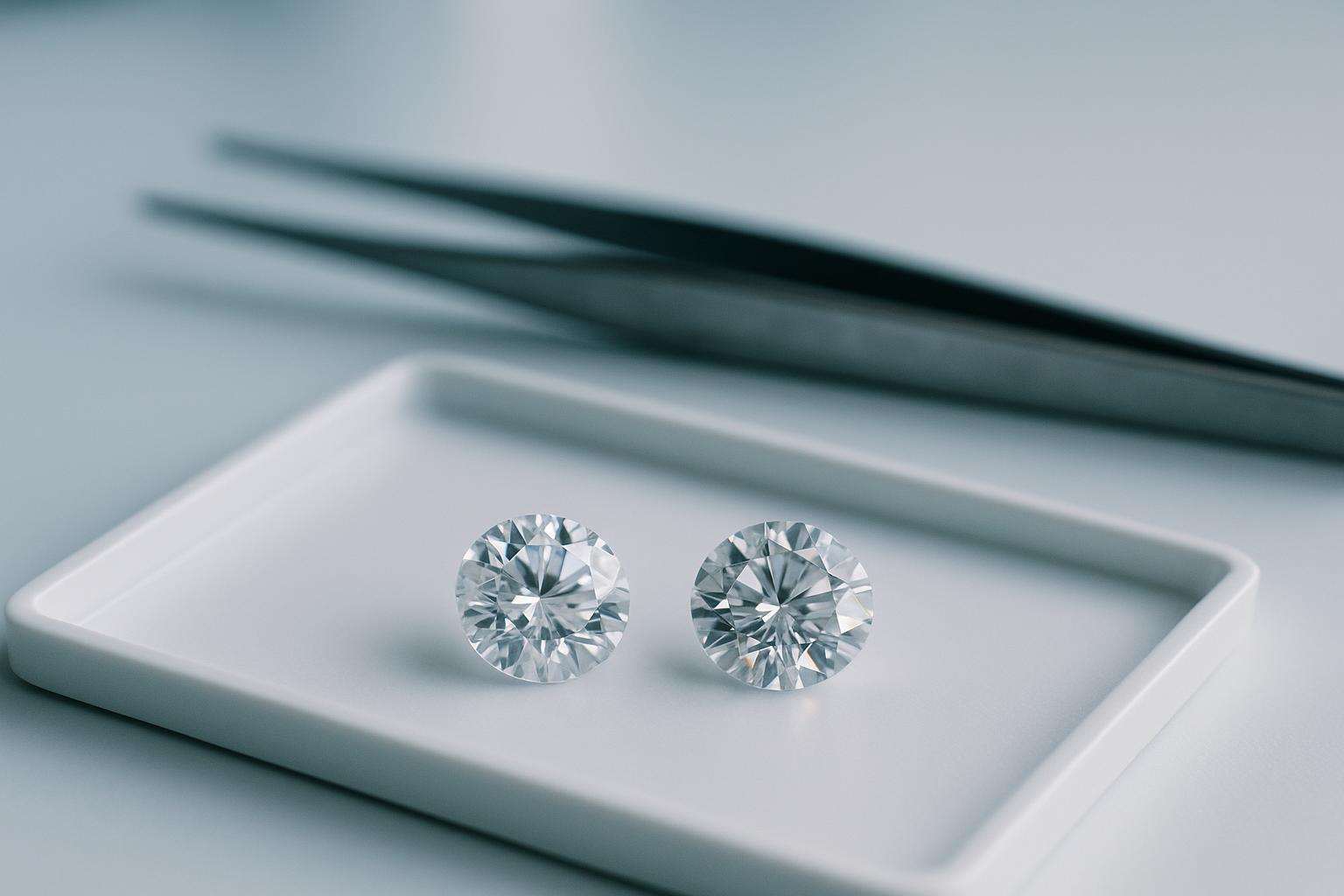
HPHT and CVD are the only two methods used to grow commercial lab diamonds. Both produce real diamonds — same hardness, same refractive index, same carbon crystal lattice as anything mined from the earth. They differ in growth conditions, impurity chemistry, and the size ranges they dominate: HPHT for stones up to roughly 1.5 carats, CVD for larger stones. The retail price gap between equivalent stones from each method is typically under 5%. For engagement ring buyers, the growth method is secondary information — the 4Cs on the certificate and the quality of that certificate are what determine the stone you actually see on a finger.
If you have spent any time browsing lab-grown diamond retailers, you have seen the HPHT/CVD distinction mentioned in product descriptions, filter menus, and FAQ tabs. It is often presented as though one method is clearly superior — and, depending on which retailer's site you are reading, each method is declared the winner. Neither claim withstands scrutiny. What the HPHT vs CVD distinction does reveal is a fascinating window into how two entirely different industrial processes arrive at the same atomic endpoint: a pure carbon crystal with cubic structure, identical in every meaningful property to a diamond that took a billion years to form sixty miles underground.
This article is grounded in GIA's peer-reviewed research on lab-grown diamond identification, published in Gems & Gemology in Summer 2024, alongside GIA's Spring 2025 lab notes and market data from Edahn Golan's Tenoris analytics. Where specific percentages or market statistics appear, sources are cited. If you are earlier in your lab-grown decision and want the full picture on lab-grown vs natural diamonds — price gap, resale, FTC disclosure rules — our lab-grown vs natural diamonds guide covers all of that ground.
How Does HPHT Diamond Growth Actually Work?
High Pressure High Temperature growth is the older of the two methods. It was pioneered by General Electric in the 1950s for industrial applications — producing diamonds hard enough for cutting tools — and was refined over decades into a process capable of gem-quality output. The principle is straightforward: replicate the conditions under which natural diamonds form inside the earth's mantle.
In practice, a small diamond seed crystal is placed inside a growth cell alongside a carbon source (most commonly graphite) and a metallic flux catalyst — typically an iron, cobalt, or nickel alloy. That cell is then loaded into a hydraulic press and subjected to pressures of approximately 5–6 gigapascals, equivalent to roughly 58,000–60,000 times normal atmospheric pressure, and temperatures above 1,400°C. Under these extreme conditions, the graphite dissolves into the molten metal flux and recrystallizes onto the seed diamond over a period of days to several weeks, growing outward layer by layer in a cubic crystal habit.
The physical constraints of the press itself define HPHT's commercial niche. The hydraulic engineering required to maintain those pressures limits the practical size of a single growth run; commercial HPHT production is most cost-effective for stones up to approximately 1.5 carats. Chinese factories — which dominate HPHT output globally — have optimized this process extensively for smaller gem-quality stones and for fancy-colored diamonds, particularly yellows and blues, where the controlled introduction of trace elements during growth produces vivid, consistent hues.
One gemological characteristic of HPHT growth that GIA's 2024 research documented in detail: the metal flux introduces trace boron into the crystal lattice. GIA's Gems & Gemology Summer 2024 study found that more than 80% of the HPHT D-to-Z diamonds submitted since 2020 contained detectable boron concentrations at the 2800 cm⁻¹ infrared absorption peak, classifying them as Type IIb rather than the Type IIa many in the trade assumed. Type IIb is the diamond type associated with natural blue diamonds like the Hope Diamond — but in HPHT colorless production, the boron concentrations are below any threshold that affects face-up color. It is a gemological fingerprint, not a quality defect.
How Does CVD Diamond Growth Work?
Chemical Vapor Deposition takes the opposite approach: instead of crushing carbon into a diamond under immense pressure, it grows diamond from a gas phase in a controlled low-pressure environment. A thin diamond seed plate — the same crystalline material as the finished gem — is placed inside a sealed vacuum chamber. The chamber is filled with hydrogen gas and a carbon-rich source gas, almost always methane (CH₄). Microwave energy or radio-frequency excitation ionizes the gas mixture into a plasma at temperatures of 900–1,200°C. In this plasma state, carbon atoms are energetically liberated from the methane and deposit — atom by atom, layer by layer — onto the seed plate below.
Growth cycles for gem-quality CVD stones typically run 2–6 weeks. The finished crystal is then cut from the seed plate, analyzed, and — in many cases — subjected to post-growth treatment before it becomes a finished polished diamond. This treatment step is important and worth understanding.
Post-growth HPHT annealing of CVD stones is a common, legal, and commercially widespread practice. As-grown CVD diamonds often exhibit a brownish or grayish body color caused by structural defects — primarily nitrogen-vacancy (NV) centers — introduced during the plasma deposition process. Applying high pressure and high temperature to the finished CVD rough corrects many of these defects and can dramatically improve color, converting a K-color as-grown stone into a D or E. The treatment is disclosed on GIA and IGI certificates. Gemologically, it leaves a detectable signature: sharp photoluminescence peaks in the 520–580 nm range observed during standard lab screening, described in detail in GIA's Spring 2025 lab notes.
CVD's capacity to produce larger stones — 2 carats and above — is why India's Surat manufacturing cluster expanded aggressively into this method after 2020. Edahn Golan's Tenoris retail analytics, which track the US bridal market, confirm the size division: HPHT dominates commercial production below 1.5 carats; CVD dominates at 2 carats and above, and faces correspondingly more pricing pressure at larger sizes as supply scaled to meet bridal demand.
HPHT vs CVD: A Direct Quality and Detectability Comparison
Both methods produce diamonds that pass thermal conductivity testers — the handheld “diamond testers” used in retail for decades — because both have the same thermal conductivity as natural diamonds. Detection requires purpose-built instruments or laboratory analysis. The table below summarizes the key gemological distinctions between the two growth types, drawn from GIA's published research.
| Characteristic | HPHT | CVD |
|---|---|---|
| Growth conditions | ~5–6 GPa pressure; >1,400°C; metal flux catalyst | Low pressure; 900–1,200°C; hydrogen + methane plasma |
| Diamond type (nitrogen/boron) | Predominantly Type IIb (boron detectable by IR); some Type Ib (nitrogen) | Predominantly Type IIa (negligible nitrogen or boron) |
| Inclusions specific to growth method | Metallic flux inclusions (Fe, Ni, Co): black, opaque, metallic luster in reflected light | Planar growth striations; NV-center defects; occasional SiV centers from reactor walls |
| DiamondView UV imaging | Sector-dependent fluorescence pattern; cubic/octahedral growth sectors visible | Red fluorescence; horizontal striated banding from layered growth |
| Photoluminescence (PL) signature | Sector-dependent defect emissions; NV centers; S2 or N3 peaks depending on treatment | NV⁰ at 575 nm; NV⁻ at 637 nm; SiV⁻ doublet at 736.6/736.9 nm; post-anneal peaks at 520–580 nm |
| Post-growth treatment | Less common; may receive irradiation for fancy color | HPHT annealing to improve color is widespread; disclosed on cert |
| Dominant size range (commercial) | Under 1.5 carats | 2 carats and above (also used at smaller sizes) |
| Primary production geography | China (dominant); also India, Russia, US | India (Surat, dominant at scale); also US, Singapore, UAE |
| Fancy color production | Especially suited: yellow (nitrogen), blue (boron) | Colorless D-F grades very common at Type IIa purity |
| Retail price difference vs equivalent CVD/HPHT | Typically <5% — 4Cs drive >95% of price | |
What the Grading Labs Say — and What Changed in 2025
Every major gemological laboratory — GIA, IGI, GCAL — identifies the growth method on certified lab-grown diamond reports. For buyers, this means the HPHT or CVD designation is a piece of disclosed information, not a hidden variable. GIA inscribes "Laboratory-Grown" on the girdle of every certified lab-grown diamond via laser engraving and identifies the growth process in the report body.
A significant institutional shift occurred on October 1, 2025: GIA replaced its traditional full 4Cs grading for lab-grown diamonds with a two-tier "Premium" or "Standard" quality assessment, at a per-carat fee of $15. GIA president Pritesh Patel stated that "GIA will no longer use the nomenclature created for natural diamonds to describe what is a manufactured product." This is a landmark institutional repositioning: the organization that invented the 4Cs is formally treating lab-grown diamonds as manufactured goods assessed on a different scale from mined stones.
IGI has stated it will continue full 4Cs grading for lab-grown diamonds — making it, in practice, the dominant certifier for buyers and retailers who want detailed grade documentation. Among all major online lab-grown retailers (James Allen/Blue Nile, Brilliant Earth, Clean Origin, VRAI), IGI is the primary certification body for lab-grown inventory. For resale data, Labrilliante's published figures show IGI-certified lab-grown stones command approximately 3–7% better secondary-market retention than GIA-certified lab-grown stones, reflecting IGI's continued full-grade documentation and its acceptance as the lab-grown market standard.
The practical consequence for buyers considering HPHT vs CVD at the certification level: both methods are equally identifiable and equally disclosed under current lab standards. Neither method evades detection at a qualified gemological lab. The challenge for screening is melee — small accent stones below 0.10 carats — where per-stone instrument time is impractical at commercial volumes. Rapaport Magazine's investigation into lab-grown diamond detection documented that major manufacturers such as Stuller deploy 62 screening instruments staffed by 40 associates, testing every stone individually using a minimum of two different technologies, with approximately 50,000 stones per year forwarded to an in-house GIA melee lab for additional analysis out of more than 5 million screened annually — a scale that illustrates the operational complexity of comprehensive melee screening.
How Does the Growth Method Affect Pricing in 2026?
Short answer: very little, directly. The two methods are priced at near parity in the retail market — typically less than 5% apart for stones of equivalent 4Cs grade — because consumers buy on cut, color, clarity, and carat weight, not on growth methodology. What does differ is the pricing trajectory each method faces at different size tiers.
Edahn Golan's Tenoris analytics documented a notable divergence in late 2025: sub-1.5-carat HPHT stones saw price increases of 10–20% as rough HPHT feedstock costs rose to approximately $10 per carat, establishing a production cost floor below which polished HPHT prices cannot sustainably fall. Meanwhile, larger CVD stones (2 carats and above) faced the most continued pricing pressure as Indian production capacity remained elevated. The overall lab-grown market saw wholesale prices decline 26% on a full-year basis in 2025, but the quarterly pace of decline decelerated sharply — Q4 2025 registered only a 4.7% quarter-on-quarter drop, the smallest since tracking began.
For buyers, this translates into a nuanced picture. If you are buying a 1.0-carat lab-grown round, you are almost certainly buying an HPHT stone, and its price has recently stabilized. If you are buying a 2.5-carat lab-grown round, you are almost certainly buying a CVD stone, and you are buying into a market where prices remain under gradual downward pressure from supply. Neither is a reason to avoid one method; both are reasons to buy at current market rather than wait for further declines that may not materialize at the rate they did from 2020–2024.
The resale picture is worth acknowledging, though lab-grown diamonds are best understood as a consumer purchase rather than an investment. CVD stones outperform HPHT by approximately 5–8% in secondary-market retention, attributed to their Type IIa purity profile and the absence of metallic inclusions. Both dramatically underperform natural diamonds in resale retention — lab-grown stones overall retain approximately 30–40% of their purchase price on the secondary market, versus 60–80% for natural diamonds. If long-term value retention matters to your decision, that gap between lab-grown and natural is far more consequential than the gap between HPHT and CVD. Our lab-grown vs natural comparison covers that question in full.
What Should Engagement Ring Buyers Actually Do With This Information?
Here is the honest practical summary: for most engagement ring buyers, HPHT vs CVD is the last thing to look at, not the first.
The growth method appears on every major-lab certificate. If you are buying a certified stone from a reputable retailer, the method is disclosed by default — you do not have to ask. The visual outcome of the two methods, in a finished, well-cut, well-graded diamond, is indistinguishable to any unaided human eye. The price difference is negligible. The quality difference is measurable under laboratory instruments but invisible in a mounted ring in any real-world lighting condition.
What matters in descending order of impact: the 4Cs of the specific stone; the certifying lab (IGI for full 4Cs documentation on lab-grown; GIA's new Premium/Standard grading if you are comfortable with less granularity); whether the stone has been treated (disclosed on the certificate); and the retailer's return and warranty policy. After all of that is confirmed, if you still want to specify CVD for the slightly better resale data or HPHT for its established track record in smaller colorless grades, that is a perfectly reasonable refinement — it is just not the decision that determines whether you end up with a beautiful ring.
For context on what the 4Cs mean in practical buying terms, our diamond 4Cs guide is the right place to start before stone shopping of any kind.
Frequently asked
Is HPHT or CVD better for an engagement ring?
Neither method is categorically better — the finished 4Cs grade of the individual stone matters far more than how it was grown. Both HPHT and CVD produce diamonds that are physically, chemically, and optically identical to natural diamonds, with the same hardness (10 Mohs), refractive index (2.42), and carbon crystal structure. The retail price difference between equivalent HPHT and CVD stones is typically less than 5%, since the 4Cs drive more than 95% of pricing. What matters at the buying stage is the GIA or IGI certificate grading the specific stone, not the growth method box checked on the report. That said, CVD diamonds have a slight edge in secondary-market resale data — approximately 5–8% better retention — attributed to their Type IIa purity characteristics and fewer metallic inclusions. For a ring bought and worn rather than eventually sold, that difference is largely irrelevant to daily experience.
Can you tell HPHT and CVD diamonds apart with the naked eye?
No. To the naked eye, and under standard 10× loupe magnification used in retail, HPHT and CVD diamonds are indistinguishable from each other and from natural diamonds. Detection requires specialized instrumentation — specifically, short-wave UV imaging (DiamondView), photoluminescence spectroscopy, infrared absorption spectroscopy, or Raman spectroscopy. The GIA, IGI, and GCAL run multi-method protocols on all submitted stones and note the growth method on the certificate. The practical implication for buyers: if a stone is certified by a major lab, the growth method is already documented and disclosed. If a stone lacks a certificate, you have no reliable way to know its origin or growth method without sending it to a gemological laboratory.
Why does HPHT dominate at smaller sizes and CVD at larger sizes?
It comes down to the physical constraints of each growth process. HPHT uses a hydraulic press that applies up to 60,000 atmospheres of pressure to a small growth cell; the mechanical engineering limits limit the practical size of single-crystal growth runs, making HPHT most economical for stones up to approximately 1.5 carats. CVD grows diamonds layer by layer inside a sealed plasma chamber — a slower process but one that can be configured to produce larger seed plates and, over a 2–6 week cycle, yield gem-quality stones of 2 carats and above. India's Surat manufacturing cluster, which dramatically expanded CVD capacity after 2020, has become the dominant global source of larger CVD gem stones. Edahn Golan's Tenoris retail analytics confirmed this size split is reflected clearly in the US bridal market as of Q3 2025.
Does it matter whether a lab diamond is HPHT or CVD for insurance or appraisal?
For insurance purposes, growth method has no material bearing on coverage or premium — what insurers care about is the replacement value documented on the appraisal, which is based on the 4Cs and current market pricing. For appraisal, a qualified appraiser will note the growth method (it appears on the GIA or IGI certificate) but the valuation is based on like-for-like replacement in the current lab-grown market, not any HPHT/CVD premium. Since both methods sell at nearly equivalent retail prices, the appraised replacement value will be essentially the same. What matters for your appraisal and insurance is that the stone has a current major-lab certificate and that the appraisal is updated every few years — lab-grown diamond prices have changed rapidly enough that a 2022 appraisal may significantly overstate today's replacement cost.
What did GIA's 2024 study find about HPHT diamonds and boron?
GIA's Gems & Gemology Summer 2024 research paper on lab-grown diamond identification included a significant finding that overturned earlier assumptions about HPHT diamond chemistry: more than 80% of the HPHT D-to-Z diamonds submitted to GIA since 2020 contained detectable concentrations of boron via infrared spectroscopy at the 2800 cm⁻¹ peak. This uncompensated boron classifies them as Type IIb diamonds rather than the Type IIa classification many in the trade had assumed for HPHT stones. Type IIb is the category associated with natural blue diamonds like the Hope Diamond. The boron enters during the metal flux growth process and appears to be a widespread characteristic of modern HPHT production. For buyers, this finding has no practical quality implication — the boron concentrations involved do not affect color or clarity in the D-to-Z range — but it is a gemological identifier that helps labs distinguish HPHT origins.
What is post-growth HPHT annealing, and why does it matter for CVD diamonds?
Post-growth HPHT annealing is a treatment applied to some CVD-grown diamonds after they come out of the growth chamber. As-grown CVD diamonds often have a brownish or grayish body color caused by structural defects introduced during layer-by-layer deposition. Subjecting the finished CVD stone to high pressure and high temperature in an annealing process corrects many of these defects, improving color — sometimes dramatically, turning a J or K color stone into a D or E. The treatment is legal and common, but it must be disclosed per FTC guidelines. Gemologically, it leaves a detectable fingerprint: additional sharp photoluminescence peaks in the 520–580 nm range that GIA and other labs observe during standard multi-method screening. Post-growth-treated stones are noted on GIA certificates. Buyers purchasing CVD stones in the D-F colorless range at unusually low prices should confirm their certificate discloses or is clear of post-growth color treatment.