Diamonds & Stones
Diamond Color Scale D–Z: Where the Real Value Is
The GIA's 23-grade color scale separates diamonds that cost a fortune from diamonds that look identical — once you know which grades actually matter face-up.
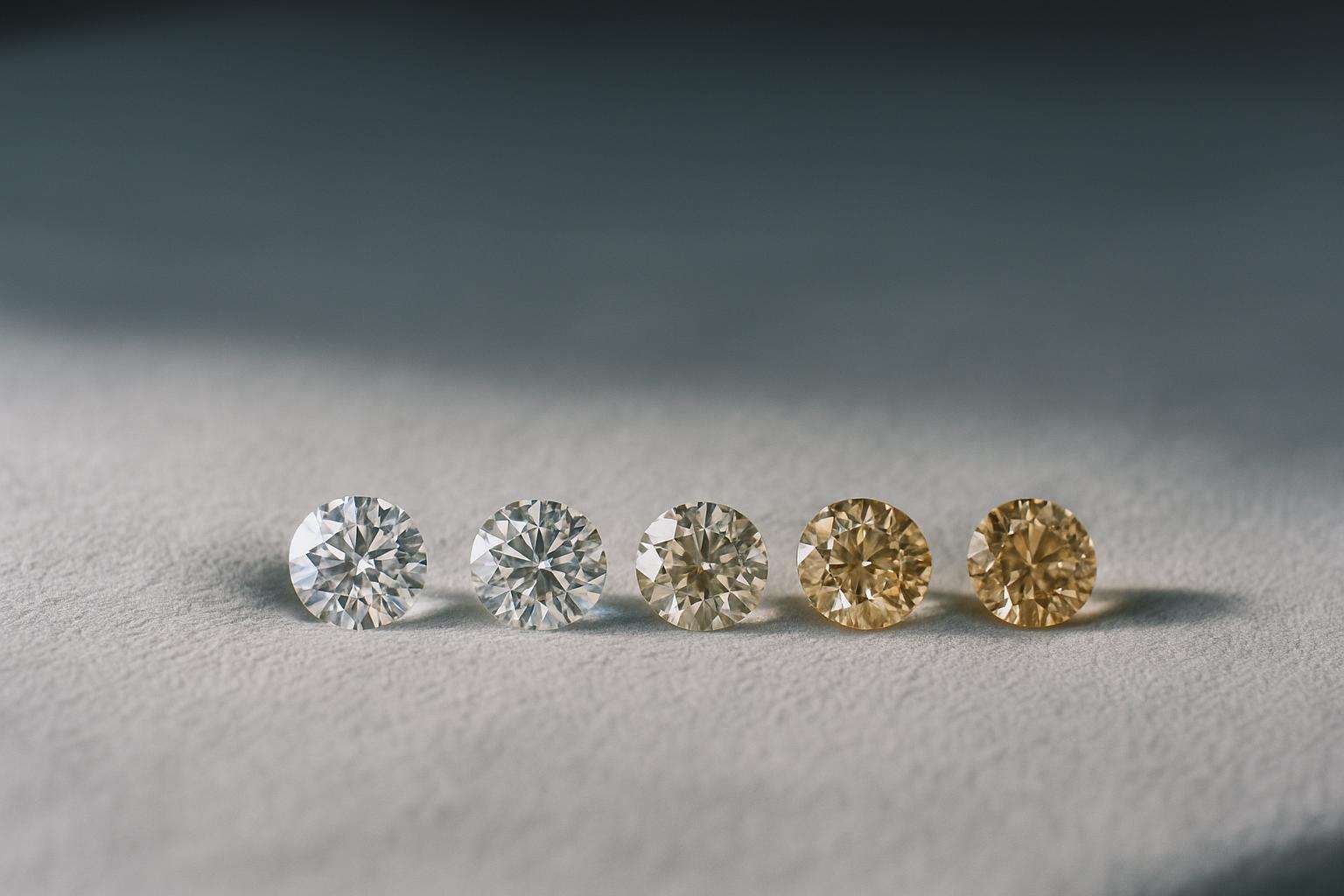
GIA's D-to-Z diamond color scale measures yellow or brown body color across 23 grades in five groups. For engagement-ring buyers, the entire practical decision lives in the Near-Colorless range (G–J): stones in this group appear white face-up in a mounted ring and cost 25–50% less than top-grade D–F stones with no visible beauty difference. Metal choice shifts the equation further — yellow and rose gold neutralize warmth so effectively that buyers in those settings can drop one or two grades versus white-metal buyers and still see an identical face-up result.
In the early 1950s, a GIA researcher named Richard T. Liddicoat and his colleagues at the Gemological Institute of America needed to impose order on a diamond market where color grading had become a chaos of inconsistent regional systems — some using A, AA, and AAA; others using Roman numerals; still others using trade terms like "River," "Wesselton," and "Cape" inherited from the South African mining vocabulary. Their solution was elegant: start the scale at D, a letter with no prior gemological associations, and work downward through the alphabet as body color increases. No dealer could claim their existing "A" grade stones were equivalent to the new top grade, because there was no A. The resulting D-to-Z scale has governed every serious diamond transaction on earth for more than 70 years.
Understanding what that scale actually measures — and where the value genuinely lives within it — is one of the most financially consequential pieces of diamond knowledge a buyer can acquire before walking into a conversation with a jeweler or clicking through an online retailer's inventory. The difference between choosing D and choosing G on a 1.5-carat natural diamond can be $2,500 or more. The difference in what you see in the ring: nothing.
What Does the GIA Color Scale Actually Measure?
The D-to-Z scale measures body color: the intrinsic yellow or brown tint present in a white diamond, caused by trace amounts of nitrogen atoms incorporated into the diamond's carbon lattice during formation. The more nitrogen present, the more yellow the stone. The scale runs from D — complete absence of detectable body color — down to Z, where yellow or light brown saturation is obvious and unmistakable.
GIA divides the 23 grades into five named groups, each with practical implications for what buyers actually see in a finished ring:
| Group | Grades | Face-Up Appearance (Mounted) | Best Metal Pairing | Buyer Profile |
|---|---|---|---|---|
| Colorless | D, E, F | No detectable color; D–F differences require master-stone side-by-side comparison | Platinum or white gold (max contrast) | Collectors; buyers who value certificate perfection; long-term investment stones |
| Near-Colorless | G, H, I, J | G–H appear white face-up in all settings; I–J appear white in yellow/rose gold, may show faint warmth in white metal | G–H: any metal; I–J: yellow or rose gold for maximum warmth-masking | Most engagement-ring buyers; the value sweet spot |
| Faint | K, L, M | Noticeable warmth visible face-up in most settings; soft, vintage quality in yellow gold | Yellow gold; antique or vintage settings | Budget-driven buyers; those drawn to warm, antique aesthetics |
| Very Light | N–R | Clearly visible yellow tint in any setting | Yellow gold only | Significant budget constraint; large-carat-weight priority over color |
| Light | S–Z | Obvious yellow or light brown saturation approaching fancy-color intensity | Yellow gold; intentional warm or champagne aesthetic | Buyers intentionally choosing a champagne look; consider GIA Fancy color grade instead |
One critical grading nuance: GIA evaluates color by placing the diamond table-down on a white grading tray and viewing it through the pavilion under standardized fluorescent daylight-equivalent lighting. This is the opposite of how you view a diamond in a ring — face-up, table toward you, in ambient room light. Body color that is detectable table-down in a grading environment is frequently invisible face-up in a mounted ring, which is why G and H diamonds that show measurable tint on a grading tray appear white and bright when worn. The grading methodology is rigorous, consistent, and well-calibrated for comparing stones against each other — it is not calibrated to predict what you will see across your finger at a candlelit dinner.
Where Is the Real Value on the Color Scale?
The honest answer is a tight range: G through I, with the right metal pairing, delivers face-up appearance indistinguishable from D–F at pricing that is 25–50% lower depending on the specific grade and carat weight. Here is how each Near-Colorless grade performs in practice.
G Color: The Near-Colorless Gateway
G is widely recognized among independent gemologists as the best value entry point on the color scale. It sits at the top of the Near-Colorless group, just one grade below Colorless F. In a mounted ring viewed face-up under normal lighting — indoor, outdoor, candlelit, fluorescent — G appears completely white to virtually every unaided observer. The faint body color detectable in a side-by-side master-stone comparison simply does not translate to the viewing conditions of everyday wear.
The price difference versus D is meaningful at every carat level. At the 1.00-carat round brilliant benchmark (VS2 clarity, Excellent cut), a G-color stone runs approximately $4,500–$7,000 versus $6,500–$9,500 for D — a saving of approximately 25–30%. At 1.50 carats the gap widens further; a G-to-D choice can represent $2,500–$4,000 in cost. That saving is real money that can alternatively fund a step up in carat weight, a platinum setting instead of white gold, a better clarity grade, or simply a reduced total outlay.
G is the pragmatic choice for buyers who want the confidence of unquestionable whiteness without paying the rarity premium that D, E, and F command. It is the grade at which beauty and value converge most cleanly.
H Color: The Overlooked Middle Ground
H occupies a comfortable second position. In most lighting conditions and from normal viewing distances, H diamonds appear white and bright. The warmth of an H stone is most noticeable when the stone is removed from its setting and placed table-down on a white background for direct comparison — a scenario that does not arise in the context of wearing the ring.
H performs particularly well in yellow gold settings. Yellow gold reflects a warm amber tone upward into the diamond's pavilion, neutralizing any residual warmth in the stone and making it appear fully white face-up. This physical interaction between setting metal and stone color is one of the diamond trade's best-kept practical secrets: an H-color diamond in an 18k yellow gold pavé setting looks as white and bright as an F-color diamond in platinum, at a cost savings of 35–40% on the center stone alone.
H is also a strong choice in rose gold, which similarly warms the stone's visual temperature. In white gold or platinum, H is still an excellent performer — the faint warmth exists but requires side-by-side comparison to perceive. At approximately $4,000–$6,500 per carat at the 1.00-carat VS2 Excellent benchmark, H represents roughly 35–40% savings versus D of identical cut, clarity, and carat weight.
I Color: The Yellow-Gold Specialist
I color sits at the lower edge of the Near-Colorless group, and the grade behaves differently depending on setting and viewing conditions in a way that G and H do not. Approximately half of I-color diamonds appear fully white face-up in any setting; the other half display a very slight warmth that becomes more apparent in the high-contrast environment of platinum or white gold, where the cool metal amplifies the difference. In yellow gold or rose gold, I color diamonds consistently look white face-up because the warm metal neutralizes any tint effectively.
This means I color is not universally the right choice — it depends on the setting. For buyers committed to a yellow or rose gold design, I represents an exceptional value proposition: approximately $3,500–$5,500 per carat at the 1.00-carat VS2 Excellent benchmark, roughly 45–50% below D. In white metal, I works well but requires individual stone inspection rather than grade-based confidence alone. The combination of stone viewing tools available at retailers like Blue Nile and James Allen — particularly the latter's 360-degree 20x HD video viewer — makes it practical to evaluate face-up warmth on a specific I-color stone before purchasing, rather than trusting a grade alone.
One additional asset worth knowing at the I grade: GIA fluorescence. A diamond graded I color with Medium or Strong Blue fluorescence glows faintly blue under UV wavelengths present in natural daylight and many indoor fluorescent environments. That blue glow counteracts the stone's slight yellow body color, making it appear one or more grades whiter in everyday viewing conditions. Blue fluorescence at I or J is a genuine performance asset — the stone physically looks better in real-world conditions than its grade on paper suggests. At D–F, strong fluorescence slightly depresses trade value. At I–J, it is an advantage. The International Gem Society provides detailed guidance on evaluating fluorescence by color grade for buyers who want to explore this further.
How Much Does Each Color Grade Step Cost?
Price decreases approximately 8–12% with each step down the color scale, holding cut, clarity, and carat weight constant. The compounding effect across several grades is significant. At 1.00 carat (round brilliant, VS2 clarity, Excellent cut), 2026 benchmark retail pricing shows:
| Color Grade | Group | Approx. Retail Range | Savings vs. D | Face-Up in White Metal |
|---|---|---|---|---|
| D | Colorless | $6,500–$9,500 | — | Completely colorless |
| E | Colorless | $6,000–$9,000 | ~5–8% | Completely colorless |
| F | Colorless | $5,500–$8,500 | ~10–15% | Completely colorless |
| G | Near-Colorless | $4,500–$7,000 | ~25–30% | White face-up; indistinguishable from D–F when mounted |
| H | Near-Colorless | $4,000–$6,500 | ~35–40% | White face-up; warmth visible only in side-by-side comparison |
| I | Near-Colorless | $3,500–$5,500 | ~45–50% | White in yellow/rose gold; slight warmth possible in white metal |
| J | Near-Colorless | $3,000–$5,000 | ~50–55% | Faint warmth visible in white metal; white in yellow gold |
| K | Faint | $2,500–$4,000 | ~55–60% | Noticeable warmth in most settings; suited to vintage aesthetics |
Pricing data from The Diamond Price's 2026 price chart and cross-referenced against live James Allen and Blue Nile inventory. Ranges reflect market variation; individual stones will fall within or near these bands depending on retailer, exact proportions, and fluorescence. At 1.50 carats, a D-to-G color difference represents approximately $2,500–$4,000. At 2.00 carats, that gap can approach $8,000–$15,000 — making color-grade selection one of the highest-leverage financial decisions in the entire ring-buying process.
Does Diamond Shape Change Which Color Grade to Choose?
Yes, meaningfully. Brilliant-cut shapes — rounds, ovals, cushions, pears, marquises, radiants — scatter and reflect light in multiple directions simultaneously, which effectively breaks up and masks body color within the stone's brilliance. This forgiving optical behavior means body color is harder to detect face-up in these cuts, making G and H safe and H and I often viable. The round brilliant is the most forgiving of all; its 58 precisely angled facets maximize this light-scattering effect.
Step-cut shapes — emerald and Asscher cuts — operate on entirely different optical principles. Their large, parallel, open-table facets create the celebrated hall-of-mirrors effect, but those same facets also function as windows into the diamond's interior. Body color pools visibly in the corners and along the facet planes of a step cut in a way that is nearly invisible in a brilliant cut. Emerald-cut buyers who tolerate H color in a round brilliant should typically target G in an emerald cut; buyers considering I in a round brilliant should step up to H or even G in an emerald or Asscher. Step cuts also interact more dramatically with fluorescence; a Medium Blue fluorescence designation can appear as an undesirable blue cast in a large-table emerald cut under fluorescent lighting where a round brilliant would simply appear white.
The same principle applies at larger carat weights: a larger table surface means more color pools visibly at the stone's face. A 2.00-carat round can comfortably absorb H color; a 3.00-carat round in H may show warmth that a 1.00-carat H does not. For buyers targeting 2.00 carats and above in any shape, consider stepping up one color grade relative to what you would choose at 1.00 carat. Our diamond shapes guide covers the full shape comparison including how each cut's optical character interacts with all four 4Cs.
The Myth of the D-Color Upgrade
One of the most persistent myths in diamond retail is that buying D color provides a visible quality upgrade over G or H. It does not, in the context of a mounted engagement ring worn in everyday life. This is not a budget rationalization — it is a direct consequence of how GIA's grading methodology works and how the human eye perceives color in three-dimensional objects surrounded by reflective metal.
The premium paid for D over G is a rarity premium and, to some extent, a certificate premium. Buyers who value the investment or collector dimension of the stone — who may trade it at the wholesale market in 10 years, who want the documentation to confirm a provenance purchase — have legitimate reasons to choose D. For buyers whose primary goal is a beautiful ring that looks spectacular on the hand, G delivers identical visible results at a meaningfully lower cost.
That freed-up budget is not hypothetical. On a 1.5-carat diamond, choosing G over D while holding cut, clarity, and carat weight constant saves approximately $2,500–$4,000. That is a meaningful platinum setting upgrade from white gold. It is a clarity step from VS2 to VVS1 for buyers who want that assurance. It is the difference between a 1.40-carat and a 1.60-carat stone with identical visible quality. The 4Cs are a system for optimizing across four variables — and color, uniquely, is the one where the grade on paper and the appearance in a ring diverge most dramatically. Using that divergence intelligently is what separates informed buyers from buyers who pay for distinctions they cannot see.
For buyers also weighing clarity decisions alongside color, our clarity and eye-clean threshold guide covers VS1, VS2, and SI1 by shape with the same practical, grade-to-appearance framework applied here. And if the broader 4Cs context is useful first, the Diamond 4Cs guide covers the full framework — cut, color, clarity, and carat — with the priority order that governs every trade-off decision.
Frequently asked
What is the best diamond color grade for an engagement ring?
G or H is the practical sweet spot for the vast majority of engagement-ring buyers, regardless of budget tier. Both grades fall in GIA's Near-Colorless group (G–J) and appear visually indistinguishable from the higher-priced Colorless grades (D–F) when the diamond is mounted and viewed face-up under normal lighting. The warmth detectable in a G or H stone requires side-by-side comparison against a master stone on a controlled white background — a viewing condition you will never replicate wearing the ring. G color typically runs 25–30% less than D of otherwise equal cut, clarity, and carat weight. On a 1.5-carat purchase that saving can approach $2,500. H performs similarly in yellow or rose gold settings, where the warm metal tone blends with any residual warmth in the stone and renders tint essentially invisible. Only choose D–F if the rarity designation matters to you — you are paying for a certificate distinction, not a visible beauty difference.
Can you see the difference between D and G color diamonds?
Not in a mounted ring under normal lighting. The difference between D and G color — or even D and H — is imperceptible to the unaided human eye when a diamond is set in a ring and viewed face-up. Even trained gemologists require a side-by-side comparison against GIA master stones to distinguish consecutive grades reliably. The visual difference between D and F is essentially undetectable without controlled comparison. The premium paid for D over G is a rarity premium: you are paying for the perfection of the grading certificate, not for a beauty improvement you or anyone looking at the ring will actually perceive. For buyers who value the investment or collector dimension of the stone, D makes sense. For buyers prioritizing face-up appearance per dollar spent, G delivers identical visible results at a substantially lower price.
How does metal color affect which diamond color grade to choose?
Metal setting color is one of the most underappreciated variables in color-grade selection. Platinum and white gold provide a cool, bright backdrop that reflects back into the diamond's pavilion — and that cool reflection can make any residual yellow tint in the stone more visible by contrast. In white-metal settings, G or H is the practical minimum for a face-up white appearance; I color works in white gold but requires individual stone inspection. Yellow gold reflects a warm amber tone upward into the diamond, effectively neutralizing any yellow body color in the stone and making even I and J color grades appear white and bright face-up. Rose gold similarly warms the stone's face-up appearance. The practical implication: buyers choosing yellow or rose gold can comfortably drop one to two color grades compared with white-metal buyers — saving 15–25% on color — without any visible loss in face-up whiteness. An H in yellow gold looks as white as an F in platinum, at a fraction of the price.
What does fluorescence do to diamond color appearance?
GIA reports fluorescence — the tendency of some diamonds to glow blue (or occasionally yellow) under ultraviolet light — separately from the color grade. For most buyers it is a secondary consideration, but it has one practical use. Medium or Strong Blue fluorescence at the I or J color grade can make a slightly warm stone appear one or more grades whiter in natural daylight and fluorescent-lit indoor environments, because those light sources contain UV wavelengths that activate the blue glow and counteract yellow body color. This means a well-priced I-color stone with Strong Blue fluorescence can appear as white face-up as a G or H with no fluorescence — at a lower price. For Colorless D–F stones, strong fluorescence is generally viewed as a mild negative by the trade, slightly depressing resale value (though the GIA notes it affects fewer than 35% of graded diamonds). For G–H, fluorescence is a non-event either way. Never avoid fluorescence categorically; evaluate it grade by grade.
What are the five GIA diamond color groups?
GIA's D-to-Z scale organizes its 23 grades into five named groups. Colorless (D–F): no detectable color even under controlled comparison; maximum rarity premium. Near-Colorless (G–J): appear white face-up in a mounted ring; the practical sweet spot for engagement-ring buyers. Faint (K–M): noticeable warmth visible face-up in most settings; best suited to yellow gold and vintage or antique aesthetics. Very Light (N–R): clearly visible yellow tint in any setting. Light (S–Z): obvious yellow or light brown saturation, approaching the intensity of GIA's Fancy color range. For engagement-ring purposes, the actionable decision space runs from D to approximately J in white-metal settings, or D to K in yellow gold, depending on aesthetic preference and budget.
Is an I color diamond a good choice?
Yes, with the right pairing. I color sits at the lower edge of GIA's Near-Colorless group, and roughly half of I color diamonds appear fully white face-up; the other half display a very faint warmth that becomes more visible in platinum or white gold settings, where the cool metal provides a contrasting backdrop. In yellow or rose gold, I color diamonds consistently appear white face-up because the warm metal tone counteracts any residual tint in the stone. At a 1.00-carat round brilliant with VS2 clarity and Excellent cut, an I color stone costs approximately $3,500–$5,500 at major online retailers — representing roughly 45–50% savings versus an identical D color stone. Blue fluorescence rated Medium or Strong by GIA is a meaningful asset at the I grade, as it further whitens the stone's face-up appearance in daylight. Always inspect an I color stone individually via a retailer's high-resolution video tool rather than relying on the grade alone.
How much cheaper are H and I color diamonds compared to D?
The price gap is substantial and grows with carat weight. For a 1.00-carat round brilliant at VS2 clarity and Excellent cut, benchmark retail pricing in 2026 shows: D color at approximately $6,500–$9,500; G color at approximately $4,500–$7,000 (roughly 25–30% less than D); H color at approximately $4,000–$6,500 (approximately 35–40% less than D); and I color at approximately $3,500–$5,500 (approximately 45–50% less than D). Each step down the color scale saves roughly 8–12% versus the grade immediately above it. These percentage savings compound at higher carat weights: at 2.00 carats, a D-to-G color difference can represent $8,000–$15,000 in price for an otherwise identical stone. The savings from choosing G over D can fund a meaningful upgrade in carat weight, clarity, or setting quality — all of which may deliver more visible value than the color distinction itself.