Diamonds & Stones
Diamond Shapes Compared: All 10 Engagement Ring Styles
From the timeless round brilliant to the comeback marquise, here is every diamond shape ranked by face-up size, price, and finger-flattering power.
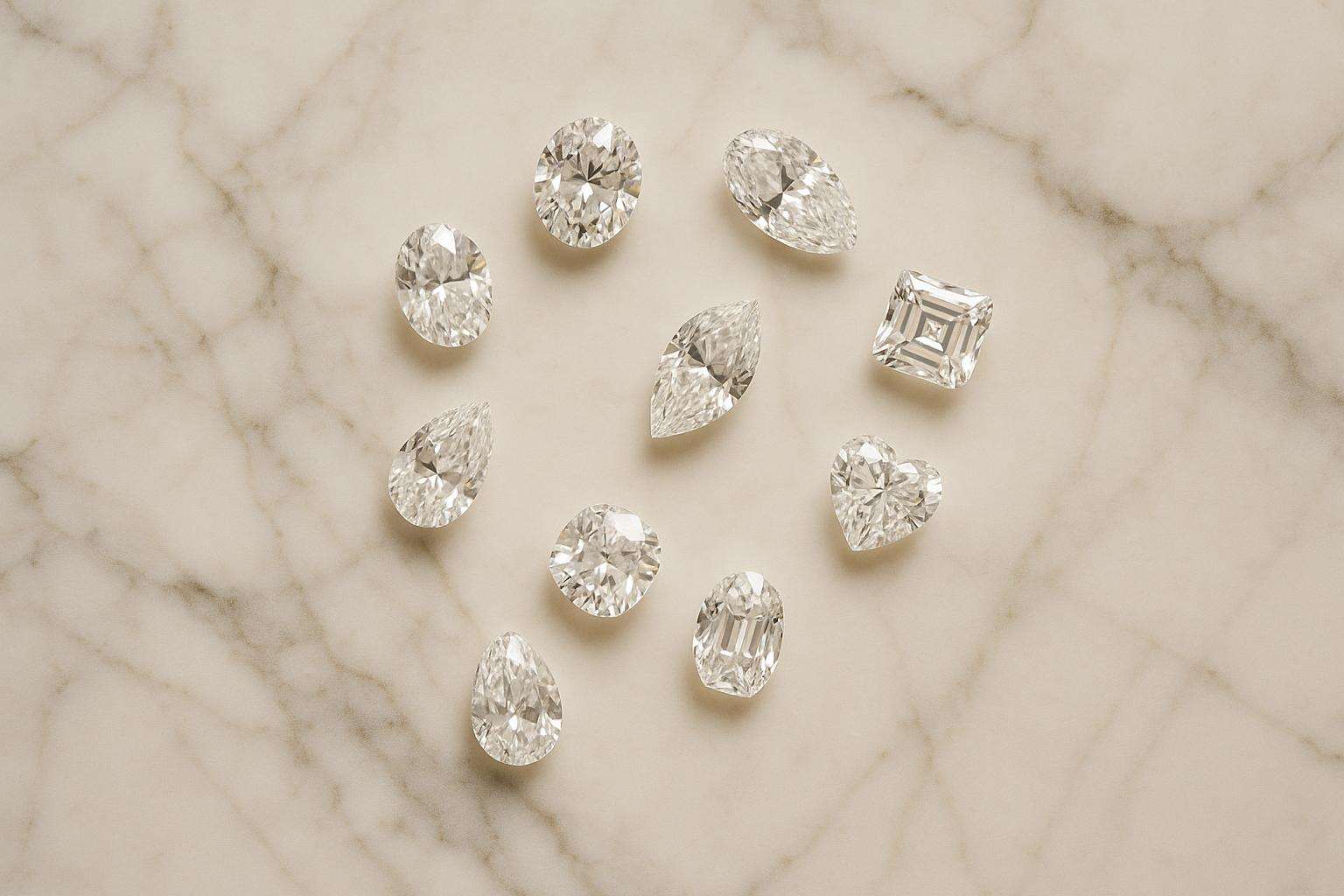
Round brilliant diamonds maximize brilliance and carry the highest per-carat price. Elongated shapes — oval, marquise, and pear — look 10–30% larger on the hand and cost 15–35% less than rounds. Step cuts (emerald, asscher) trade sparkle for glamour but demand higher clarity grades. Your choice of shape is the single biggest lever on both look and budget.
Walk into any fine jeweler — or scroll through Blue Nile's inventory on a lunch break — and you will face ten distinct diamond silhouettes, each with its own price, personality, and performance characteristics. The round brilliant has held the top position in U.S. engagement ring sales for generations. But according to The Knot's 2026 Real Weddings Study, which surveyed 10,474 couples married in 2025, round and oval are now nearly tied — 28% and 25% respectively — with emerald cut surging 50% year-over-year and the marquise staging one of jewelry's more dramatic comebacks.
This guide covers everything that actually changes by shape: face-up surface area per carat, the price hierarchy from most to least expensive, finger-flattering geometry, optical characteristics, and the bow-tie shadow that lurks inside poorly chosen elongated stones. The comparison table gives you a single reference for all ten shapes.
What actually changes between diamond shapes?
A diamond's shape is the outline you see from above — round, square, rectangular, elongated. The cut is the quality of the faceting work within that shape. These are different things, and conflating them is the source of most buyer confusion.
Four variables move meaningfully across shapes:
- Price per carat. Round brilliants require the most rough-diamond waste during cutting — up to 50–60% of the original crystal — and command a price premium of 15–35% over fancy shapes of identical grade. Step cuts and less fashionable brilliant shapes sit at the low end of the price range.
- Face-up surface area. Carat weight measures mass, not spread. An elongated marquise at 1 carat covers roughly 30% more finger area than a round brilliant at the same weight. Square cuts (princess, asscher) concentrate mass in depth and face up smaller.
- Optical character. Brilliant-cut facet arrangements (round, oval, cushion, pear, marquise, princess, radiant, heart) generate rapid, dancing sparkle. Step-cut facet arrangements (emerald, asscher, baguette) create long, glassy flashes — the so-called hall-of-mirrors effect — and greater optical transparency.
- Clarity sensitivity. Step cuts amplify inclusions; a VS2 in an emerald cut can show inclusions that would be invisible in a round brilliant of the same grade. Brilliant cuts scatter and mask internal flaws far more effectively.
One more structural point: GIA issues a formal cut grade only for round brilliant diamonds. For all other shapes, GIA reports list polish and symmetry grades but no overall cut grade. This means buying a fancy shape requires more buyer effort — 360-degree video evaluation, proportion review, and close attention to the stone's live optical behavior rather than a single certificate field.
How do all 10 shapes compare on price, size, and flattery?
| Shape | Est. price vs. round | Approx. face-up (1 ct) | Optical style | Bow-tie risk | Ideal clarity minimum | Finger effect |
|---|---|---|---|---|---|---|
| Round Brilliant | Baseline (highest) | 6.5 mm diameter | Maximum brilliance | None | SI1 | Neutral |
| Oval | ~20–25% below round | 7.7 × 5.7 mm | Near-round brilliance | Moderate | SI1 | Elongating |
| Marquise | ~20–30% below round | 10 × 5 mm | High brilliance | High | VS2 | Most elongating |
| Pear | ~30–35% below round | 7.7 × 5.7 mm | Brilliant sparkle | Moderate | SI1 | Elongating |
| Princess | ~25–30% below round | 5.5 × 5.5 mm | Brilliant sparkle | None | VS2 (corners concentrate inclusions) | Neutral to widening |
| Emerald | ~30–35% below round | 7 × 5 mm | Hall-of-mirrors | None | VS2 minimum | Elongating |
| Cushion | ~30–40% below round | 5.5 × 5.5 mm | Soft brilliance / crushed-ice | None–Low | SI1 | Neutral |
| Radiant | ~25–30% below round | 5.5 × 5.5 mm (square) / elongated version larger | Brilliant-step hybrid | Low | SI1 | Neutral to elongating |
| Asscher | ~20–25% below round | 5.5 × 5.5 mm | Hall-of-mirrors | None | VS2 minimum | Neutral |
| Heart | ~30–35% below round | ~6.5 mm wide | Brilliant sparkle | Moderate | VS2 (cleft detail) | Neutral |
Price ranges are directional benchmarks based on Blue Nile's 2026 shape price data and International Gem Society research. Individual stones vary by cut quality, proportions, and market conditions. Face-up dimensions are based on VRAI's diamond size chart at standard cutting proportions.
Which shapes are trending — and why does it matter for resale?
Understanding where the market is moving matters both for buying the ring you want and for thinking about long-term value. The Natural Diamond Council's 2025 Trends Report, drawn from more than four million transactions at 2,500 U.S. specialty jewelers, puts round brilliants at 62% of engagement ring sales — still the clear leader but meaningfully down from prior years. Oval sits at approximately 14% in that dataset, though The Knot's 2026 Real Weddings Study places it at 25%, nearly tied with round. The difference likely reflects sampling methodology: the NDC data skews toward specialty jeweler transactions, while The Knot surveys couples directly.
The shapes with the clearest upward momentum heading into 2026, confirmed by both National Jeweler's trade reporting and Stuller's retail buying data, are:
- Marquise. After decades of dormancy following its 1980s and early-1990s peak, the marquise has surged, with some market data reporting 94% year-over-year unit growth. Younger buyers are embracing it in bezel settings, east-west orientations, and alongside contrasting accent stones in toi et moi configurations. Designer Lorraine West, quoted in National Jeweler's 2026 trend coverage, named marquise as her personal third-ranked shape behind round and emerald.
- Elongated cushion. The Travis Kelce and Taylor Swift effect is real at the transaction level: Stuller's trade data confirms that the elongated cushion — which combines cushion's rounded corners and romantic proportions with more finger coverage than the square version — has converted from a trend topic to a purchase pattern. It offers an alternative to the oval for buyers who find the latter too mainstream.
- Emerald cut. The Knot places it at 10% of engagement ring center stones, and Queen Smith's 2026 trend report shows it up 50% year-over-year. Its revival is tied to the broader resurgence of Art Deco aesthetics and a preference for understated, architectural luxury over maximum sparkle.
From a resale standpoint, round brilliants have historically commanded the strongest secondary market because their universal appeal creates the broadest pool of buyers. Fancy shapes trade at steeper discounts when resold because their appeal is more personal. This is not a reason to avoid fancy shapes — engagement rings are primarily worn, not liquidated — but it is worth knowing if financial circumstances might require selling the ring.
Shape-by-shape buying guidance
Round brilliant
The round brilliant's 58 precisely engineered facets are the result of over a century of optical refinement. It is the only shape for which GIA issues a formal cut grade, giving buyers a single verifiable benchmark — Excellent cut is the standard to target. You are paying a premium for the universal appeal, the maximum light return, and the certainty of that cut grade. It is not a compromise; it is a deliberate choice for the person who wants the highest-performing stone with the clearest buying criteria.
Oval
The oval delivers near-round brilliance through a similar brilliant-cut facet arrangement, while offering roughly 10–15% more face-up surface area than a round of equal carat weight at a 20–25% lower per-carat price. The trade-off is the bow-tie shadow: stay between a 1.35 and 1.50 length-to-width ratio to minimize risk. Depth percentage of 57–66% and table percentage of 53–64% are the proportion sweet spots. Always evaluate via 360-degree video. Its proximity to the round in market share (25% vs. 28% per The Knot's 2026 data) gives it reasonable resale liquidity for a fancy shape.
Marquise
The marquise offers the largest face-up spread of any shape — approximately 30% more visible area than a round at equal weight — at a price typically 20–30% below rounds. The required symmetry discipline is real: any asymmetry in the pointed tips causes the inevitable bow-tie shadow to appear tilted, compounding the visual distraction. Restrict purchases to Excellent symmetry grades. The recommended length-to-width ratio is 1.75–2.25, with 2.00 as the classic sweet spot. Protect the pointed tips with V-prong settings.
Pear
The pear combines the pointed tip of a marquise with the rounded base of an oval, producing a silhouette that many wearers find the most romantic of the elongated shapes. Length-to-width ratio preference sits between 1.45 and 1.70. Like the oval and marquise, it is susceptible to the bow-tie effect — most visibly near the widest section of the rounded end. Wear the point toward the fingernail for the classic elongating effect; reversing orientation for a cupped, eastward look is a contemporary option gaining traction.
Princess
The princess cut is a square brilliant — modern, geometrically clean, and roughly 25–30% below round in price. Its concentrated weight distribution means it faces up smaller than elongated shapes at the same carat weight (approximately 5.5 mm at 1 carat versus 7.7 mm for an oval). The four sharp corners are its structural vulnerability: they chip under impact and require protective V-tip prong settings. It is also the step-sibling of the round in terms of hiding inclusions — its complex facet pattern is forgiving through SI1 clarity in most cases, but corner inclusions remain visible.
Emerald cut
The emerald cut's parallel step facets create its signature hall-of-mirrors effect: long, luminous flashes rather than scintillating sparkle. That open facet geometry is also its clarity demand. Gemologists consistently recommend VS2 as the minimum clarity for emerald cuts; a VS2 that would be eye-clean in a round brilliant can show inclusions floating plainly inside an emerald's large table. The net per-carat price advantage of 30–35% below rounds is real, but budget for a clarity upgrade from what you might buy in a round. For the right buyer — one who values architectural serenity over rapid sparkle — the emerald is incomparable.
Cushion
The cushion cut is available in two fundamentally different facet patterns: the traditional cushion brilliant, with chunky facets that produce a vintage-inspired sparkle pattern, and the modified cushion brilliant (commonly called crushed-ice), which generates a scattered, contemporary scintillation. They are not interchangeable aesthetically. At roughly 30–40% below round pricing, cushion is one of the market's best per-carat values, but its compact square footprint means it faces up small. Cushion-cut lab-grown diamonds, in particular, offer remarkable size at price points that were unattainable in natural stones five years ago.
Radiant
The radiant is the hybrid that shouldn't work but does: step-cut corners trimmed to resemble an emerald outline, combined with brilliant-cut facets underneath. The result is a shape that absorbs both brilliant sparkle and the geometric framing of a rectangular cut, with significantly better bow-tie resistance than other elongated brilliants. The elongated radiant (length-to-width 1.20–1.35) is worth considering for buyers who want finger coverage without the bow-tie risk of an oval or marquise.
Asscher
The asscher is the square equivalent of the emerald cut: same step-cut structure, same hall-of-mirrors character, same VS2 minimum clarity requirement, same absence of a GIA cut grade. Its higher crown and smaller table (relative to the emerald) produce a slightly more three-dimensional, octagonal silhouette that many buyers find more distinctive than the emerald's rectangle. Asscher cuts command a modest premium over emerald cuts at some quality tiers due to its more niche appeal and higher production complexity; at others, they trade below. Shop both and compare directly.
Heart
The heart is the most technically demanding shape to execute well: the cleft at the top of the stone must be sharp and symmetrical, the two lobes must be equal, and the point must be well-defined. Any asymmetry is immediately obvious. Length-to-width ratios between 0.90 and 1.05 produce the most balanced silhouette. The heart's appeal is unambiguous sentimentality; its market share is a small fraction of total engagement ring sales. For a solitaire, prioritize excellent symmetry grades and VS2 clarity to keep the cleft clean and visible.
The lab-grown factor: shapes, size, and value in 2026
Lab-grown diamonds are available in all ten standard shapes, graded by GIA and IGI under the same standards applied to natural stones. In 2026, lab-grown stones trade at roughly 60–80% below natural-diamond prices across all shapes, according to Blue Nile's current pricing data. The Knot's 2026 Real Weddings Study reports that 61% of all engagement ring center stones are now lab-grown — a 239% increase since 2020.
The practical implication for shape selection: lab-grown pricing makes the fancy-shape size advantage dramatically more accessible. A 2-carat marquise or elongated cushion in lab-grown at G color, VS2 clarity now falls within reach of budgets that would have bought a 1-carat round natural five years ago. The shapes that benefit most from this price reset are the elongated brilliants (oval, marquise, pear, elongated cushion) — exactly the shapes trending upward in market share. For more on how lab-grown and natural diamonds compare beyond price, see our lab-grown vs. natural diamond guide.
The one shape characteristic that lab-grown origin does not change: clarity sensitivity in step cuts. An emerald or asscher cut lab-grown diamond requires the same VS2 minimum clarity as its natural counterpart. The hall-of-mirrors facet structure amplifies inclusions regardless of how the diamond was grown.
Frequently asked
Which diamond shape looks the biggest per carat?
The marquise cut produces the largest face-up surface area per carat of any commercially available shape — roughly 30% more visible area than a round brilliant of the same weight. At 1 carat, a marquise measures approximately 10 mm × 5 mm, compared to the round's 6.5 mm diameter. Oval and pear shapes follow closely, each offering roughly 10–15% more face-up area than a round at identical carat weight. These three elongated shapes also create a finger-lengthening illusion that amplifies their apparent size on the hand. Square compact shapes — princess, asscher, cushion, and radiant — face up smallest per carat, typically around 5.5 mm at 1 carat, because they carry proportionally more weight in depth rather than spread. If visual presence is the priority, the elongated brilliant shapes (marquise, oval, pear) deliver the most surface area for your money.
Which diamond shape is the least expensive?
Among the ten standard shapes, cushion and radiant cuts typically sit at the lowest price tier — roughly 30–40% below round brilliants of equivalent grade. Emerald and pear cuts follow closely at around 30–35% below rounds. The pricing hierarchy exists because round brilliants require the most rough-diamond waste during cutting (up to 50–60% of the original crystal), a cost that flows directly through to the per-carat price. Fancy and step shapes retain more of the rough, reducing production cost. The practical implication: for the same budget, a cushion or emerald cut will get you a significantly larger stone than a round brilliant. One caveat — step cuts like the emerald and asscher demand higher clarity grades (VS2 minimum) to stay eye-clean, which partially narrows the effective savings. The net-best-value shapes for a large, eye-clean stone on a moderate budget are oval and pear: below-round pricing and above-round face-up spread.
Does GIA grade the cut of fancy-shaped diamonds?
No — and this is one of the most important facts to understand before shopping for a non-round stone. GIA issues a formal cut grade only for round brilliant diamonds. For all other shapes — oval, cushion, emerald, marquise, princess, pear, radiant, asscher, and heart — the GIA report lists polish and symmetry grades but no overall cut grade. This means a certificate cannot tell you at a glance whether an oval's proportions produce good light performance. You must evaluate the stone visually: look for even brilliance across the face-up surface, check the length-to-width ratio against recommended ranges, and for elongated shapes specifically, watch for a bow-tie shadow — a dark, horizontal band caused by light leakage through the pavilion. IGI began incorporating bow-tie considerations into fancy-shape reporting in 2022, but a GIA-graded fancy shape still requires buyer due diligence beyond the certificate. Always request 360-degree video before purchasing.
What is the bow-tie effect and which shapes are affected?
The bow-tie effect is a dark, horizontal shadow that appears across the center of certain diamond shapes when viewed face-up. It forms when the elongated facet arrangement creates a zone where light leaks through the pavilion rather than reflecting back to the viewer's eye. Five shapes are susceptible: oval, pear, marquise, heart, and radiant. Marquise cuts carry the highest risk and typically show the most severe shadows. Round brilliants, princess cuts, emerald cuts, and asscher cuts are not affected. A faint bow-tie can actually add depth and contrast; only a wide, dominant shadow that washes out the stone's center is a meaningful quality defect. GIA certificates do not report bow-tie severity for any shape — visual inspection via high-quality video or in-person viewing is the only reliable detection method. For elongated shapes, prioritize Excellent or Very Good symmetry grades to minimize shadow asymmetry, and stay within recommended length-to-width ratio ranges (oval: 1.35–1.50; marquise: 1.75–2.25; pear: 1.45–1.70).
Which diamond shape is best for short or wide fingers?
Elongated shapes — oval, marquise, and pear — are universally recommended for shorter or wider fingers because their extended silhouette draws the eye along the length of the finger, creating a slimming and lengthening visual effect. The marquise offers the most dramatic elongation of the three. The emerald cut, with its rectangular outline, also reads as elegantly elongated. Round, cushion, asscher, and princess shapes are more compact and symmetrical; they work beautifully on most hand types but do not produce the same lengthening illusion. Princess and asscher cuts can actually emphasize width on shorter fingers due to their square geometry. Ultimately, what flatters most is the setting and band choice: a slim pavé band or a low-profile solitaire makes any shape look proportional. We recommend trying multiple shapes in person — the difference between what you expect to love and what actually looks right on your hand can be surprising.
Are lab-grown diamonds available in all shapes?
Yes — all ten standard diamond shapes are available in lab-grown diamonds, graded by IGI and GIA under the same color, clarity, and polish/symmetry standards applied to natural stones. Lab-grown diamonds of every shape currently trade at roughly 60–80% below natural-diamond prices, according to Blue Nile's 2026 price data. This price gap makes previously budget-constrained fancy shapes — marquise, elongated cushion, and elongated radiant — accessible at significant carat weights. According to The Knot's 2026 Real Weddings Study, lab-grown stones now represent 61% of all engagement ring center-stone purchases, a 239% increase since 2020. The optical properties of lab-grown and natural diamonds are identical; a GIA or IGI report for a lab-grown stone carries the same grading authority as one for a natural stone. The primary difference is origin and long-term resale behavior, not beauty or durability.