Diamonds & Stones
Diamond Cut Grades: Excellent vs. Very Good vs. Good Explained
Cut is the one quality entirely in human hands — and it does more to determine how a diamond looks than color, clarity, or carat combined. Here's what every grade really means, with real price differences.
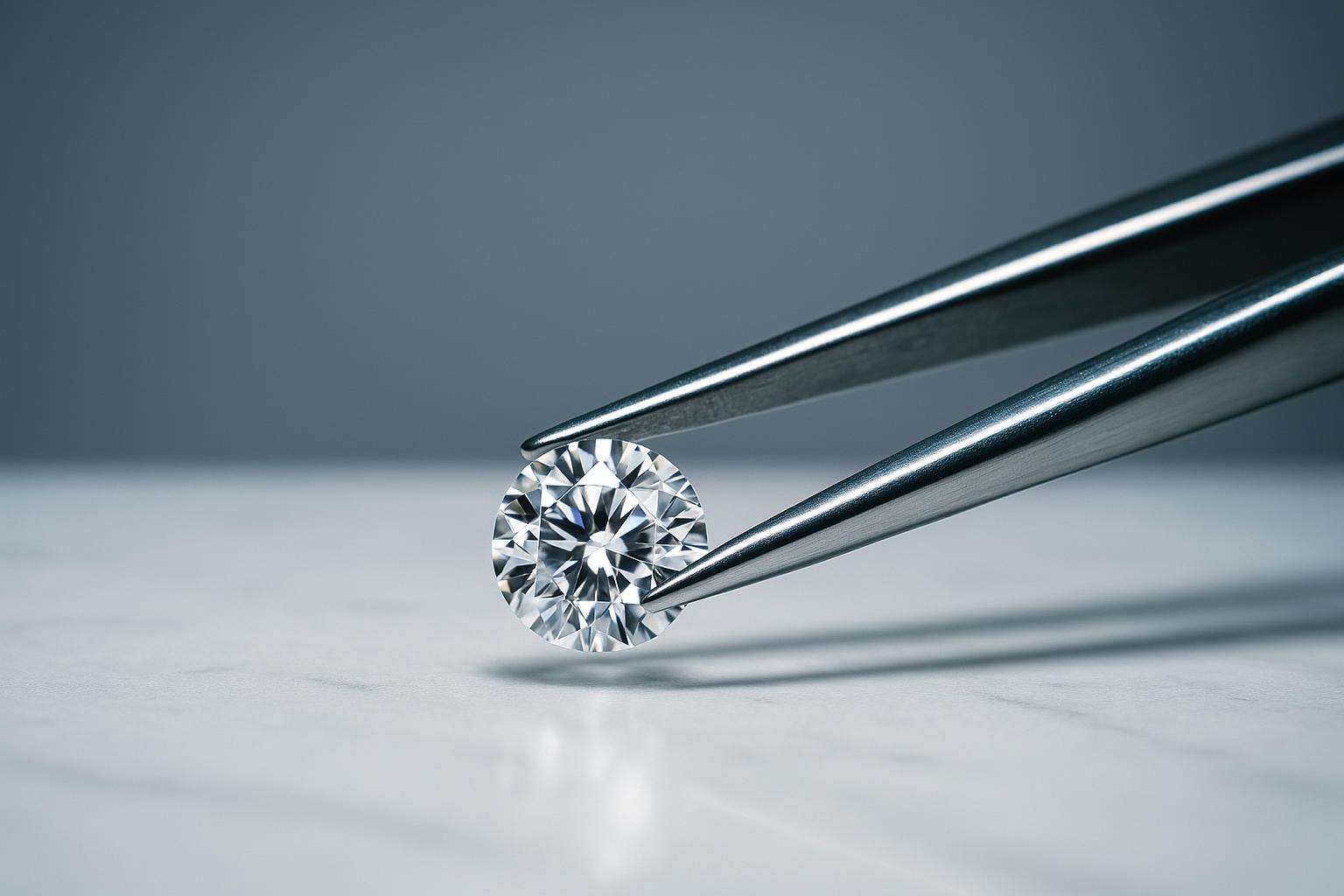
GIA grades round brilliant diamonds on a five-point cut scale: Excellent, Very Good, Good, Fair, and Poor. Cut is the only quality variable entirely in human control after a diamond is mined, and it is the single biggest driver of how a stone looks in everyday wear. An Excellent cut costs roughly 10–15% more than Very Good — a difference that is often imperceptible to the naked eye. Good cut introduces clearly visible light leakage and is not recommended for center stones at any budget. When budget forces a trade-off among the 4Cs, protect cut first and sacrifice color or clarity instead.
Of the four properties the Gemological Institute of America uses to grade diamonds, three are determined by nature: a diamond's color, clarity, and carat weight are set the moment a crystal finishes forming miles underground. Cut is different. Cut is entirely the work of human hands and human decisions — the cutter's choice of where to orient the rough, which facets to place and at what angles, how to balance retaining weight against optimizing light performance. It is also the quality that has the greatest visible impact on the finished stone.
That makes cut grade the most consequential decision a buyer makes. Yet it is also the most frequently misunderstood, because "cut" sounds like it means shape — round, oval, princess. It does not. Cut grade measures how precisely a diamond's facets are proportioned, aligned, and polished to capture light and return it through the table. Two round brilliants of identical carat, color, and clarity can look dramatically different if one is cut to Excellent and the other to Good standards. This guide walks through what each grade actually delivers, what it costs, and where the real value boundaries lie.
What Do the Five GIA Cut Grades Mean in Practice?
GIA grades round brilliant diamonds on five levels: Excellent, Very Good, Good, Fair, and Poor. Fair and Poor are easy to dismiss — no reputable retailer sells these as engagement-ring center stones, and most major online retailers (James Allen, Blue Nile, Brilliant Earth) filter them out of consumer-facing search results entirely. The meaningful decision for any engagement-ring buyer sits among Excellent, Very Good, and occasionally Good.
The grade is not a single measurement but a composite assessment of seven attributes: brightness (total white light returned through the table), fire (the spectral color flashes produced by light dispersion), scintillation (the sparkle-and-contrast pattern as the stone moves), weight ratio (how efficiently the carat weight contributes to face-up size), durability (girdle thickness and culet treatment), polish (surface finish quality), and symmetry (facet alignment and shape regularity). Table percentage, crown angle, pavilion depth, and girdle thickness must all fall within defined ranges simultaneously. Two stones can reach Excellent via slightly different proportion combinations — which is why reading the proportion data alongside the grade is worthwhile for high-value purchases.
| GIA Grade | Approx. Light Return | Visible Character | Price vs. Excellent (1 ct, G/VS1) | Engagement-Ring Verdict |
|---|---|---|---|---|
| Excellent | 90–95% | Maximum brightness, fire, and scintillation; no visible light leakage | Baseline | Recommended; the defensible ceiling for any budget |
| Very Good | 85–90% | Visually very close to Excellent; difference imperceptible without direct side-by-side comparison in most conditions | ~10–15% less ($400–$900 on a 1 ct G/VS1) | Acceptable minimum; verify proportions on the grading report |
| Good | 75–85% | Noticeable light leakage; dull or gray zones visible in pavilion; reduced sparkle clearly apparent side-by-side | ~25–30% less | Not recommended for center stones at any budget |
| Fair | Below 75% | Obvious light leakage; lifeless appearance; one or more proportion attributes severely outside optimal range | ~40–50% less | Avoid entirely for engagement jewelry |
| Poor | Below 65% | Significant light loss; dark center or fisheye effect; often cut purely to preserve carat weight from rough | ~50–65% less | Avoid entirely |
Excellent Cut: What Justifies the Premium?
An Excellent-cut round brilliant meets strict criteria across all seven GIA attributes simultaneously. In practical terms, this means table percentages typically between 54% and 57%, crown angles between approximately 34° and 35°, and pavilion depths between approximately 42.8% and 43.2% — though GIA's actual Excellent envelope is somewhat broader than these idealized ranges suggest. The physical consequence is approximately 90–95% of incoming light returned through the table as brightness, fire, and scintillation.
The resulting visual character is what jewelers describe as "life" in a stone: the way an Excellent-cut diamond catches light across the room, produces sharp spectral flashes across a range of lighting conditions, and maintains its sparkle in motion. For round brilliants specifically, this is not a marginal effect — it is the primary aesthetic output of the stone, and it holds across dim restaurant lighting, office fluorescents, and bright outdoor sun in a way that lower cut grades do not replicate.
The price premium for Excellent over Very Good is approximately 10–15% on a standard 1-carat round brilliant in G color and VS1 clarity — roughly $400–$900 depending on retailer and market conditions, according to The Diamond Price's 2026 pricing guide. At 1.5 carats, the same percentage gap widens to a dollar difference of approximately $800–$1,800. Whether that premium is worth paying depends on the buyer's priorities: those who want the absolute best optical performance and will notice the difference pay it; buyers under a firm total budget often redirect those funds toward a larger carat weight or higher color without meaningful visual sacrifice.
Very Good Cut: The Pragmatic Choice — With One Condition
Very Good cut diamonds return roughly 85–90% of incoming light. Proportions fall slightly outside the Excellent envelope — a marginally shallower crown angle here, a fraction of a degree off on pavilion depth there. The GIA itself acknowledges that one or two dimensional attributes may push a Very Good stone just outside top-grade criteria while all remaining attributes remain within the Excellent range. The visual consequence in most real-world conditions: essentially imperceptible without a direct side-by-side comparison against an Excellent stone under controlled lighting.
This is the grade independent gemologists most frequently describe as the "acceptable floor" for engagement-ring center stones — meaning it represents the minimum cut quality buyers should seriously consider. The $400–$900 savings on a 1-carat stone is real money that can fund a meaningful step up in color (e.g., from H to G) or help reach a larger carat weight that changes the ring's presence on the finger.
The one condition: not all Very Good stones are equal. Because the grade accommodates a range of proportion combinations, some Very Good diamonds sit very close to the Excellent boundary and perform nearly identically; others sit near the Good boundary and show slightly more light leakage than average. For buyers selecting Very Good, it is worth examining the grading report's proportion table and — if the retailer provides it — a performance image or video of the specific stone rather than relying on the grade alone. James Allen's 360° HD video viewer and Blue Nile's imagery are particularly useful for this assessment.
Good Cut: Why the Discount Rarely Makes Sense
Good cut carries a 25–30% price discount versus Excellent, which sounds compelling. The problem is that unlike the Excellent-to-Very Good step — where the visual trade-off is largely theoretical for most buyers in most conditions — the Very Good-to-Good step introduces a clearly visible reduction in sparkle that most observers notice once they have seen both grades side by side.
Good-cut diamonds frequently show dull or gray zones in the pavilion, produced by light escaping through the bottom of the stone rather than returning through the table. Under jewelry-store lighting, where intense overhead spotlights make even poor-cut diamonds look acceptable, this may be masked. In natural daylight, office lighting, or candlelight — the conditions in which a ring is worn every day — the lifelessness of a Good-cut stone relative to Excellent or Very Good becomes apparent.
The budget math also runs against Good cut. A Good-cut D/Internally Flawless diamond at $12,000 looks visually duller in everyday wear than an Excellent-cut G/VS2 diamond priced at approximately $5,000. The premium paid for the perfect color and clarity certificate does not survive the cut penalty. Every independent gemologist's core advice on the 4Cs trade-off hierarchy — protect cut first, sacrifice color or clarity — is rooted in exactly this dynamic. See our complete 4Cs guide for the full priority framework and price comparisons across all four variables.
The AGS "Super-Ideal" Tier and What Happened to It
Before December 2022, a separate tier above GIA Excellent existed in practical market recognition: the AGS Triple Ideal grade (AGS 0 on its 0–10 scale), assigned by the American Gem Society Laboratories. AGS applied ray-tracing — actual light-performance modeling — rather than the proportion tables GIA uses, making its top designation more discriminating. A subset of cutters submitted their finest round brilliants specifically for AGS 0 as a differentiator; those stones, typically exhibiting a crisp, symmetrical Hearts and Arrows optical pattern, came to be called super-ideal.
AGS Laboratories closed permanently on December 5, 2022, when GIA acquired its intellectual property, staff, technology, and Las Vegas facility. GIA now offers the AGS Ideal® Report as a $25 digital supplement to its own grading reports — using the AGS light-performance methodology — for qualifying colorless natural and lab-grown round brilliants and select fancy shapes. Retailers specializing in super-ideal rounds, notably Whiteflash and Brian Gavin Diamonds, apply their own proprietary cut-quality audits and optical pattern verification.
The premium over standard GIA Excellent for super-ideal rounds is typically 5–15%. Whether that premium is worth it depends on scrutiny level: the visual difference relative to a well-proportioned standard Excellent is generally apparent only under controlled conditions or optical instruments, not in normal ring-wearing. For buyers who want the absolute best with supporting documentation, super-ideal is the legitimate ceiling. For most buyers working within a practical budget, standard GIA Excellent is the appropriate target.
Cut Grade and Fancy Shapes: A Critical Gap in the System
One important limitation of the GIA cut-grade system: it applies only to standard round brilliant diamonds. Fancy shapes — ovals, cushions, pear, marquise, emerald, Asscher, princess, radiant, and heart — do not receive an official GIA cut grade on their grading reports. GIA does grade polish and symmetry on fancy shapes, but the combined cut grade that synthesizes all seven attributes is absent.
This matters because cut quality varies enormously across fancy shapes. An oval with an L:W ratio of 1.35:1 and ideal crown proportions performs very differently from a stubby 1.1:1 oval with excessive pavilion depth that conceals weight rather than maximizing face-up spread. For step cuts like emerald and Asscher, proportion quality determines not only brilliance but also how readily inclusions appear — which is why step-cut clarity recommendations are more conservative than brilliant-cut equivalents. Our diamond shapes guide covers the proportion guidelines and optical considerations for all ten major shapes in detail.
For buyers evaluating a fancy shape, the substitute for a missing GIA cut grade is: examine the proportion data on the grading report, scrutinize a high-resolution video or image of the specific stone, and — if the retailer doesn't provide per-stone imagery — consider a different retailer that does. James Allen and Blue Nile both offer stone-level video that is particularly valuable for oval, pear, and cushion buyers checking for bow-tie shadow severity and face-up symmetry.
The One Rule That Holds Across Every Budget
The core principle that gemologists consistently apply — and that the price data consistently supports — is simple: sacrifice color or clarity before sacrificing cut. A well-cut stone with a slight color tint or a minor invisible inclusion sparkles vibrantly across all lighting conditions. A poorly cut stone with perfect color and flawless clarity looks dull across all lighting conditions.
This hierarchy has a practical application for every budget level. For buyers with $3,000: choose Excellent cut at G or H color and VS2 or SI1 clarity rather than Very Good or Good cut at D color and VS1. For buyers with $6,000: choose Excellent cut at G/VS2 rather than Very Good cut at E/VVS1 — the sparkle gain from optimal cut outperforms the marginal color and clarity upgrades at equivalent spend. For buyers working with a lab-grown budget (where the same $6,000 can reach 1.5 carats or larger): apply the same cut-first principle, because lab-grown diamonds are physically and chemically identical to natural stones and respond to cut quality in exactly the same way.
The cut grade is the foundation. Everything else in diamond selection — the shape decision, the color sweet spot, the clarity trade-off, the buy-shy carat strategy — layers on top of it. Understanding what each grade delivers, what it costs, and where the genuine visual boundaries lie is the single most useful piece of knowledge a ring buyer can walk into the market with.
For the complementary decisions: our diamond color scale guide covers every grade from D to Z with metal-pairing guidance and face-up value data; our clarity and eye-clean threshold guide maps inclusion visibility by shape and carat size with real price savings at each grade.
Frequently asked
Is Excellent cut worth the extra cost over Very Good?
For most buyers: yes, but with nuance. An Excellent-cut round brilliant costs roughly 10–15% more than an otherwise identical Very Good stone. The visual payoff under everyday lighting is real — Excellent cut returns approximately 90–95% of incoming light versus 85–90% for Very Good — but side-by-side comparison under controlled conditions is typically required to distinguish them. If the budget is tight, a very well-proportioned Very Good stone (check that crown angle and pavilion depth fall within GIA's Excellent-adjacent ranges on the grading report) is a legitimate choice. Where the premium is clearly worth it: stones above 1.5 carats, where light performance differences become more visible at larger face-up sizes.
Why don't fancy-shape diamonds get a GIA cut grade?
GIA's official cut grade — Excellent through Poor — applies only to standard round brilliant diamonds. The geometry of fancy shapes (ovals, cushions, pear, marquise, emerald, Asscher, princess, radiant, heart) varies so widely that no single proportion standard defines optimal light performance across the category. GIA does grade polish and symmetry on fancy shapes, but not the combined cut grade. Some retailers, including James Allen and Whiteflash, apply proprietary cut-quality ratings to their fancy-shape inventory. For ovals and cushions, experienced gemologists recommend checking the length-to-width ratio, crown height, and pavilion depth on the grading report rather than relying on any single cut-grade label. Our diamond shapes guide covers per-shape proportion guidelines in detail.
What does GIA actually measure to assign a cut grade?
GIA evaluates seven attributes when assigning a cut grade to a round brilliant: brightness (total white light returned through the table), fire (spectral color flashes from light dispersion), scintillation (the sparkle-and-contrast pattern as the stone moves), weight ratio (how efficiently the stone uses its carat weight for face-up size), durability (girdle thickness and culet size), polish (surface finish quality), and symmetry (facet alignment and shape regularity). Table percentage, crown angle, pavilion depth, and girdle thickness must all fall within defined ranges. No single parameter controls the grade; it is the combination that matters, which is why two stones with different proportions can both earn Excellent, and why reading proportion data alongside the grade is worthwhile for critical purchases. The GIA's cut education page details the full proportion table for round brilliants.
What is a 'super-ideal' cut, and is it worth the premium?
Super-ideal is an informal designation for round brilliants that perform at the top of GIA's Excellent tier — typically exhibiting a crisp, symmetrical Hearts and Arrows optical pattern when viewed through a special viewer. Before AGS Laboratories closed in December 2022, AGS 0 (Triple Ideal) was the benchmark for this tier; GIA now offers an AGS Ideal® supplement report for qualifying stones. Retailers specializing in super-ideal rounds — notably Whiteflash and Brian Gavin Diamonds — apply their own rigorous light-performance standards. The premium over standard GIA Excellent is typically 5–15%. Whether that premium is worth it depends on how closely the buyer will scrutinize the stone: the visual difference relative to a well-proportioned standard Excellent is generally apparent only under controlled conditions or with optical instruments, not in normal ring-wearing. For buyers who want the absolute best and have the budget, super-ideal is meaningful. For buyers working within a constraint, standard Excellent is a completely defensible ceiling.
Should I buy Good cut to save money and upgrade color or clarity instead?
No — and this is one of the most widely held mistakes in diamond shopping. Unlike the Excellent-to-Very Good step (where the visual difference is subtle and debatable), the step from Very Good to Good introduces clearly visible light leakage. Good-cut stones can show dull or gray zones in the pavilion because light escapes through the bottom rather than returning through the table. The price discount versus Excellent is 25–30%, which sounds substantial — but a Good-cut D/Flawless diamond at $12,000 looks visually duller than an Excellent-cut G/VS2 diamond at approximately $5,000. The correct trade-off direction is always: reduce color or clarity before reducing cut. An Excellent-cut G/SI1 inspected for eye-cleanliness consistently delivers better visual value than a Good-cut D/VVS2 at equivalent or higher price. See our 4Cs priority guide for the full trade-off framework.
Do cut grades apply to lab-grown diamonds the same way?
Yes. The physics of light interaction is identical whether a diamond was formed underground over a billion years or grown in a controlled reactor over a few weeks. A lab-grown round brilliant cut to GIA Excellent proportions returns light just as efficiently as a natural Excellent-cut stone of the same dimensions. GIA certifies lab-grown diamonds (it withdrew from detailed 4Cs grading of lab-grown stones in late 2025, issuing Premium or Standard assessments rather than per-C grades), but IGI — which remained the dominant certifier for lab-grown stones — applies the same Excellent-to-Poor cut scale. When buying a lab-grown diamond with an IGI report, the cut grade is fully comparable to GIA's scale. The same hierarchy applies: protect cut first, then navigate color and clarity. Lab-grown diamonds typically cost 70–85% less per carat than natural equivalents at the same grades, meaning the budget freed by choosing lab-grown is often better redirected into cut quality and carat size rather than incremental color or clarity upgrades.