Diamonds & Stones
Diamond Carat vs. Face-Up Size: What You're Actually Buying
Carat is weight, not width. Here's the complete guide to understanding how much diamond you see versus how much you're paying for — and how to get the most face-up size for your money.
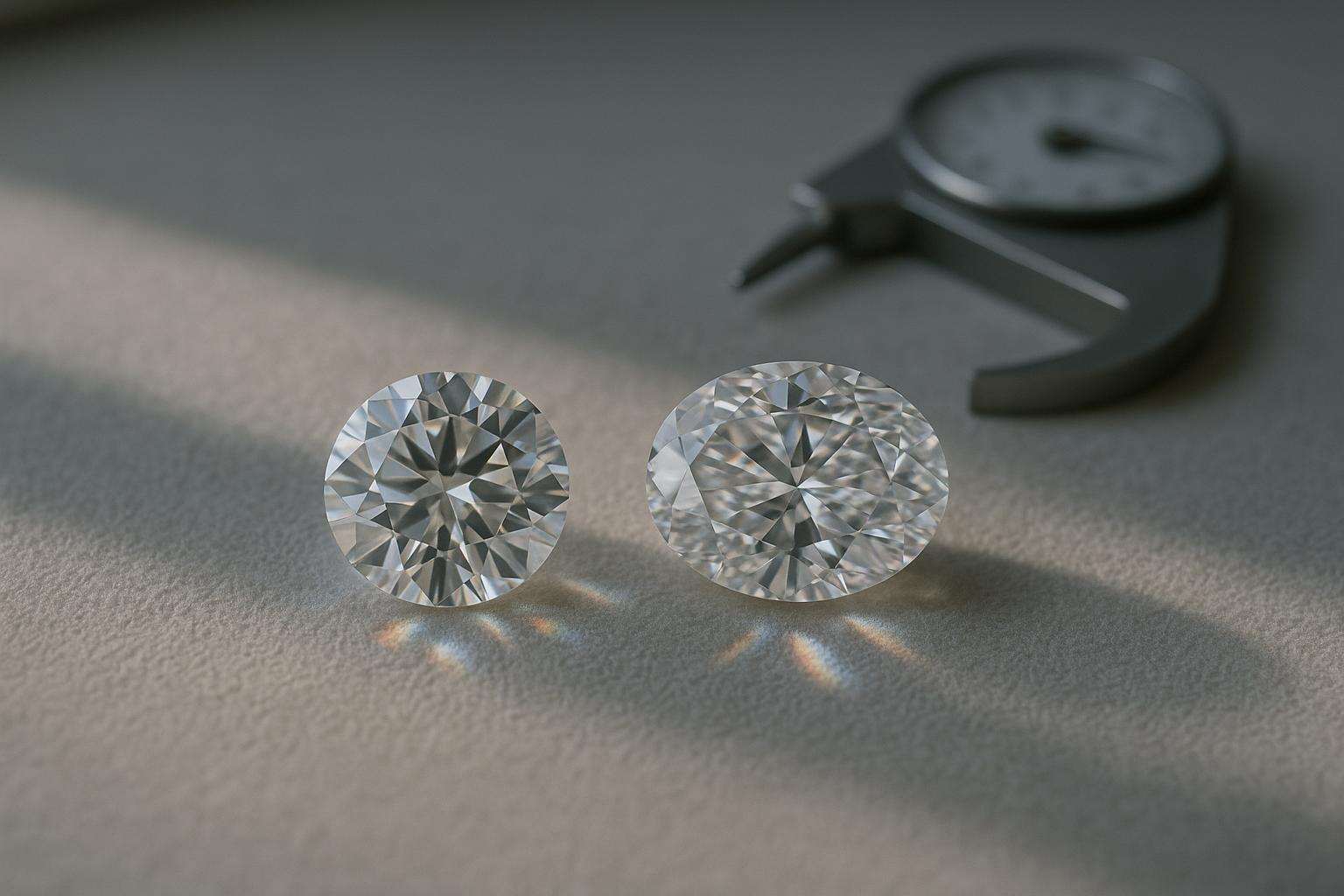
Carat is a unit of mass — 200 milligrams — not a measurement of how large a diamond looks on your finger. Face-up size is determined by three separate variables: shape (marquise and oval spread wider per carat than round or princess), cut quality (a deeper pavilion hides mass below the girdle), and where a stone sits relative to the industry's benchmark weight cliffs at 0.50, 1.00, 1.50, 2.00, and 3.00 carats. Understanding all three lets you maximize visible size without paying for weight you'll never see.
The first thing a jeweler learns about carat weight is that most consumers misunderstand it. When someone says "I want a 1-carat diamond," they are almost always describing a visual target — a certain apparent size on the hand — but carat itself says nothing about dimensions. One carat equals exactly 200 milligrams, a unit of mass inherited from the carob seeds medieval gem traders used as counterweights before standardized measures existed. The Gemological Institute of America, which formalized the 4Cs grading system in the 1950s, defines carat weight precisely and independently of the other three Cs — because it is a wholly separate physical measurement from cut, color, or clarity.
This distinction has real money implications. Two 1.00-carat round brilliants sitting side by side in a jewelry display can measure 6.1 mm and 6.9 mm across the table respectively — a nearly 13% diameter difference that is clearly visible to the naked eye — because one stone was cut with a deeper pavilion that concentrated mass below the girdle where a viewer never sees it. The lighter-looking stone is not defective; it is simply a trade-off the cutter made, potentially to reach a round-number weight target. The wider stone is not necessarily heavier; it is cut to spread its mass more efficiently across the face-up surface. Diamonds Pro's carat guide documents this spread range across thousands of stones and confirms that cut proportions account for the majority of within-grade size variation.
This guide covers the three levers that control face-up size — cut quality, shape, and the pricing benchmark effect — and provides the reference tables you need to make a buying decision based on real dimensions rather than round-number assumptions.
Why Does Diamond Shape Change How Large a 1-Carat Stone Looks?
Shape changes face-up size because different cutting styles distribute carat weight differently between the crown (what you see) and the pavilion (what you don't). An elongated brilliant cut such as an oval or marquise spreads its mass laterally across a wider footprint, placing more surface area at the top of the stone where it is visible. A deep-pavilioned shape such as a standard round brilliant or a princess cut retains more mass below the girdle, producing a smaller face-up appearance at equivalent weight.
The marquise cut is the extreme end of this principle. A 1-carat marquise measures approximately 10 mm × 5 mm — an elongated ellipse with pointed tips that delivers roughly 15% more face-up surface area than a 1-carat round brilliant measuring 6.4–6.5 mm in diameter. That extra surface area translates directly into visual impact on the hand: the marquise covers more finger length and creates the optical illusion of a substantially heavier stone. Per-carat price for marquise cuts runs 10–25% below comparable round brilliants, partly because limited consumer demand keeps inventory priced competitively. The combination of lower price per carat and larger visual footprint makes the marquise the most efficient shape for buyers who prioritize apparent size.
Oval diamonds — currently the second most popular engagement ring shape in the United States, holding approximately 14% of the market per the Natural Diamond Council's 2025 data — offer a similar but more moderate advantage. A 1-carat oval averages roughly 7.7 mm × 5.7 mm, delivering approximately 8% more face-up surface area than a 1-carat round. That margin translates the oval into looking visually comparable to a 1.1–1.2-carat round, a meaningful perception gain at a 25–30% price discount. Ovals are also less susceptible to the bow-tie shadow effect than marquise cuts when proportions are well chosen, making them a popular compromise between size efficiency and optical manageability. Our oval engagement rings guide covers length-to-width ratios and bow-tie avoidance in detail.
Pear shapes produce roughly the same 8% face-up advantage over rounds as ovals, with slightly deeper per-carat discounts (approximately 30–33% below round at equivalent grade). Princess cuts and square cushions face up smaller than equivalent-weight rounds because their square geometry distributes mass evenly in all four directions, and a significant portion sits in the pavilion's depth rather than at the surface. A 1-carat princess measures approximately 5.5 mm × 5.5 mm — visibly smaller face-up than the round's 6.4–6.5 mm — despite carrying a per-carat price discount of 25–35%.
Face-Up Size by Shape: Reference Table at Common Carat Weights
The dimensions below are averages from well-cut stones at each weight; individual stones vary based on depth and proportions. Elongated shapes are listed as length × width.
| Shape | 0.50 ct | 1.00 ct | 1.50 ct | 2.00 ct |
|---|---|---|---|---|
| Round Brilliant | 5.1 mm | 6.4–6.5 mm | 7.3–7.4 mm | 8.1–8.2 mm |
| Oval | 6.0 × 4.5 mm | 7.7 × 5.7 mm | 9.0 × 6.5 mm | 10.0 × 7.5 mm |
| Marquise | 7.5 × 3.8 mm | 10.0 × 5.0 mm | 12.0 × 6.0 mm | 13.5 × 6.8 mm |
| Pear | 6.5 × 4.5 mm | 8.0 × 5.5 mm | 9.5 × 6.5 mm | 10.5 × 7.5 mm |
| Princess | 4.5 × 4.5 mm | 5.5 × 5.5 mm | 6.5 × 6.5 mm | 7.2 × 7.2 mm |
| Cushion | 4.5 × 4.5 mm | 5.5 × 5.5 mm | 6.5 × 6.5 mm | 7.2 × 7.2 mm |
| Radiant | 4.5 × 4.0 mm | 5.8 × 5.5 mm | 6.8 × 6.3 mm | 7.5 × 7.0 mm |
| Emerald | 5.5 × 3.5 mm | 7.0 × 5.0 mm | 8.0 × 6.0 mm | 9.0 × 7.0 mm |
| Asscher | 4.5 × 4.5 mm | 5.5 × 5.5 mm | 6.5 × 6.5 mm | 7.3 × 7.3 mm |
| Heart | 5.0 × 5.0 mm | 6.3 × 6.3 mm | 7.5 × 7.5 mm | 8.3 × 8.3 mm |
These dimensions assume well-cut stones within typical depth ranges. A poorly cut oval with a very deep pavilion can face up significantly smaller than the averages above, reinforcing the principle that cut quality governs real-world face-up size even within a shape. Always confirm actual millimeter dimensions on the retailer's grading report or product listing rather than relying on weight alone.
What Are Magic-Weight Price Cliffs and How Do You Use Them to Your Advantage?
Diamond pricing does not increase smoothly with carat weight. It increases in steps — with predictable, sharp jumps at six benchmark weights where consumer demand clusters: 0.50, 0.75, 1.00, 1.50, 2.00, and 3.00 carats. The mechanism is straightforward: engagement ring shoppers disproportionately search for and purchase stones at these round numbers, and retailers and wholesale suppliers price their inventory to capture that demand concentration. The result is that a 1.00-carat stone is not simply one-third more expensive than a 0.75-carat stone of identical quality — it is priced at a premium that exceeds any rational per-weight interpolation.
The Diamond Price's 2026 pricing data, drawn from aggregated retail transaction records, documents these jumps precisely for natural round brilliants at Excellent cut, G color, VS2 clarity:
| Benchmark Weight | Approx. Price/ct | Buy-Shy Target | Approx. Saving | Face-Up Diameter Difference |
|---|---|---|---|---|
| 0.50 ct | ~$2,200/ct | 0.46–0.48 ct | 8–12% | ~0.1 mm (imperceptible) |
| 0.75 ct | ~$3,100/ct | 0.70–0.72 ct | 7–10% | ~0.1 mm (imperceptible) |
| 1.00 ct | ~$4,435/ct | 0.90–0.95 ct | 10–17% | ~0.15 mm (imperceptible) |
| 1.50 ct | ~$6,322/ct | 1.40–1.45 ct | 10–15% | ~0.2 mm (imperceptible) |
| 2.00 ct | ~$9,689/ct | 1.90–1.95 ct | 12–18% | ~0.2 mm (imperceptible) |
| 3.00 ct | ~$13,442/ct | 2.85–2.95 ct | 10–15% | ~0.25 mm (barely perceptible) |
The 1.00-carat cliff is the most strategically significant for most buyers. The physical diameter difference between a 0.95-carat and a 1.00-carat round brilliant is approximately 0.15 mm — less than the thickness of two sheets of paper — and is imperceptible in a mounted ring setting. Yet per the data above, a 0.95-carat stone of identical cut, color, and clarity costs roughly 10–17% less. On an absolute dollar basis at median market pricing, this represents a saving of approximately $420–$750 on a mid-range stone. That freed capital can be redirected toward a higher-grade cut, a better clarity tier, platinum rather than 14k white gold, a more elaborate setting, or simply retained.
There is a second, less-discussed benefit to buying shy: stones calibrated to exact benchmark weights are approximately 30% more likely to fall outside ideal cut proportion ranges compared with stones just below those milestones. When a rough crystal happens to yield a stone that, when cut to Excellent proportions, would weigh 0.94 carats, the cutter faces a choice: accept the optimal cut grade and certificate the stone at 0.94 ct, or sacrifice pavilion depth or crown angle to push the weight to an even 1.00 ct and command the benchmark premium. Cutters working with better rough resist this temptation; cutters working with lower-quality rough or under commercial pressure sometimes do not. The buy-shy buyer, by targeting stones between 0.90 and 0.97 carats, encounters a pool with a higher proportion of stones that were cut for optical performance rather than weight optimization.
The strategy is executable in practice. Both James Allen and Blue Nile maintain large enough inventories of natural and lab-grown diamonds in the 0.90–0.97 carat range to provide genuine selection — not a consolation pool of seconds. Blue Nile prices 1.00-carat natural rounds approximately 2–4% higher than James Allen on comparable specifications for most mid-range quality tiers, making James Allen the preferred search tool for the 0.90–1.99 ct natural range, while Blue Nile prices more competitively at 2.00 carats and above.
How Does Cut Quality Interact With Carat Weight to Affect Face-Up Size?
Cut quality is the variable most buyers underweight when thinking about face-up size — because it is invisible on the certificate in the way that color and clarity grades are not. The GIA's cut grade for round brilliants (Excellent, Very Good, Good, Fair, Poor) encodes proportional information that directly determines how mass is distributed between the visible crown and the hidden pavilion depth. An Excellent-cut 1.00-carat round has a table diameter of approximately 6.4–6.5 mm. A Good-cut 1.00-carat round — lower on the price scale, with the same weight printed on its certificate — can measure as little as 6.1 mm, appearing smaller face-up by a clearly visible margin despite identical carat weight.
The interaction compounds with the buy-shy strategy in a useful way. A well-cut 0.93-carat Excellent round at James Allen can measure 6.2–6.3 mm face-up — equal to or larger than the face-up width of a Good-cut 1.00-carat stone — while costing 15–25% less in total. The buyer who understands this relationship buys more apparent size with less money by maintaining cut quality and reducing carat weight, rather than trading cut quality to preserve the benchmark weight number.
For fancy shapes — ovals, marquise, pears, cushions — no official GIA cut grade exists on the certificate, which means the buyer carries more of the evaluation burden. The proportional guidelines that determine face-up efficiency for these shapes include depth percentage (the ratio of total stone depth to maximum width) and table percentage (the table facet's width as a proportion of maximum stone width). For ovals, a depth percentage between 57–66% and a table percentage of 53–64% preserves both optical performance and face-up efficiency; stones outside these ranges either sacrifice sparkle (too shallow) or hide mass in depth (too deep). The recommendation to always inspect a fancy-shape stone via a 360-degree video — standard at James Allen, Brilliant Earth, and Blue Nile — is not a marketing suggestion; it is the only reliable method to assess face-up presence when a formal cut grade is absent from the document.
Step-cut shapes — emerald and asscher — have a different relationship with face-up size than brilliant cuts. Their parallel rectangular facets and square proportions face up slightly smaller than rounds of equivalent weight, but their distinctive optical character (the hall-of-mirrors effect of long, glassy light reflections) is a function of those proportions rather than a trade-off. The practical guidance for step-cut buyers is to prioritize clarity over carat weight because step-cut geometry makes inclusions more visible than any brilliant-cut equivalent — a VS2 minimum for emerald and asscher, VS1 for stones above 1.5 carats — then optimize weight within that clarity constraint. Our step-cut diamonds guide covers clarity-first selection in full.
Putting It Together: A Framework for Maximizing Face-Up Size Per Dollar
For buyers whose primary goal is to maximize visible size within a fixed budget, the four levers work as a coordinated system:
- Protect cut quality. Never reduce below Very Good (GIA round brilliants) or the equivalent quality tier at a reputable retailer for fancy shapes. A poorly cut stone faces up smaller and sparkles less regardless of weight. This is the non-negotiable floor. See our 4Cs guide for the full cut-first principle.
- Choose an elongated brilliant shape. For maximum face-up size per carat, rank the shapes: marquise → pear → oval → elongated radiant → elongated cushion → round → princess/asscher/square cushion. Each step up the elongated scale delivers more visible surface area at the same or lower price per carat. Ovals are the most popular entry point because they combine size efficiency with minimal bow-tie risk in optimal proportions.
- Apply the buy-shy strategy at the nearest benchmark. Identify which benchmark weight your target falls near, then search 5–8% below it. At the 1.00-carat cliff, search 0.90–0.95 ct; at 1.50 ct, search 1.40–1.45 ct. The savings are real, the visual difference is not.
- Evaluate lab-grown as a size amplifier. Lab-grown diamonds are physically and chemically identical to natural diamonds, carry GIA or IGI certificates, and cost approximately 67–85% less per carat at equivalent grades. A buyer committed to a $5,000 budget can reach a 2.00-carat lab-grown oval where the natural-diamond path would deliver approximately 0.90–1.00 carats. For buyers who prioritize apparent size above natural provenance, lab-grown removes carat weight as a constraint entirely. Our lab-grown vs. natural comparison covers the trade-offs in full detail.
The industry's persistent focus on carat as the primary descriptor of a diamond's quality is a pricing phenomenon as much as an educational one: benchmark weights command premiums, so sellers benefit from buyers equating weight with value. The gemological reality is more useful: face-up size is what you see every day, and face-up size is determined by shape, cut, and where your stone lands relative to the demand cliffs — not by the weight number on the certificate. Understanding those three variables precisely is how buyers get more of what they actually want.
Frequently asked
How big is a 1-carat diamond in millimeters?
A 1-carat round brilliant diamond averages approximately 6.4–6.5 mm in diameter when cut to ideal proportions. However, this number is not fixed: a round with a deep pavilion can measure as little as 6.1 mm, while a shallow cut of the same weight can reach 6.9 mm — a nearly 13% spread that is visible to the naked eye. Shape changes the dimensions further. A 1-carat oval typically measures around 7.7 mm × 5.7 mm, a marquise around 10 mm × 5 mm, and a princess about 5.5 mm × 5.5 mm. Because carat measures mass rather than physical dimensions, checking the actual millimeter spread on a diamond's grading report or retailer listing is more informative than the carat weight alone. Our face-up size table below shows average dimensions across all ten common shapes at 0.50, 1.00, 1.50, and 2.00 carats.
What is the buy-shy diamond strategy and how much does it save?
The buy-shy strategy means purchasing a diamond just below a benchmark carat weight — 0.90–0.95 ct instead of 1.00 ct, 1.40–1.45 ct instead of 1.50 ct, 1.90–1.95 ct instead of 2.00 ct — to avoid the demand-driven price premium that forms at round numbers. Diamond prices jump non-linearly at these milestones because consumer searches and retailer pricing concentrate there. At the 1.00-carat threshold, the price-per-carat premium versus 0.95 ct runs approximately 10–17%; at 1.50 and 2.00 carats, savings of 10–15% and 12–18% respectively are typical. The physical diameter difference between a 0.95-carat and a 1.00-carat round brilliant is about 0.15 mm — less than the thickness of two sheets of paper — and is imperceptible in a mounted ring. As a secondary benefit, buying shy correlates with better average cut quality: stones calibrated to exact benchmark weights are roughly 30% more likely to have been stretched beyond ideal proportions to hit a target weight.
Which diamond shape looks biggest per carat?
Marquise cut diamonds produce the largest face-up appearance per carat of any commercially available shape — approximately 15% more visible surface area than a round brilliant of equal weight. A 1-carat marquise measures roughly 10 mm × 5 mm versus the round brilliant's 6.5 mm diameter, delivering dramatically more finger coverage at the same carat weight. Oval and pear shapes follow, each offering approximately 8% more face-up area than a round, and both carry meaningful price discounts (ovals typically run 25–30% below equivalent rounds, pears 30–33% below). Princess, asscher, and square cushion cuts face up smaller than a round of equal weight because they concentrate mass in depth. If maximizing visible size is the priority, the ranking of elongated shapes from largest to smallest face-up appearance per carat is: marquise → pear → oval → elongated cushion → radiant → round. See our full diamond shapes guide for a side-by-side shape comparison at common carat weights.
Does a higher carat weight always mean a more expensive diamond?
Not always — and the relationship is far from linear. Diamond price per carat increases non-linearly with weight, meaning a 2-carat stone costs considerably more than twice the price of a 1-carat stone of identical grade. At benchmark weights (0.50, 0.75, 1.00, 1.50, 2.00, 3.00 carats), demand concentration from consumers pushes per-carat prices sharply upward. Stones just below these benchmarks therefore offer meaningful savings at nearly identical visual sizes. Additionally, shape matters: a 1-carat marquise typically costs 10–25% less per carat than a 1-carat round brilliant, yet appears larger face-up. Lab-grown diamonds offer the most dramatic size-for-budget advantage, running approximately 67–85% less per carat than natural equivalents at identical grade — effectively removing carat weight as a hard budget constraint for buyers who prioritize apparent size over natural provenance. The combination of buying shy, choosing an elongated fancy shape, and considering lab-grown can together more than double the face-up size achievable within a fixed budget.
Why does cut quality affect how big a diamond looks?
Cut quality determines where a diamond's mass is concentrated — in depth or spread. A round brilliant cut to ideal GIA Excellent proportions returns light efficiently through the table (the flat top facet), creating the perception of a bright, wide-looking stone. A poorly cut stone of identical carat weight may have a deeper pavilion, hiding mass below the girdle where it is never visible to the viewer — that stone faces up smaller despite weighing the same. The difference between a well-cut and a poorly cut 1.00-carat round can be as much as 0.8 mm in diameter (roughly 6.1 mm vs. 6.9 mm), which is clearly perceptible face-up. This is why gemologists consistently advise against sacrificing cut quality to buy more carat weight: a well-cut 0.90-carat stone at Excellent grade can measure larger face-up than a Good-cut 1.00-carat stone and will deliver far superior brilliance. Always prioritize cut first, then apply buy-shy and shape strategy to maximize apparent size within budget. Our 4Cs guide explains the cut-first principle in full.
At what carat weights do diamond prices jump the most?
Diamond prices jump sharply at six benchmark weights: 0.50, 0.75, 1.00, 1.50, 2.00, and 3.00 carats. These are the points where consumer demand concentrates — most engagement ring searches, gift purchases, and anniversary upgrades target round numbers — and retailers price their inventory to match. Expressed as average price per carat for a natural round brilliant at Excellent cut, G color, VS2 clarity: 0.50 ct averages approximately $2,200/ct; 1.00 ct approximately $4,435/ct; 1.50 ct approximately $6,322/ct; 2.00 ct approximately $9,689/ct; and 3.00 ct approximately $13,442/ct. The steepest jump in percentage terms is at 1.00 carat, where per-carat price increases roughly 100% versus 0.50 ct. Stones calibrated to exactly 1.00 or 2.00 carats are also about 30% more likely to have been cut outside ideal proportion ranges, as rough-crystal sawyers sometimes stretch proportions to hit a round-number target weight. The practical implication: buying a 0.95-carat over a 1.00-carat stone saves roughly 10–17% with an imperceptible 0.15 mm size difference.
Are lab-grown diamonds the same carat weight and size as natural diamonds?
Yes. Lab-grown diamonds are physically and chemically identical to natural diamonds — both are crystallized carbon with the same density, hardness (10 on the Mohs scale), and refractive index. A 1.00-carat lab-grown round brilliant will measure the same approximately 6.4–6.5 mm as a natural 1.00-carat round of comparable cut quality. The GIA grades lab-grown diamonds on the same 4Cs scale as natural stones (noting their growth origin on the report), and IGI is the dominant certifier for lab-grown diamonds at major online retailers including James Allen, Blue Nile, and Brilliant Earth. The significant practical difference is price: lab-grown diamonds cost approximately 67–85% less per carat than natural equivalents at equivalent grades. This means a buyer who allocates a $5,000 budget to a 1.00-carat natural diamond could purchase a 2.00-carat lab-grown of identical cut, color, and clarity. For buyers whose priority is maximizing face-up size, lab-grown removes carat weight as a meaningful constraint.