Diamonds & Stones
Oval Engagement Rings: Why They Look Bigger (And How to Buy One Right)
The second most popular engagement ring shape delivers more face-up size per carat than any brilliant cut, costs 20–25% less than round, and elongates the finger — but only if you nail the length-to-width ratio and avoid the bow-tie trap.
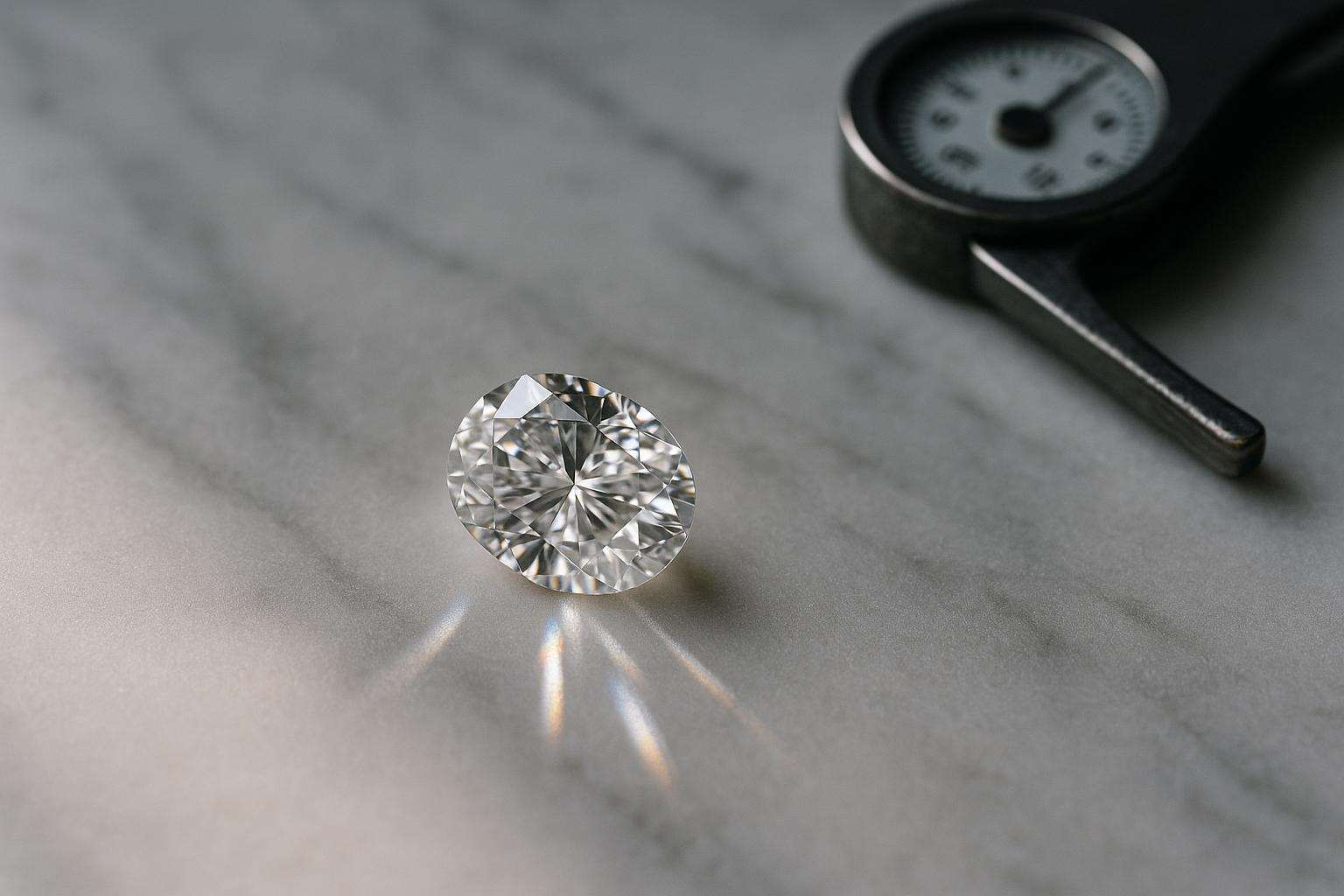
Oval engagement rings deliver roughly 10–15% more face-up surface area than a round diamond of equal carat weight, cost 20–28% less per carat, and create a finger-lengthening visual effect — making them the most efficient shape for buyers who want to maximize apparent size within a budget. The catch: GIA does not grade oval cut quality, so you must evaluate each stone individually for bow-tie severity and length-to-width ratio. Target a ratio of 1.35–1.50 (sweet spot: 1.40–1.45), request Excellent symmetry on the GIA certificate, and always inspect a 360-degree video in multiple lighting conditions before buying.
For most of the 20th century, the oval engagement ring was a quiet classic — elegant, established, but firmly in the shadow of the round brilliant. That changed visibly in the early 2010s when Blake Lively appeared wearing a pink oval diamond from jeweler Lorraine Schwartz, and accelerated dramatically through the mid-2020s as Hailey Bieber's iconic solitaire oval (originally circa 2018, upgraded in 2024 to a dramatically elongated stone estimated at approximately 18 carats) became one of the most searched jewelry items online. Today, The Knot's 2026 Real Weddings Study places ovals at 25% of U.S. engagement ring sales — nearly matching round brilliants at 26% — and separate Stuller trade data shows the oval as one of the shapes with the most consistent year-over-year volume growth among specialty jewelers.
But popularity data only tells you what other people are doing. The more useful question is what makes the oval shape genuinely distinctive — and what it demands from a careful buyer.
Why Does an Oval Diamond Look Bigger Per Carat?
The size advantage of the oval is not a perception trick or marketing language. It is a direct consequence of how carat weight is distributed across a diamond's geometry. Carat measures mass — one carat equals exactly 200 milligrams — not physical dimension. A round brilliant achieves its trademark brilliance by concentrating weight in the pavilion depth, sending light on a precise journey from table to pavilion facets and back out through the crown. That depth is invisible from above but accounts for roughly 60–65% of the stone's total height. A well-cut 1.00-carat round brilliant has a face-up diameter of approximately 6.5 mm.
An oval cut spreads its mass differently. The elongated outline covers more of the finger's surface in two dimensions, trading some pavilion depth for horizontal and vertical reach. A 1.00-carat oval at an ideal 1.40–1.45 ratio measures approximately 8.1 mm × 5.7 mm — an elongated footprint that delivers roughly 10–15% more face-up surface area than the round brilliant of equal weight. Multiple independent sources confirm this range: the International Gem Society's shape and size guide cites the oval's face-up advantage consistently at the lower end of that range for most standard ratios, while elongated ovals approaching 1.50 can reach the upper end.
The finger-lengthening effect compounds the perceived size difference. Because the oval's long axis aligns with the length of the finger, the eye reads the stone as larger relative to the hand than a compact round footprint would suggest. Gemologists sometimes describe this as the oval's structural flattery: it works with human anatomy rather than against it. Buyers with shorter fingers or wider hands tend to find the elongated silhouette particularly effective, though the effect is favorable across most hand proportions.
The cost advantage reinforces the value case. Oval diamonds typically price 20–28% below round brilliants of equivalent grade. The gap traces to cutting yield: producing a round brilliant from rough diamond crystal wastes approximately 50–60% of the original material, because the shape demands discarding rough from four corners and both poles. The oval's outline follows a path closer to the natural crystal's form, retaining more material. That yield difference flows through to price. A 1.00-carat natural J/SI1 round brilliant at Blue Nile lists at approximately $3,390; a comparable oval runs around $2,440 — a $950 difference that can be redirected toward a higher carat weight, better clarity, or a more elaborate setting. For lab-grown stones, both natural and oval savings compound: lab-grown ovals retail at approximately 75–80% below natural-diamond equivalents, making a 2-carat lab-grown oval accessible at many budgets that would otherwise support only a 1-carat natural round.
| Carat Weight | Round Brilliant (approx. diameter) | Oval (approx. dimensions at 1.42 ratio) | Oval Face-Up Advantage | Typical Price Discount vs. Round |
|---|---|---|---|---|
| 0.75 ct | 5.8 mm | 7.0 × 4.9 mm | ~10% | ~20% |
| 1.00 ct | 6.5 mm | 8.1 × 5.7 mm | ~12% | ~22–28% |
| 1.50 ct | 7.4 mm | 9.5 × 6.7 mm | ~13% | ~22–27% |
| 2.00 ct | 8.2 mm | 10.2 × 7.2 mm | ~14% | ~20–25% |
Dimensions are approximations based on published industry benchmarks; actual measurements vary by individual cut and cutter. Price discounts reflect directional market conditions as of mid-2026 and will vary by retailer and stone specification.
What Is the Bow-Tie Effect, and How Do You Avoid It?
The bow-tie effect is the most important quality consideration specific to oval diamonds — and the one most commonly misunderstood by buyers. It appears as a dark, roughly horizontal shadow across the center of the stone when viewed face-up, resembling the shape of a formal bow tie. The shadow forms because the elongated brilliant facet arrangement creates a zone where light entering the stone exits through the pavilion rather than reflecting back to the viewer's eye. The effect worsens when the viewer's own head or shoulders block ambient side-lighting, which is how most people naturally look at a ring on their hand.
The critical clarification that separates experienced gemologists from casual advice: every oval diamond has some degree of bow-tie. The question is not whether a bow-tie exists but whether it is faint, moderate, or severe. A faint bow-tie can actually enhance a stone's dimensionality, creating a sense of depth at the center that a uniformly bright stone lacks. Only a severe, wide shadow that dominates the face-up view constitutes a meaningful quality defect — and even a severe bow-tie can be used as a negotiating lever, since dealers typically discount such stones 15–20% from equivalent unblemished inventory.
GIA certificates do not report bow-tie presence, severity, or even the proportion ranges most associated with its appearance. The Fall 2024 issue of GIA's Gems & Gemology published ten years of research on oval, pear, and marquise face-up appearance — a landmark study building toward a future fancy-cut grading system — but as of mid-2026, no formal GIA cut grade for oval diamonds has been implemented. That means visual inspection of the actual stone remains the only reliable method.
Several proportion factors correlate strongly with bow-tie severity:
- Depth percentage: Most gemologists recommend oval depth in the range of 57–66%. Stones cut shallower than 57% tend to window (the eye sees straight through the pavilion), while stones deeper than 66–68% concentrate light leakage in a tighter band, producing a more defined and severe shadow.
- Table percentage: A table in the 53–64% range supports balanced light distribution. Extremely large tables (above 65%) reduce the crown's ability to redirect off-axis light, worsening bow-tie intensity.
- Symmetry grade: Always require Excellent symmetry on the GIA report. Asymmetric ovals — where one half of the silhouette curves differently than the other — cause the bow-tie to appear tilted or one-sided, which is visually far more distracting than a symmetrically centered shadow.
- Length-to-width ratio: Ratios above 1.55 significantly elevate bow-tie risk (discussed in detail below).
The practical protocol before buying: request 360-degree video of the specific stone under at least two different lighting environments (direct overhead spotlight and diffused natural light). Overhead spot lighting suppresses bow-tie by design — the shadow only becomes apparent in directional or ambient natural light. If a retailer cannot provide multi-angle video, treat the purchase with the same caution you would apply to buying a car without a test drive.
How to Choose the Right Length-to-Width Ratio
The length-to-width (L:W) ratio is the number most buyers ask about first, and for good reason: it defines the stone's overall silhouette and is the single variable most directly correlated with both visual appeal and bow-tie risk. The ratio is simply the longer dimension divided by the shorter. A stone measuring 8.10 mm × 5.75 mm has an L:W ratio of 1.41.
The GIA's oval diamond buying guide cites 1.30–1.50 as the broadly preferred range; industry consensus further narrows the sweet spot to 1.40–1.45 as the most universally flattering. Here is what each zone delivers in practice:
| L:W Ratio Range | Visual Profile | Bow-Tie Risk | Best For |
|---|---|---|---|
| 1.20–1.29 | Short, rounded — approaches cushion silhouette | Lower | Buyers who want oval identity with cushion-like compactness |
| 1.30–1.39 | Gently elongated; subtle finger-lengthening effect | Low to moderate | Conservative or shorter-fingered buyers; wider band settings |
| 1.40–1.50 | Classic oval proportion; strong finger coverage; dramatic without excess | Moderate (manageable with good symmetry) | Most buyers; solitaire and hidden halo settings |
| 1.51–1.60 | Distinctly elongated; near the boundary of Hailey Bieber's 2024 upgrade proportions | Elevated | Buyers who specifically want the elongated modern look; requires careful individual stone inspection |
| Above 1.60 | Narrow, dramatic — closer to pear territory | High | Only with individual expert review; not generally advisable for first-time oval buyers |
One practical note on celebrity reference points: Hailey Bieber's 2024 Lorraine Schwartz upgrade is estimated at approximately 18 carats with a notably elongated ratio. At very large carat weights (above 3–4 carats), the elongated oval works differently — the stone's sheer scale masks bow-tie severity in ways that a 1-carat stone at the same ratio cannot. If you are referencing a celebrity ring as a style target, verify whether the star's ring is scaled to proportions that translate to your own budget and carat weight. For most buyers shopping in the 1.00–2.00-carat range, ratios above 1.52 require careful vetting of the individual stone.
Which Settings Work Best with an Oval Diamond?
The oval's geometry interacts with setting architecture differently than a round brilliant does. The elongated outline creates clear directionality — the stone reads as having a head, a tail, and a waist — and the setting must respect that visual axis or actively subvert it by design.
Four-prong solitaire on a thin band remains the most widely chosen configuration. Four prongs positioned at the cardinal points — tips and sides — lift the stone, allow maximum light entry from all angles, and frame the outline without competing with it. A thin pavé or plain band (1.5–2.0 mm) emphasizes the stone's elongated dominance and maximizes the apparent size advantage. This is the closest counterpart to what Hailey Bieber's original 2018 ring embodied: the solitaire oval on a plain gold band, restrained and stone-first.
Hidden halo adds a ring of micro-pavé diamonds set beneath the center stone and visible only from the side or at finger level. From above, the ring reads as a solitaire; from the side, the halo adds luminosity and depth. The elevated mounting characteristic of most hidden halo settings also lifts the center oval higher off the finger, increasing its visual presence. This setting suits buyers who want sparkle from every angle without the larger visual footprint of a traditional full halo.
East-west horizontal orientation is the defining setting trend of 2025–2026 for oval diamonds. Rather than aligning the oval's long axis with the finger's length, an east-west mount rotates the stone 90 degrees, placing its width across the hand. The result reads as a deliberate, architectural design choice rather than a conventional ring — it maximizes lateral finger coverage and creates a modern, low-profile silhouette. East-west ovals photograph distinctively and are increasingly requested by buyers who want a recognizable but non-standard look. The setting requires slightly adjusted prong placement to secure the stone's waist safely; confirm with any custom jeweler that the east-west mount includes adequate girdle support.
For metal choice, oval diamonds pair well with all four major options, but the oval's size advantage varies by combination. Yellow gold (14k or 18k) complements warmer color grades (H–J) by blending with any residual stone warmth, delivering better face-up whiteness than the same stone would show in platinum. Platinum and white gold maximize the brightness of near-colorless grades (D–G). See our diamond shapes guide for size and setting comparisons across all ten major cuts, and our 4Cs primer for color-grade decision logic by metal.
Natural vs. Lab-Grown Oval Diamonds: The 2026 Calculus
The oval shape exists in both natural and lab-grown form at every major retailer, and the decision between them sits at the center of most oval ring budgets in 2026. Per The Knot's 2026 Real Weddings Study, lab-grown diamonds now account for approximately 61% of all U.S. engagement ring purchases — a majority driven substantially by buyers who chose a fancy shape (oval, marquise, elongated cushion) and used lab-grown pricing to buy up in size.
The math is straightforward. A 1.50-carat natural oval in G color, VS2 clarity at a major online retailer runs approximately $5,500–$7,000 in mid-2026. A 1.50-carat lab-grown oval at the same grade runs approximately $1,200–$1,800 — a 70–80% reduction that could alternatively fund a 2.50-carat lab-grown oval at equivalent quality. Both diamonds are physically and chemically identical; neither a trained gemologist nor advanced spectroscopic equipment can distinguish a lab-grown from a natural oval diamond by appearance alone. The differentiator is provenance and long-term resale value: natural diamonds retain 40–60% of retail value after five years, while lab-grown diamonds retain roughly 10–20%, reflecting the ongoing decline in lab-grown production costs and wholesale prices.
For buyers who prioritize wearing a large, brilliant stone on their hand and place limited weight on heirloom transferability or resale, the lab-grown oval represents one of the most rational choices in the current market. For buyers who view the ring as a lasting asset or who want a stone with natural provenance, a natural oval at the 20–28% round-to-oval discount remains the most efficient path to a larger natural diamond within budget.
Certification standards differ by stone type. GIA certifies both natural and lab-grown ovals, issuing the same polish and symmetry grades (no cut grade for either, as GIA's cut grade applies only to round brilliants). IGI has become the dominant lab for lab-grown diamonds and is accepted at all major retailers including Blue Nile, Brilliant Earth, and VRAI. For natural ovals above 1.50 carats intended as long-term holdings, GIA certification is the more defensible choice by resale convention; for lab-grown of any size, IGI certification is the effective market standard and carries equivalent purchasing credibility.
The oval engagement ring's appeal is ultimately a convergence of practical advantages — more size per carat, lower price per carat, finger-flattering geometry — with a silhouette that has proven durable across decades of trend cycles. The shape that Blake Lively wore in 2012 and Hailey Bieber made definitional in the 2020s is not a moment; it is one of the few diamond shapes where the gemological case and the aesthetic case align completely. Buy it correctly — with deliberate ratio selection, disciplined bow-tie vetting, and the right setting for your finger and lifestyle — and it is among the most consistently satisfying choices in the engagement ring market.
For context on how the oval fits within the full shape landscape, see our diamond shapes guide, which compares all ten major cuts side by side for price, face-up size, and personality. If you are weighing the bow-tie question across multiple elongated shapes, our forthcoming pear-shaped engagement rings guide covers the same proportion decisions for the teardrop silhouette.
Frequently asked
Why do oval engagement rings look bigger than round diamonds of the same carat weight?
Carat measures mass, not surface area — and the oval cut distributes its mass across a larger, elongated footprint rather than concentrating it in pavilion depth the way a round brilliant does. The practical result: a 1.00-carat oval measures approximately 8.1 mm × 5.4 mm, delivering roughly 10–15% more face-up surface area than a 1.00-carat round brilliant's 6.5 mm diameter circle. That additional spread translates directly into a visually larger stone on the finger. The elongated silhouette also creates an optical finger-lengthening effect, which amplifies the perception of size beyond the raw millimeter difference. A second contributor is setting geometry: most oval rings are set in raised solitaire or hidden-halo mounts that lift the stone, increasing its visual presence from every angle.
What is the bow-tie effect in oval diamonds, and how serious is it?
The bow-tie effect is a dark, horizontal shadow across the center of an oval diamond that resembles a formal bow tie when viewed face-up. It forms because the elongated facet arrangement creates a zone where incoming light exits through the pavilion rather than returning to the viewer's eye — a phenomenon that worsens when the viewer's head or shoulders block ambient light from the sides. Every oval diamond has some degree of bow-tie; a faint one can add depth and contrast, enhancing the stone's three-dimensionality. A severe, wide bow-tie that dominates the face-up view is a meaningful quality defect. GIA certificates do not report bow-tie presence or severity, making visual inspection — ideally via 360-degree video in multiple lighting conditions — the only reliable detection method. Stones with severe bow-tie are frequently discounted 15–20% and can be a legitimate bargain if the shadow is only visible in certain lighting.
What length-to-width ratio should I choose for an oval engagement ring?
The length-to-width (L:W) ratio is the single most important visual decision when buying an oval diamond. Divide the longer dimension by the shorter: a 1.40 ratio means the stone is 40% longer than it is wide. The most popular range is 1.35 to 1.50, which strikes a balance between elegant elongation and manageable bow-tie risk. Ratios below 1.30 produce a round, almost cushion-like outline that defeats the purpose of the oval's size advantage. Ratios above 1.55 tend to show more pronounced bow-tie shadows and can look narrow rather than graceful. The GIA's own oval buying guide cites 1.30–1.50 as the broadly preferred range; the sweet spot between 1.40 and 1.45 is the most frequently recommended. Look at the actual stone (or high-resolution 360-degree video) rather than relying on ratio alone — two diamonds at 1.42 can look quite different depending on shoulder shape and belly curvature.
How much cheaper are oval engagement rings compared to round diamonds?
Oval diamonds typically cost 20–28% less per carat than round brilliants of equivalent cut quality, color, clarity, and carat weight. The gap exists because round brilliant cutting wastes 50–60% of the rough crystal, while oval cutting retains significantly more material — and that yield difference is passed through to pricing. As a real-world benchmark, a 1-carat natural J/SI1 round brilliant at Blue Nile runs approximately $3,390, while a comparable oval lists around $2,440 — a 28% discount. Lab-grown ovals are approximately 75–80% less than their natural-diamond equivalents, making a 2-carat lab-grown oval achievable for many moderate budgets. One caveat: oval demand surged significantly through 2024–2026, and ovals have seen a roughly 6% price increase relative to other fancy shapes as popularity has driven up competition for well-proportioned stones. The round-to-oval discount remains substantial, but the premium for a particularly well-cut oval at an ideal ratio (1.40–1.45, excellent symmetry) has narrowed at the top of the market.
Does GIA grade oval diamonds for cut?
No. The GIA issues an overall cut grade only for standard round brilliant diamonds. Oval diamonds — along with all other fancy shapes — receive only polish and symmetry grades on their GIA certificate. The absence of a cut grade is a critical practical point: two ovals at the same GIA-graded color and clarity can differ dramatically in light performance and bow-tie severity, with no certificate field capturing those differences. In Fall 2024, GIA published a landmark decade-long study in Gems & Gemology on oval, pear, and marquise face-up appearance, laying groundwork for a future fancy-cut grading system — but none has been formalized as of mid-2026. In the meantime, buyers must evaluate oval cut quality through proportion review (table %, depth %, L:W ratio) and direct visual inspection of high-quality video, both of which are now standard at online retailers including Blue Nile, Brilliant Earth, and VRAI.
What are the best settings for an oval engagement ring?
Four settings work particularly well with the oval's geometry. A four-prong solitaire on a thin band — the most classic choice — focuses all attention on the stone and maximizes the apparent size advantage. A hidden halo adds a ring of micro-pavé diamonds set below the center stone, invisible from above but adding luminosity from the side and finger-level; the elevated mounting also makes the oval appear larger. A six-prong elongated solitaire (two prongs at the tips, four around the body) provides extra security at the pointed ends and is preferred by gemologists for ovals above 2 carats. An east-west horizontal orientation — rotating the oval 90 degrees on the band — is one of 2026's most discussed design choices: the stone reads wider across the hand, creates a modern, architectural silhouette, and sidesteps the convention of the vertical engagement ring. Avoid very wide split-shank bands that compete visually with the stone's elongated outline. Yellow and rose gold both complement warmer color grades (H–J), while platinum and white gold maximize the brightness of G or better.
Should I buy a natural or lab-grown oval diamond?
Both are physically and chemically identical — optically, a lab-grown oval diamond is indistinguishable from a natural one. The decision turns on priorities. Lab-grown oval diamonds currently retail for approximately 75–80% less than natural equivalents of the same grade; a 2-carat lab-grown oval in G color, VS2 clarity is accessible at many moderate budgets, enabling a significantly larger stone for the same spend. The trade-off is resale value: lab-grown diamonds retain roughly 10–20% of retail value after five years, compared to 40–60% for natural stones. If long-term resale or heirloom status matters, natural is the defensible choice. If size, brilliance-per-dollar, and ethical simplicity (no mining) take priority, lab-grown is rational. Most major retailers — Blue Nile, Brilliant Earth, VRAI — carry both, typically certified by GIA (natural) or IGI (lab-grown), both of which are widely accepted. See our full lab-grown vs. natural diamond comparison for the complete breakdown.