Owning & Protecting
Comfort Fit vs. Standard Fit Rings: Which Interior Profile Is Right for You?
The inside of the band matters as much as the outside. Here is how comfort fit and standard fit profiles differ, how each interacts with knuckle anatomy, and the half-size adjustment you must know before ordering.
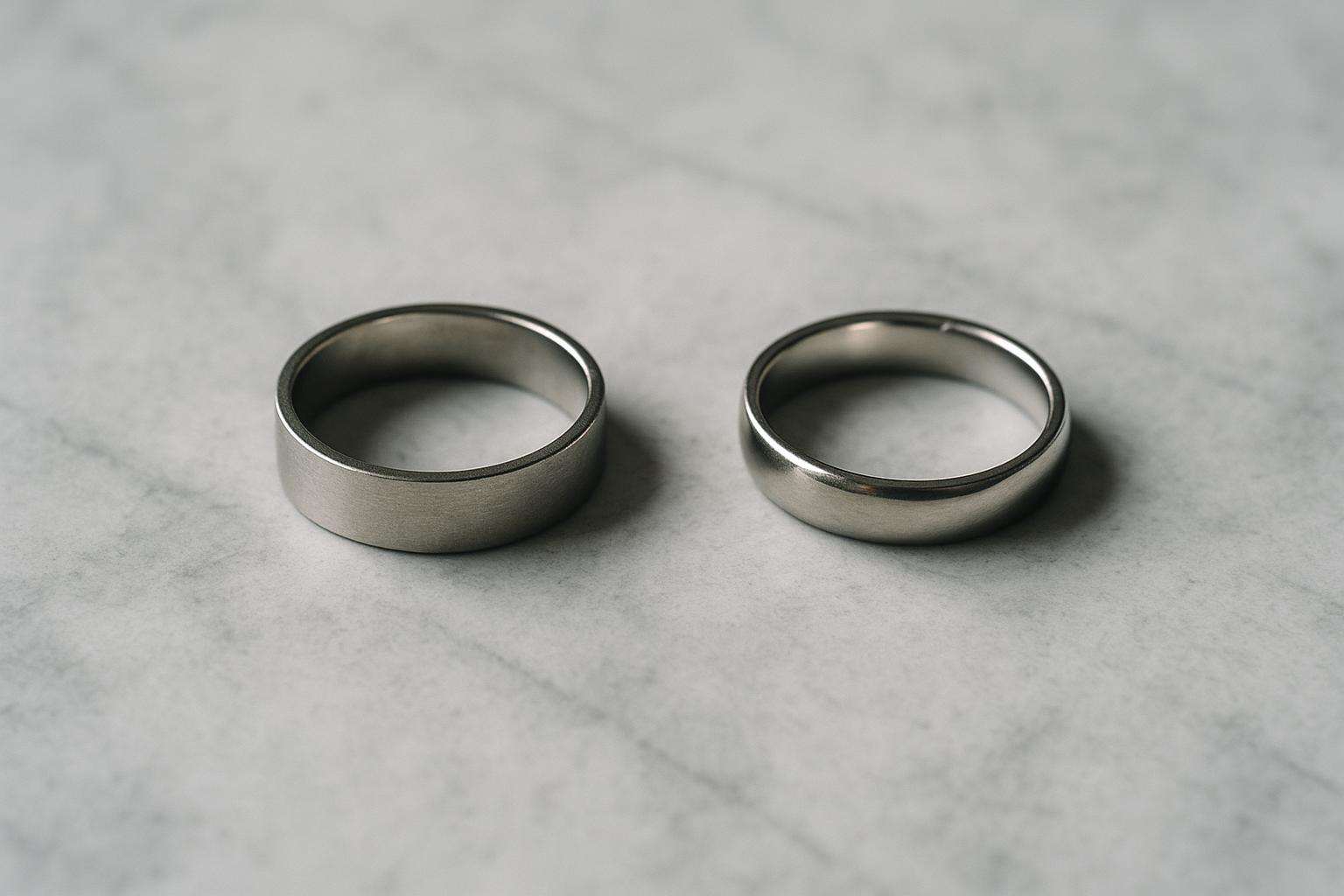
Comfort fit rings have a domed, convex interior that reduces friction, helps the band glide over knuckles, and eases pressure during warm-weather swelling. Standard fit rings have a flat interior that provides a snug, defined feel and costs fractionally less. If your band is 5 mm or wider, your knuckles are noticeably larger than your finger base, or you experience any joint swelling, comfort fit is the more wearable choice — but order a half size smaller than your standard fit measurement, because the interior curvature creates a sensation of looser fit at the same nominal size.
Walk into any jeweler and ask to try on two rings of identical size and width — one marked comfort fit, one standard fit — and you will feel the difference immediately. The standard fit ring slides down your finger and settles against your skin in a flat, even band of pressure. The comfort fit ring barely registers. The interior of the band is subtly rounded, and the contact point is a narrow arc at the center of the inner surface rather than the full width of metal against skin. What feels like a small design detail turns out to have significant consequences for daily wearability, and — critically — for how you size the ring before you order it.
This guide explains both profiles in full, covers the anatomy of who benefits most from comfort fit, and addresses the specific sizing adjustment that comfort fit rings require. It also covers how both profiles interact with band width and which metals allow resizing if you need it later.
What Exactly Is the Difference Between Comfort Fit and Standard Fit?
Standard fit — also called flat fit or traditional fit — presents a completely flat, flush inner surface. When the ring is on the finger, the full width of the band's interior is in uniform contact with the skin from one edge of the shank to the other. This produces a snug, defined sensation that most people associate intuitively with a "secure" fit, and it has been the default interior profile for fine jewelry for most of the twentieth century. For narrow bands under 4 mm, this total-contact approach is comfortable for most wearers across long periods of wear.
Comfort fit features a gently domed, convex interior surface. Rather than touching the skin across the full width of the band, only the curved center arc makes direct contact. The edges of the band lift slightly away from the skin, creating a small air gap on each side. The immediate effect is a perceptible reduction in edge pressure and friction. The secondary effect — the one that matters most for sizing — is that the ring feels larger at the same numeric size, because less total surface area is bearing down on the finger at any given moment.
According to Larson Jewelers, comfort fit's rounded interior also glides more smoothly over the knuckle joint during installation and removal. This is the profile's most practically important advantage for a meaningful portion of ring wearers.
Who Benefits Most from Comfort Fit — and How Does Knuckle Anatomy Factor In?
The comfort fit advantage is not universal; it scales with two variables: band width and the anatomical relationship between your knuckle diameter and your base-of-finger diameter.
For people whose knuckles are noticeably wider than the base of their finger — a common and entirely normal anatomy — standard ring sizing presents a dilemma. Size the ring to pass over the knuckle and it will spin loosely at the base of the finger. Size it to the base and it will not clear the knuckle. Comfort fit's domed interior encounters less friction against knuckle skin and passes over the joint at a smaller nominal size than a flat-interior ring requires. Jewelry brand ANTOANETTA notes that this makes comfort fit the recommended profile for anyone who finds ring installation or removal difficult, or who has arthritis or periodic joint swelling. Temperature-related swelling — fingers expand measurably in warm weather, during exercise, and by the end of the day — is also meaningfully moderated by the domed interior, which allows the band to accommodate modest expansion without the edge-pinching that a flat-interior band produces under the same conditions.
For people with uniformly slim fingers where the knuckle and base diameters are close to equal, the comfort fit benefit is smaller but still perceptible with wider bands. For anyone choosing a band of 5 mm or more for daily wear, most jewelers recommend comfort fit as the default rather than the upgrade.
How Do Band Width and Interior Profile Interact?
Width is the multiplier that determines how much interior profile matters in practice. The guidance from the jewelry trade is consistent across sources:
| Band Width | Standard Fit Feel | Comfort Fit Advantage | Recommended Profile |
|---|---|---|---|
| Under 4 mm | Comfortable for most wearers; minimal edge pressure | Marginal; profiles feel similar to most people | Either; personal preference |
| 4–5 mm | Comfortable for most; edge pressure begins at wider end | Perceptible benefit for knuckle-sizing issues; warm-weather comfort | Comfort fit preferred, especially for knuckle anatomy concerns |
| 5–6 mm | Noticeable edge-to-edge pressure during extended wear or swelling | Clearly beneficial; reduces pressure and eases installation | Comfort fit recommended |
| 6 mm and above | Meaningful edge pressure across full skin contact area; can feel restrictive in heat | Substantial; most wearers report significant daily comfort difference | Comfort fit strongly recommended for daily wear |
Men's wedding bands — which typically run 6–8 mm — are where comfort fit was originally developed and where it delivers its most significant practical benefit. A flat-interior 8 mm platinum band worn continuously can create noticeable edge pressure by the end of a warm day; the same band in comfort fit is often described as barely perceptible after break-in. This is why comfort fit is now the manufacturing default at many jewelers for bands above 5 mm, offered at no premium in some shops.
The Half-Size Adjustment: The Most Important Thing to Know Before Ordering
The single most consequential fact about comfort fit rings is the sizing adjustment they require — and it is the one most often missed in the ordering process. Because the domed interior creates a sensation of looser fit at the same numeric size, comfort fit rings typically size approximately a half size smaller than your standard fit measurement. A woman who measures at size 6.5 in a standard flat-interior sizing ring should try size 6 in comfort fit before finalizing her order.
This is not a minor detail. Jeweler's sizing rings used in stores are almost universally standard fit rings. If a jeweler measures your finger with a standard sizing ring, records your size as 6.5, and you then order a comfort fit ring in size 6.5, that ring will feel noticeably roomier than expected when it arrives — as if you ordered a half size too large. According to ANTOANETTA, this discrepancy is the source of the majority of comfort fit sizing returns and exchanges at independent jewelers.
The adjustment is most important for wider bands, where the interior curvature's effect on perceived fit is most pronounced. For narrow bands under 4 mm, the standard-to-comfort-fit adjustment may be less than a half size and some wearers find the same nominal size works in either profile. For bands of 6 mm and above, the half-size-down rule is reliable and important to follow.
Practical ordering checklist for comfort fit rings:
- Measure your finger with a standard sizing ring at your jeweler, recording your standard fit size.
- Subtract a half size to arrive at your provisional comfort fit size.
- If the jeweler has a physical comfort fit sample ring in your target width, try it in the provisional size before ordering — this is the only reliable confirmation.
- If ordering online, confirm the retailer's comfort fit sizing policy; most reputable online jewelers offer at least one free exchange for sizing within the first 30–60 days.
- Measure at the end of the day rather than the morning, when fingers are at their largest daily size, to avoid ordering too small.
For guidance on finding a ring size without your partner knowing before a proposal, or on resizing a ring after the fact, see those dedicated guides in this hub.
Standard Fit: When It Is Still the Right Choice
Comfort fit is not the objectively superior profile for every buyer. Standard fit retains genuine advantages in the right circumstances.
Cost. Standard fit uses marginally less metal — the flat inner surface requires no additional material to create the dome profile. In precious metals priced by weight, this translates to a small but real reduction in manufacturing cost. On a platinum band, where metal costs are substantial, the weight difference between comfort and standard fit can amount to a few tenths of a gram, which at platinum's current spot prices represents a modest but non-zero saving. For buyers working to a tight metal-weight budget, standard fit is worth specifying.
Fit feedback. The total-contact surface of a standard fit ring provides clearer tactile feedback about whether the ring is rotating on the finger — which some experienced wearers rely on as an informal monitor of fit changes due to weight fluctuation or pregnancy. A ring that begins to spin more freely is a signal to revisit sizing. Comfort fit's reduced contact area makes this feedback subtler.
Narrow bands. For engagement ring shanks under 4 mm — which describes the majority of women's solitaire settings — both profiles feel similar in daily wear, and the comfort fit premium (where it exists) does not deliver a proportionate benefit. For a delicate 2 mm pavé shank or a 3 mm plain gold solitaire band, choosing standard fit is entirely reasonable.
Resizing simplicity. Standard fit resizing in precious metals is marginally more straightforward than comfort fit resizing because the jeweler does not need to reform the interior profile after adding or removing metal. This is a minor distinction for experienced bench jewelers, but it can affect turnaround times and cost at some shops. Both profiles are resizable in standard precious metals up to approximately two sizes in either direction; neither can be resized in contemporary hard metals like tungsten, titanium, or cobalt regardless of interior profile.
For reference, the ring maintenance schedule guide covers prong inspection and professional cleaning intervals that apply equally to comfort fit and standard fit bands — the interior profile has no bearing on how frequently your ring should be serviced.
Comfort Fit and Non-Resizable Metals: What You Must Know Before Buying
Comfort fit is especially popular in contemporary alternative metals — tungsten carbide, titanium, cobalt, and stainless steel — because these materials are hardwearing and relatively affordable. The comfort fit profile addresses what would otherwise be a significant wearability limitation: a flat-interior hard-metal band worn at a width of 6–8 mm creates substantial edge pressure that many wearers find uncomfortable over a full day.
The critical caveat is that none of these metals can be resized after manufacture. Their molecular hardness prevents the cutting and soldering process that bench jewelers use for precious-metal resizing. A tungsten comfort fit ring ordered in the wrong size requires a complete replacement ring — you cannot visit a jeweler for a simple resize. Watch Express Australia's resizing guide notes that tungsten's hardness is such that any attempt to cut and reform it shatters the material entirely.
For buyers considering tungsten or titanium comfort fit bands, the sizing protocol should be more rigorous than for precious metals: measure at multiple times of day (morning before activity, midday, and evening), measure the dominant and non-dominant hands separately (the dominant hand typically runs slightly larger due to muscular development), and measure across several days at different temperatures if your schedule allows. Jewelers Mutual Group recommends in its care guidance that buyers of non-resizable bands confirm sizing precision before any irreversible order is placed, and factor in the half-size-down adjustment for comfort fit accordingly.
In precious metals — yellow gold, white gold, rose gold, and platinum — these concerns do not apply with the same urgency. If the first ring arrives slightly off, a skilled bench jeweler can resize it. The comfort fit interior profile is reformed as part of the process, and the result is indistinguishable from a ring manufactured to that size. The standard precious-metal sizing window of up to two sizes in either direction applies to both comfort and standard fit rings in those metals.
Frequently asked
What is the difference between comfort fit and standard fit rings?
Standard fit (also called flat fit or traditional fit) has a completely flat inner surface that sits flush and uniformly against the finger from edge to edge. Comfort fit has a gently domed, convex interior that creates a slight air gap at the edges, leaving only the center arc of the band in direct contact with the skin. The practical effect of comfort fit is less friction and pressure — especially noticeable when sliding the ring over the knuckle or when fingers swell in warm weather. For narrow bands under 4 mm, most wearers find both profiles feel similar. For wider bands of 6 mm or more, comfort fit makes a meaningful difference in day-to-day wearability, and most jewelers recommend it for rings worn continuously.
Do comfort fit rings run smaller? What is the half-size adjustment?
Yes — comfort fit rings feel larger than standard fit rings at the same nominal size because the domed interior creates a sensation of less constriction. The standard industry guidance is to order approximately a half size smaller in comfort fit than your measured standard fit size. For example, if a jeweler measures you at size 6.5 using standard sizing rings (which are almost always flat-interior), you would typically order a size 6 in comfort fit before finalizing. This adjustment is most important for wider bands (5 mm and above) where the interior curvature's effect is most pronounced. Always try a physical comfort fit sample ring at your jeweler before placing a custom or online order — do not rely on your standard fit number alone.
Which fit is better if my knuckles are wider than the base of my finger?
Comfort fit is the strongly recommended choice for anyone whose knuckles are noticeably wider than the base of their finger — a common anatomical pattern that creates a sizing dilemma. If you size to the knuckle, the ring fits the joint but spins loosely at the base. If you size to the base, the ring fits snugly at rest but cannot clear the knuckle without difficulty. Comfort fit's rounded interior encounters less friction against knuckle skin and glides over the joint more easily at any given numeric size than a standard fit ring of identical measurement. This same advantage makes comfort fit the recommended profile for people with arthritis, joint inflammation, or any condition that causes periodic swelling in the finger joints.
Can a comfort fit ring be resized later?
It depends entirely on the metal. Precious-metal comfort fit rings — yellow gold, white gold, rose gold, and platinum — can be resized by a bench jeweler using the same techniques applied to standard fit rings in those metals, generally up to two full sizes in either direction. The interior profile is re-formed as part of the process. Contemporary hard metals — tungsten carbide, titanium, cobalt, and stainless steel — cannot be resized regardless of interior profile, because their molecular hardness makes cutting and soldering impossible. Owners of tungsten or titanium comfort fit bands who need a size change must order a replacement ring in the correct size, not visit a jeweler. This is the primary reason jewelers advise buyers of hard-metal bands to confirm their size across multiple measurements taken at different times of day before placing any order.
At what band width does comfort fit become important?
The comfort fit advantage scales with width. For bands under 4 mm, both flat and domed interior profiles feel broadly similar to most wearers, and the choice often reduces to personal preference or budget (standard fit uses marginally less metal and is fractionally less expensive). At 5 mm, the comfort fit benefit becomes perceptible during extended wear. At 6 mm and above, a flat-interior band creates meaningful edge-to-edge pressure across the full width of skin contact — particularly noticeable during warm weather, exercise, or long days on your feet. Most jewelers actively recommend comfort fit for all bands 6 mm or wider worn daily. Men's wedding bands, which typically run 6–8 mm, are where the comfort fit design originated and where it still delivers its greatest practical benefit.
Does comfort fit cost more than standard fit?
In precious metals, yes — but only slightly. Because comfort fit requires additional metal to create the domed interior wall, the finished band carries marginally more material than an equivalent flat-interior standard fit band of identical outer dimensions. In gold and platinum, where pricing is directly tied to metal weight, this translates to a small cost premium — typically a few percent on the final price, not a significant budget-line item. In contemporary hard metals such as tungsten or titanium, the manufacturing process means the pricing difference is negligible. The comfort fit premium is rarely a deciding financial factor; the decision should be driven primarily by wearability, width, and hand anatomy rather than by price.