Ring Styles & Settings
How Gold and Platinum Prices Affect Engagement Ring Costs in 2026
Gold hit $5,602 in January 2026. Here is exactly how the commodity markets pass through to the ring in the case — and what you can actually do about it.
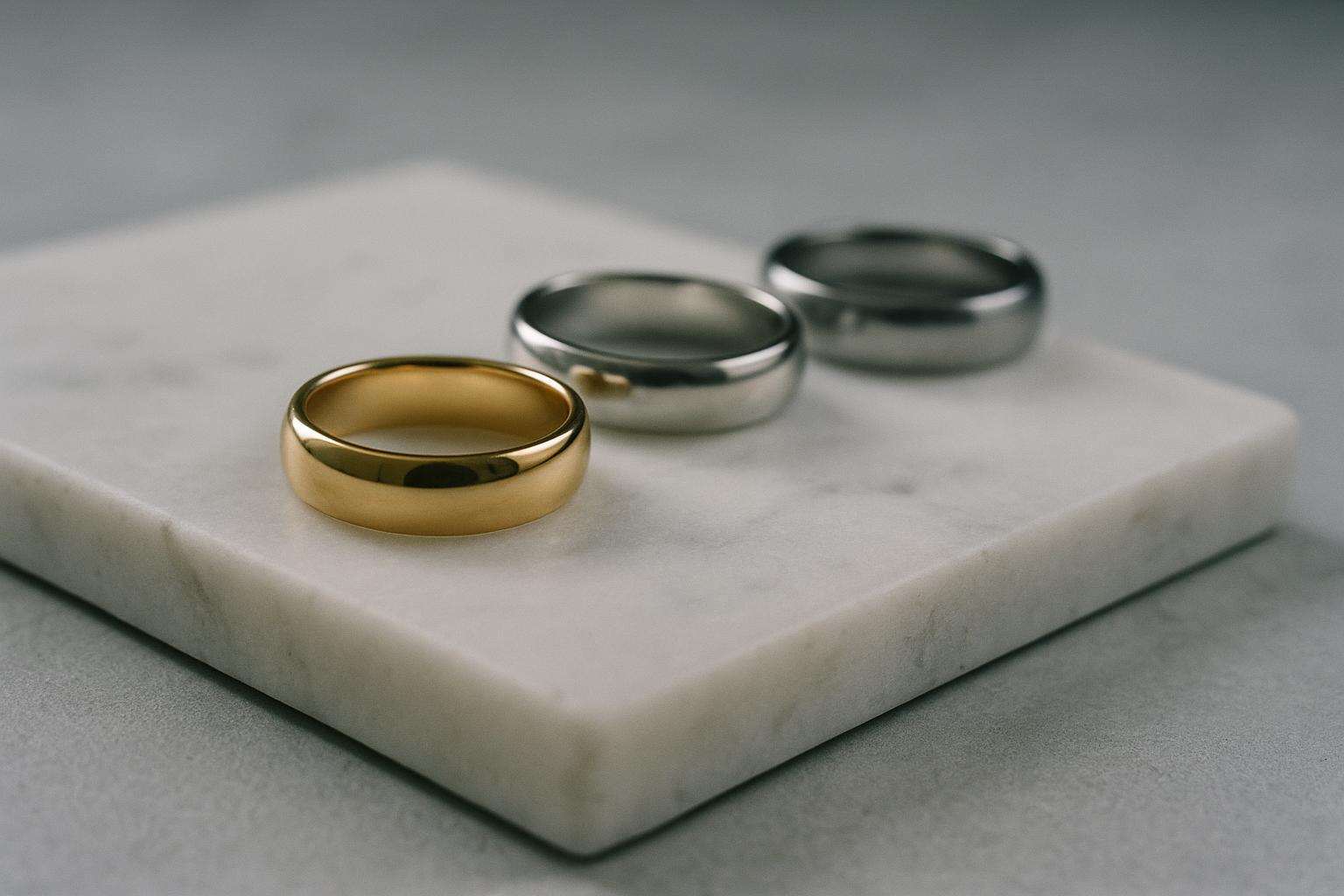
Gold hit a record $5,602 per ounce in January 2026 and still trades near $4,040 as of late June — roughly 21% above year-ago levels. Engagement ring setting prices across the industry have risen 40–50% over the past two years as a direct result. The best levers available to buyers right now: choose 14k over 18k gold (saves 20–40% on the setting), pick a setting style that uses less metal weight, and consider a lab-grown center stone (prices down ~40% over the same period) to rebalance the budget toward stone quality. Timing the gold market is not a sound strategy — the macro forces driving prices are beyond any buyer's control, and a deferred engagement rarely feels like a win.
At the bench, I spend a lot of time talking to couples about ring budgets. The conversation has changed materially over the past two years. It used to focus almost entirely on stone quality — the 4Cs, lab versus natural, shape trade-offs. Today, the opening question is often something like: "We looked at the same ring we wanted six months ago and now it costs $800 more. Why?" The answer is gold.
Gold's spot price surged from roughly $2,700 per ounce in early 2025 to an all-time record of $5,602 on January 28, 2026, according to JM Bullion's live price history. By late June 2026, it had pulled back to approximately $4,037–$4,040 per ounce — down about 28% from the peak, but still 21% above year-ago levels and dramatically elevated by any historical standard. Platinum followed its own parallel trajectory, hitting an all-time high of $2,734 per ounce on January 23, 2026, before retreating to around $1,600 by late June, as reported by Trading Economics.
Understanding how these commodity prices connect to the ring in the jewelry case requires understanding the pass-through chain — which is real, but neither immediate nor proportional. This explainer maps every link in that chain and points you toward the choices that actually matter.
How Does the Gold Spot Price Translate to a Ring's Retail Price?
The pass-through from gold's commodity price to a finished ring's retail tag operates through several layers, each adding friction — and each explaining why a 50% rise in gold's spot price does not produce a 50% rise in ring prices (though it does produce a real and significant one).
Step 1: The raw material input. A standard engagement ring setting consumes approximately 3–8 grams of gold depending on the design — a simple four-prong solitaire at the lighter end, a full pavé or three-stone design at the heavier end. At $4,040 per troy ounce (approximately $129.82 per gram), a 5-gram ring in 18k gold carries roughly $486 in raw gold content at current spot. The same ring in 14k gold carries roughly $378 — a $108 raw-material difference that, after manufacturing markup, can represent $200–$400 more at retail.
Step 2: Manufacturing and labor costs. The jewelry manufacturing sector's labor costs are denominated in dollars, not in gold. A bench jeweler spending four hours to fabricate a pavé setting costs the same in labor whether gold is at $1,500 or $4,000. This is why retail ring prices do not move in lock-step with spot: labor, overhead, and design complexity dilute the pass-through. For a $3,000 setting where labor and overhead represent $1,800 and raw gold represents $600, a 50% gold price increase adds $300 to total cost — a 10% retail increase, not 50%.
Step 3: Inventory pricing lag. Most retail jewelry stores price their inventory based on the metal cost at the time of manufacture or import, not at the moment you walk in. Ready-to-ship inventory made six months ago at lower gold prices may temporarily offer better value than made-to-order pieces priced at today's spot. The flip side: when gold falls, inventory manufactured at peak prices may price slowly out of the market as retailers carry higher-cost stock.
Step 4: Karat purity amplification. The karat system determines how much of each dollar in gold is actually in the ring. Eighteen-karat gold is 75% pure; 14k is 58.3% pure. When gold's spot price rises, the 18k ring sees a proportionally larger increase in raw material cost than the 14k ring. This is exactly why the karat premium — which in lower gold-price environments was a secondary consideration — has become a first-order budget decision in 2026.
| Setting Style | 14k Gold | 18k Gold | Platinum (Pt950) |
|---|---|---|---|
| Simple solitaire (4-prong) | $1,000–$1,700 | $1,300–$2,200 | $1,800–$3,200 |
| Hidden halo or pavé band | $1,800–$3,500 | $2,200–$4,500 | $3,000–$6,000 |
| Three-stone or side-stone | $2,000–$4,000 | $2,500–$5,000 | $3,500–$7,000+ |
| Plain wedding band (4–6mm) | $500–$1,000 | $650–$1,300 | $950–$1,800 |
| Typical premium vs. 14k gold | — | +20–40% | +$800–$1,500 (varies by weight) |
According to Washington Diamond's 2026 pricing guide, average setting prices across the industry have risen 40–50% over the past two years. Gem Breakfast's market analysis documents a 47% year-over-year increase in average ring prices despite simultaneous declines in diamond prices, directly attributing the discrepancy to gold's surge. For buyers who priced a ring in 2024 and are returning to purchase in 2026, the sticker shock is not imaginary — it reflects a genuine structural shift in input costs.
Why Does Platinum Still Cost More Than Gold Settings Even Though Gold's Spot Price Is Higher?
This is the most common — and most understandable — point of confusion among 2026 ring buyers. Gold currently trades at roughly $4,040 per ounce. Platinum trades at roughly $1,600. On a commodity basis, gold is the pricier metal by a factor of more than 2.5x. So why does a platinum setting cost more than a comparable white gold setting at the retail counter?
Three structural factors create and sustain the platinum retail premium regardless of commodity inversion:
Density. Platinum is approximately 60–65% denser than 14k gold. The same ring design, fabricated in platinum, requires substantially more metal by mass. Because the per-gram cost of platinum (roughly $51 per gram at current spot) is well below gold's per-gram cost (approximately $130 per gram), this density factor does not fully close the gap — but it does mean you are paying for significantly more grams of metal when you buy platinum.
Fabrication difficulty. Platinum's melting point is approximately 1,768°C — nearly twice gold's 1,064°C. Working platinum at the bench requires specialized torch equipment, higher-temperature kilns for casting, and more highly skilled labor time for setting stones and finishing surfaces. These labor costs are not commodity-linked; they are fixed in dollars and apply equally whether platinum is at $1,000 or $3,000 per ounce.
Purity. Pt950 — the standard hallmark for engagement rings — is 95% pure platinum. By comparison, 14k gold is 58.3% pure and 18k is 75% pure. The higher the purity, the more of the precious metal (rather than cheaper alloy) is present in every gram, amplifying the effective metal cost per piece even when the spot price differential favors platinum.
The net result is that platinum settings in 2026 typically command an $800–$1,500 premium over equivalent 14k gold designs, and a somewhat narrower premium over 18k, according to GoodStone's 2026 cost analysis. For buyers choosing between platinum and white gold for aesthetic reasons, the full picture of platinum's ownership economics is covered in our companion guide on platinum vs. white gold for engagement rings — including rhodium replating costs that add a long-term dimension to the comparison.
What Are the Practical Levers for Managing Ring Cost in a High-Gold Environment?
Gold prices being macro-driven means individual buyers cannot meaningfully time the market. What they can do is make structurally sound choices across the four variables that determine metal cost in a finished ring: karat, setting style, setting weight, and metal color.
Karat selection is the highest-leverage decision. Choosing 14k over 18k gold reduces the per-gram raw material cost by approximately 22% (from $130 to $100 per gram at current spot), and at retail this translates to a 20–40% price difference on the setting. For a $2,500 18k pavé setting, the equivalent 14k piece might cost $1,700–$2,000 — a $500–$800 savings with no visible quality compromise. Importantly, 14k gold is the superior choice for daily-wear durability: its higher alloy proportion makes it harder and more scratch-resistant than 18k, which is why roughly 90% of U.S. engagement rings are set in 14k regardless of gold prices.
Setting style and metal weight matter more than many buyers realize. A bezel setting — which wraps metal continuously around the stone's circumference — uses substantially more gold than a four-prong solitaire, which uses the minimum metal necessary to hold the stone. In 18k gold at current spot, the additional 2–3 grams of metal in a full bezel setting represents $70–$90 in raw material cost; after retail markup, the style premium for a bezel over a prong solitaire can range $400–$900 beyond the aesthetic preference. This does not mean avoiding bezels — they offer genuine stone-protection advantages, as we cover in our setting types comparison — but understanding the weight driver helps buyers contextualize the price difference.
Metal color choice carries no inherent cost premium — with one important exception. A 14k yellow gold ring and a 14k rose gold ring of identical design and weight cost exactly the same in raw material terms; the color is determined by the secondary alloy mix, not by any difference in gold content. White gold, however, requires rhodium electroplating at manufacture and periodic re-plating throughout ownership (typically every 12–24 months at $60–$120 per service visit), creating a modestly higher long-term total cost of ownership than yellow or rose gold. With yellow gold now the most-requested bridal metal — accounting for approximately 39–40% of engagement ring selections according to The Knot's 2026 data — choosing yellow gold is simultaneously the trend-forward and the lower-maintenance option.
Lab-grown diamond pricing has moved in the opposite direction. While metal costs have risen 40–50%, lab-grown diamond prices have fallen roughly 40% over the same two-year period, according to market data cited by the National Law Review's industry analysis. For budget-constrained buyers, this creates a rebalancing opportunity: choosing a lab-grown center stone frees up several thousand dollars that can be applied toward a heavier, more complex setting design, a higher stone quality grade, or both. A natural 1-carat G/VS2/Excellent stone might cost $4,500–$6,000; a lab-grown equivalent with the same GIA or IGI certifications might cost $800–$1,500 — a difference that more than absorbs any metal cost increase.
How Do Spot-Price Swings Actually Reach the Jewelry Counter?
The gap between commodity spot and retail sticker is real, and understanding its structure prevents both panic and false reassurance when you read a gold-price headline.
Jewelry manufacturers typically purchase gold and platinum from commodity dealers or refiners at or near spot, often hedging forward purchases to manage volatility. A large manufacturer might contract for gold deliveries 3–6 months in advance at a locked price, insulating their cost structure temporarily from spot moves. A small independent bench jeweler typically buys grain or sheet stock from a metals supplier at a small premium to spot, with no hedging. The pass-through speed therefore varies: large catalogue retailers reprice inventory on a schedule (often quarterly); custom and independent jewelers may quote more dynamically.
Made-to-order rings — where a customer deposits 50–75% upfront and the ring is fabricated over 4–8 weeks — lock in the metal price at the deposit date, not the delivery date. In a rising market, this is a modest buyer advantage; in a falling market, the reverse applies. Ready-to-ship inventory (rings already manufactured and sitting in a case or warehouse) reflects the metal cost at time of manufacture, which may be meaningfully lower than current spot. Searching for in-stock pieces rather than configuring a new ring from scratch can yield genuine savings when spot prices are elevated.
One structural reality worth understanding: Masina Diamonds' market analysis notes that jewelry manufacturing sector demand for gold contracted approximately 23.5% in Q1 2026 as sticker shock deterred budget-constrained buyers. This demand contraction has not yet produced meaningful price reductions at retail — manufacturer cost structures are stickier on the way down than on the way up — but it does mean retailers are more motivated to negotiate, particularly on complete rings (setting plus stone bundled) where margin structure is more flexible.
For a fuller view of how metal choice intersects with ring design decisions and setting geometry, the prong vs. bezel vs. tension setting security guide covers how setting type affects both metal weight and long-term stone retention — a parallel decision that belongs alongside metal selection in any ring-buying conversation.
Yellow Gold's 2026 Resurgence: Trend and Value Store Combined
It would be incomplete to discuss gold's market impact in 2026 without noting the cultural moment running alongside it. Yellow gold now accounts for approximately 39–40% of engagement ring metal selections in the United States — up from less than 20% five years ago — making it the top bridal metal choice for the first time in over two decades. This is not a price-avoidance trend; it is a genuine aesthetic shift.
The drivers are well-documented: a broader "quiet luxury" aesthetic favoring warm, timeless design over flash; the influence of celebrity engagements in warm metal (Taylor Swift's vintage-style yellow gold ring and Dua Lipa's bold bezel designs are consistently cited by industry analysts); and the rise of maximalist everyday gold jewelry — chunky chains, layered hoops — that has made yellow gold bridal pieces easier to coordinate with existing wardrobes. Jewelry historian Marion Fasel has noted that "there used to be just a law that the metal on an engagement ring would be white and reflect on the stone" — a convention that has decisively loosened.
The secondary effect: buyers who choose yellow gold are also making a decision aligned with lower ongoing maintenance costs (no rhodium replating required) and, in the cultural moment, with a metal that is itself widely discussed as a store of value. Whether or not a $1,700 ring setting meaningfully participates in gold's macro performance is debatable — the gold content of a typical setting is a few hundred dollars' worth of metal — but the symbolic alignment between the cultural cachet of gold-as-value and gold-as-ring is driving genuine purchase decisions. For the curious, our full analysis of yellow vs. rose vs. white gold and skin-tone pairing covers the aesthetic dimension of this choice in detail.
The Realistic Framework for Buying in 2026's Metal Market
Pulling it together: here is how I frame the metal cost question for couples I work with at the bench.
First, accept that metal prices are an environmental condition, not a problem to solve. Gold near $4,000 is the market; waiting for $2,500 gold is speculation, and the macro forces — central bank accumulation, geopolitical safe-haven demand, dollar dynamics — are genuinely unpredictable. The couples who bought at $5,500 gold in January 2026 did not make an objectively worse decision than those who bought at $3,000 in 2024; they just bought at different points in a cycle.
Second, apply leverage where it exists. The karat decision (14k vs. 18k) is real money at current prices. The center-stone choice (lab-grown vs. natural) is bigger money still, and the price trend there runs in buyers' favor. The setting style choice — how much metal weight the design requires — is a design decision with cost implications worth understanding before you fall in love with a specific ring.
Third, remember that metal is typically the minority of ring cost. The center stone accounts for 60–80% of total ring price in most configurations. Agonizing over $400 in metal cost while the stone decision holds $3,000–$6,000 in value is misallocated attention. Get the stone decision right first; the metal choice is meaningful, but it is a secondary optimization.
Fourth, shop for in-stock inventory if timing is flexible. Rings manufactured before gold peaked in January 2026 may still be priced at lower metal costs; ready-to-ship pieces represent legitimate value in a high-spot environment. Made-to-order work gives you design freedom but prices metal at the moment of deposit.
The macro picture for 2026 is genuinely challenging for engagement ring buyers in a way it has not been in prior generations — the 40–50% setting price increase over two years is not a rounding error. But the toolkit for navigating it is real, and understanding the pass-through chain from commodity to counter puts you in a materially stronger position than most buyers walking in cold.
Frequently asked
How much have engagement ring setting prices increased because of rising gold prices?
Significantly. Across the jewelry manufacturing sector, average setting prices rose an estimated 40–50% over the two years ending in mid-2026, driven primarily by gold's surge from roughly $2,700 per ounce in early 2025 to a record $5,602 on January 28, 2026. As of late June 2026, gold had moderated to approximately $4,040 per ounce — still about 21% above year-ago levels. The practical effect: a simple 14k white gold solitaire setting that cost $1,000–$1,200 two years ago may now list for $1,400–$1,700. The pass-through is not dollar-for-dollar (labor and overhead dilute it), but it is real and material, particularly for heavier settings with significant metal weight. Lab-grown diamond prices have fallen sharply over the same period — roughly 40% for comparable grades — which has partly offset the metal cost increase for buyers choosing a lab stone.
Does platinum still cost more than gold for ring settings even though gold's spot price is higher?
Yes — finished platinum settings still cost more than equivalent white gold settings, even though gold's spot price per ounce now exceeds platinum's on the commodity market. In late June 2026, gold traded near $4,040 per ounce versus platinum at approximately $1,600 per ounce. But three compounding factors keep platinum settings more expensive at retail. First, platinum is significantly denser — a ring design requires roughly 60–65% more metal by mass in platinum than in 14k gold, so you are paying the per-gram rate on a heavier piece. Second, platinum's far higher melting point (approximately 1,768°C versus 1,064°C for gold) demands more specialized bench equipment and greater bench time, raising labor costs. Third, Pt950 is 95% pure platinum; 14k gold is only 58.3% pure gold. The net result is a retail platinum premium of roughly $800–$1,500 over comparable 14k gold settings for most solitaire and halo styles.
Should I wait for gold prices to fall before buying an engagement ring?
In most cases, no — and the reasoning is straightforward. Gold's price is driven by macroeconomic forces (dollar strength, Federal Reserve policy, central bank reserve-building, geopolitical risk) that no individual buyer can predict reliably. The metal traded above $4,000 for the majority of 2025–2026 and hit an all-time record in January 2026; analysts at J.P. Morgan and Deutsche Bank have pointed to structural demand shifts that may sustain elevated prices for years. Additionally, waiting has a real cost: an engagement deferred while monitoring commodity markets is rarely the outcome couples intend. The smarter strategy is to work with price as a given and control what you can: karat choice, setting style, center-stone type (lab-grown), and retailer. Ready-to-ship inventory manufactured at earlier metal prices may offer modest near-term value; made-to-order pieces lock in the metal price at the deposit date.
Does choosing 14k versus 18k gold actually save meaningful money?
Yes — more so in 2026 than in any prior year. With gold near $4,040 per ounce, the per-gram cost gap between 14k (58.3% gold) and 18k (75% gold) translates to a larger absolute-dollar difference than when gold was at $1,500. Retail markup amplifies this: 18k pieces typically run 20–40% more than equivalent 14k designs after manufacturing costs are applied. For a mid-weight pavé setting that consumes 6–8 grams of gold, the karat premium can represent $200–$600 more at current gold prices. From a durability standpoint, 14k is also the more practical choice for daily-wear engagement rings — its higher alloy content makes it harder and more scratch-resistant than 18k. Approximately 90% of U.S. engagement rings are set in 14k for exactly this combination of value and durability.
Why does yellow gold now command nearly 40% of the engagement ring market if it has gotten more expensive?
The yellow gold resurgence is not primarily price-driven — it is aesthetic and cultural. According to The Knot's 2026 Real Weddings Study, yellow gold now accounts for approximately 39–40% of engagement ring metal selections, more than doubling its share over five years. The shift began well before gold's price surge and reflects a broader pivot away from the icy-white metal aesthetic that dominated 2005–2020. Celebrity engagements in warm metal — and the rise of the 'quiet luxury' and 'old money' aesthetic — pushed yellow gold into engagement rings after years of being the dominant choice only in fashion and stacking jewelry. Interestingly, some buyers now view yellow gold as a tangible store of value alongside its aesthetic appeal: with gold widely discussed as a hedge against economic uncertainty, choosing the metal in a ring feels doubly purposeful. The practical implication is that yellow gold rings are not a budget-avoidance choice — they are the trend-forward choice, full stop.
How does the metal choice affect the proportion of total ring cost that is metal versus stone?
For most engagement rings, the center stone accounts for 60–80% of total ring cost, meaning metal is the minority of spend even at elevated gold prices. A 1-carat natural round brilliant at G/VS2/Excellent cut might cost $4,500–$6,000; its 14k gold solitaire setting adds $1,000–$1,700. Switching to platinum adds $800–$1,500 to the setting cost — meaningful, but a small delta against the stone cost. Where metal choice bites hardest is for buyers who choose a lower-cost stone (such as a smaller natural diamond, a lab-grown diamond, or a colored gemstone), because the setting then represents a higher share of total cost. A $400 lab-grown stone in an $1,800 platinum setting inverts the normal proportion entirely. Understanding this ratio helps buyers allocate correctly: in most cases, optimizing stone quality is higher-leverage than agonizing over the karat choice.
What are the current spot prices for gold and platinum, and how do they compare historically?
As of June 25, 2026, gold trades near $4,037–$4,040 per troy ounce (JM Bullion live chart), down approximately 28% from its January 28, 2026 all-time record of $5,602 per ounce, but still about 21% above year-ago levels. Platinum trades near $1,599–$1,611 per troy ounce (Trading Economics), down significantly from its own all-time high of $2,734 set on January 23, 2026, but still approximately 14% above year-ago levels. Historically, platinum commanded a premium over gold for most of the past century; the current inversion — gold trading at more than twice platinum's spot price — is a structural reversal that began around 2015 and has widened sharply since 2024. For ring buyers, the takeaway is that platinum's retail premium over gold settings persists not from commodity-price parity but from density and labor economics.