Ring Styles & Settings
Cathedral, Basket & Flush Settings Explained
The three ring architectures that determine how high your stone sits, whether it snags on fabric, and whether your wedding band will ever lie flat — explained clearly, with real trade-offs.
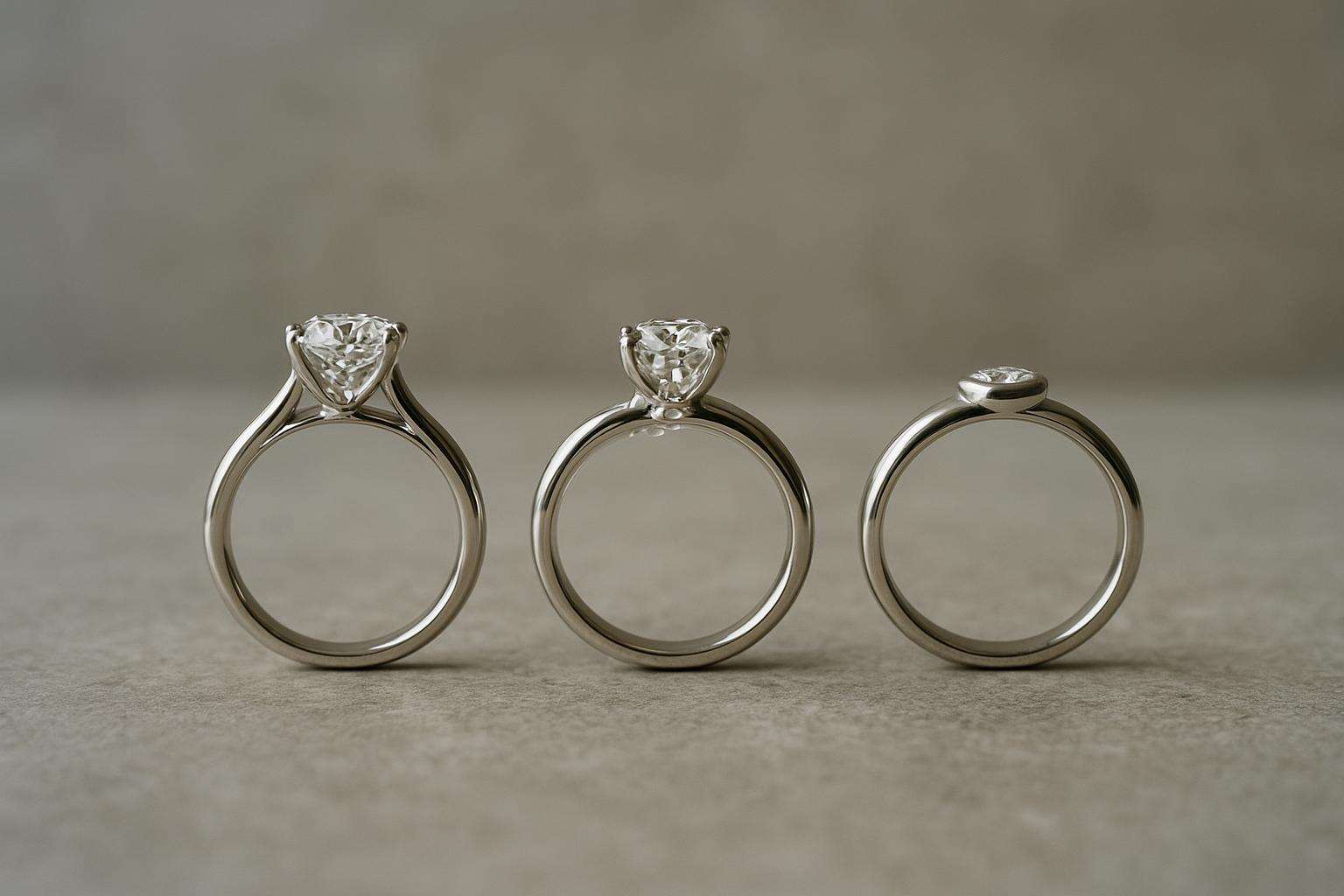
Cathedral, basket, and flush settings describe how the ring's shank supports and presents the center stone — and each creates a meaningfully different ring profile, snag risk level, brilliance trade-off, and band-pairing challenge. Cathedral settings elevate the stone for maximum light and presence but snag easily and require contoured wedding bands. Basket settings offer a lower profile with better structural security than a free-standing prong solitaire. Flush settings eliminate snag risk entirely but sacrifice brilliance and limit stone size. Choosing the right architecture is as important as choosing the right stone.
When a client sits down at my bench and says they want a ring that doesn't catch on everything, what they're actually describing is a setting architecture problem. The stone shape, the metal, the prong count — none of that matters as much as how high the stone sits above the finger and how much metal structure wraps around the shank. Cathedral, basket, and flush are the three primary answers to that question, and each involves a genuine set of trade-offs that marketing copy tends to obscure.
This guide explains the structural mechanics of all three in plain language. It is not a visual inspiration piece — it is a functional analysis of profile height, snag risk, light performance, band pairing, and resizing options. Read it before you fall in love with a specific ring, because the architecture you live in every day matters as much as the architecture you see in the product photo.
What Exactly Is a Cathedral Setting — and Why Does Height Matter?
The defining feature of a cathedral setting is the curved metal arch — some designers call them rises or bridges — that sweeps upward from the ring's shank and meets the stone head at an elevated position. The name comes from Gothic ecclesiastical architecture: the flying buttresses of medieval cathedrals, which transfer roof load outward and downward via graceful curved stone arches, are the direct visual and structural reference. On a ring, these arches serve a similar load-distributing function while dramatically raising the stone's elevation above the finger plane.
According to Blue Nile's detailed setting guide, cathedral settings exist in at least nine distinct design variants — single arch, double arch, double French arch, split arch, and several compound versions — each with different arch geometry and resulting stone heights. What they share is that additional clearance beneath the stone allows light to enter from more angles, which tends to enhance a diamond's brilliance and fire compared with a stone set low and close to the band. The stone also reads as more prominent on the hand: its elevation gives it presence from across the room.
The durability argument for cathedral settings is often underappreciated. The arched metal bridges create multiple structural connections between the shank and the head basket rather than relying on a single junction. This distributes mechanical stress over a wider area, making the head less susceptible to loosening from the shank under impact. For a ring that will be worn daily for decades, that structural redundancy matters.
Where cathedral settings fall short is in daily comfort and band compatibility. The elevated profile is significantly more likely to snag on knit fabrics, latex gloves, and hair than a low-set design. Wearers who report chronic snag frustration — pulling threads from sweaters, catching on surgical gloves, hooking on climbing holds — most commonly cite tall cathedral profiles as the cause. This is not a defect; it is a design consequence. A ring that elevates a stone enough to maximize light entry also creates enough clearance to catch on surrounding materials.
Band pairing is the second practical constraint. A standard flat wedding band placed against a cathedral engagement ring will sit with a visible gap at the arch, because the curved metal that sweeps up to the head prevents the two bands from resting flush against each other along their full length. The solution is a curved or contoured wedding band — sometimes called a shadow band — designed to follow the cathedral's arch silhouette. These are widely available and many ring designers offer them as matched sets, but it is a decision that needs to be made at the time of purchase, not after the wedding band is already bought.
What Is a Basket Setting and When Does It Make Structural Sense?
A basket setting is best understood as an upgraded prong solitaire. In a standard four-prong solitaire, four individual metal claws extend upward from the shank and grip the stone independently at four points around the girdle. Each prong is structurally isolated — if one bends or breaks, the stone loses approximately 25% of its holding support, creating genuine loss risk. According to Mikado Diamonds' security ranking, four-prong settings rank below six-prong settings specifically because of this single-prong vulnerability.
A basket setting adds horizontal metal rails beneath the stone's girdle that connect the prongs laterally, forming a continuous cage or cradle around the stone's lower section. These lateral connections change the structural physics significantly: stress from an impact or from daily wear is distributed across the entire basket frame rather than concentrated at individual prong tips. The stone is held by both the prong tips above and the lateral rails beneath, creating a more redundant grip system. As Ken & Dana Design notes in their setting comparison, this distributed structure makes basket settings measurably more secure than equivalent free-standing prong configurations for the same prong count.
The height profile of a basket setting is intermediate — typically lower than a cathedral but higher than a flush. The stone sits inside the basket cradle rather than being elevated on arching bridges, which keeps the overall ring profile closer to the finger. In practice, this reduces but does not eliminate snag risk: a basket setting is meaningfully more snag-friendly than a tall cathedral, but the prong tips still project above the basket frame and can catch on fine fabrics.
Light performance in a basket setting is good. The open lateral rails beneath the stone allow light to enter from the sides through the pavilion, preserving the diamond's brilliance and fire, while the stone's elevation above the finger plane gives it better light access than a flush design. For buyers who want security, reasonable sparkle, and a profile that is tolerable for daily wear — without the cathedral's arch height — the basket is frequently the most practical solution.
One maintenance note worth flagging: the basket's interior crevices collect debris more efficiently than a plain prong solitaire. Lotion, soap, and fine dust accumulate in the metal lattice beneath the stone and behind the lateral rails. A soft toothbrush and warm soapy water directed at the undercarriage of the basket every few months will clear this; an annual professional ultrasonic cleaning will handle the rest. This is a minor upkeep commitment, not a significant deterrent, but buyers who hate ring cleaning should know it going in.
What Does a Flush Setting Actually Do to a Diamond's Brilliance?
Flush settings — also called gypsy settings, a term dating to Victorian-era jewelry when the style was popular in men's signet rings — work on a fundamentally different principle than elevated settings. Instead of supporting the stone above the band, a flush setting sinks the stone into a precisely drilled or milled pocket in the band metal, so the stone's table surface sits at or marginally above the band's surface. The metal closes around the stone's girdle from all sides, and no prong tips project above the band. The resulting ring profile is essentially smooth.
The practical benefit is absolute: flush settings have the lowest snag profile of any setting architecture. There is nothing on a flush-set ring to catch fabric, puncture gloves, or snag hair. This is why flush settings dominate men's wedding bands and have a loyal following among buyers whose occupations or activities make prong-set rings genuinely problematic — surgical nurses, mechanics, pottery teachers, climbers, and anyone who regularly wears tight-fitting work gloves. The ring simply does not interfere with the hand's activity.
The optical cost is real and should not be minimized. A diamond held in an elevated setting receives light from above through the table and from the sides through the girdle and pavilion facets. A diamond sunk into a flush pocket receives light almost exclusively from above — the metal walls of the pocket block or absorb light that would otherwise enter from the side. Less light entering the pavilion means less total internal reflection, less spectral dispersion, and substantially less of the brilliance and fire that define a diamond's visual appeal. A 0.50-carat round brilliant in a flush setting will not perform optically like the same stone in a cathedral or basket setting. This is not a subtle difference — it is visible to any observer.
Flush settings also carry an implicit size ceiling. The structural mechanics limit their viability to smaller stones — typically under 0.75–1.00 carat — because drilling a pocket large enough for a heavier stone risks compromising the band's cross-sectional integrity. A band that is too thin at the pocket location can flex, crack, or allow the stone to loosen over time. For buyers who want the snag-free lifestyle of a flush setting at a larger stone size, a low-profile bezel setting is the closer alternative: it wraps a metal rim around the stone's girdle rather than sinking the stone into the band, and can accommodate larger stones while still eliminating prong-snag risk.
| Feature | Cathedral | Basket | Flush (Gypsy) |
|---|---|---|---|
| Stone Height Above Finger | High (arch-elevated) | Medium (cradle-supported) | None (sunk into band) |
| Snag Risk | High | Moderate | Minimal |
| Brilliance / Light Entry | Excellent | Good | Reduced |
| Structural Security | Strong (arched bridges) | Strong (distributed basket frame) | Strong (all-round metal grip) |
| Max Practical Stone Size | Any | Any | ~0.75–1.00 ct |
| Flat Wedding Band Compatible? | No — gap at arch | Usually yes | Yes — fully flush |
| Resizing Difficulty | Moderate (ornate arches harder) | Moderate (plain shank easier) | Difficult — buy correct size |
| Cleaning Demand | Moderate | Moderate (basket interior) | Low (smooth surface) |
How Does Setting Architecture Affect Wedding Band Pairing?
Band pairing is a decision that couples routinely defer until after the wedding ring shopping begins — and then discover that the engagement ring's architecture has already made certain choices for them. The three setting architectures create three distinct stacking scenarios.
Cathedral settings stack most comfortably with curved or contoured wedding bands. The arch that rises from the shank creates a void between the engagement ring and any band that sits against it; a contoured band fills that void by following the arch's profile. Cathedral settings also work with a deliberate gap — some wearers choose to separate the two rings intentionally, wearing the engagement ring alone most of the time and adding the wedding band for formal occasions. What does not work well is a flat band worn pressed against a tall cathedral arch: it will sit unevenly, create a visual interruption, and in some cases apply pressure to the arch metal over time.
Basket settings are the most versatile band pairing. Because the stone sits in a lower cradle rather than elevated on arching bridges, the transition from band to head is smoother and shallower. Standard flat wedding bands generally sit comfortably alongside basket-set engagement rings without a significant gap. Lightly curved bands also work well and create a cleaner stacked look. Couples who want maximum flexibility in their eventual wedding band choice — whether they select it now or years later — benefit from a basket setting's architectural tolerance.
Flush settings accept nearly any band design because the engagement ring profile is itself essentially flat. A straight flat wedding band sits flush against a flush-set engagement ring with no gap and no arch interference. This is one of the few architectural advantages of the flush configuration, and for buyers who prefer a minimal, modern stacking look — two flat bands worn together — flush settings deliver it most cleanly. As noted in the International Gem Society's setting guide, flush and channel settings are particularly compatible with clean, geometric wedding band designs.
One practical recommendation: if a client is buying an engagement ring without a matched wedding band in mind, choosing a basket setting gives them the most future flexibility. They can pair it with a flat band, a curved band, a pavé eternity band, or a plain comfort-fit band — almost any design works. Cathedral settings pre-commit to a contoured or specifically designed companion band, and flush settings work best with equally flat designs. Architecture first, band second — in that order — avoids the common frustration of loving your engagement ring and then discovering the wedding band options are limited.
For a deeper look at how different setting families — prong, bezel, tension, channel, and pavé — compare on security and maintenance, see our setting security and durability ranking. If you are weighing whether a cathedral setting is right for your lifestyle alongside other arch and elevation options, our full setting types comparison covers the complete landscape including halo and three-stone architectures.
Frequently asked
What is a cathedral setting on an engagement ring?
A cathedral setting uses curved metal arches — named for their resemblance to Gothic flying buttresses — that rise from the ring's shank and cradle the stone head at an elevated height above the finger. The raised profile allows more light to enter beneath the center stone, which can enhance brilliance and make the stone appear to sit prominently on the hand. Cathedral settings are among the most structurally robust shank configurations because the arched metal bridges provide multiple attachment points between the band and the head. The trade-off is a higher profile that is more prone to snagging on fabric, knitwear, latex gloves, and hair. Couples choosing a cathedral setting should plan for a curved or contoured wedding band to nest cleanly alongside the arch geometry — a standard flat band will sit with a visible gap.
What is a basket setting and how does it differ from a standard prong setting?
A basket setting is a hybrid prong architecture: four or six prongs extend upward from the shank as in a standard prong design, but horizontal bands of metal beneath the stone's girdle connect the prongs laterally, forming a cage or basket that nestles the center stone. The lateral rails distribute mechanical stress across the entire basket frame rather than concentrating it at individual prong tips — which is why basket settings are structurally more secure than free-standing four-prong configurations where each prong acts as an independent lever. Basket settings also position the stone lower to the finger than cathedral settings, which reduces snag risk while still maintaining open light paths beneath the stone for good brilliance. The interior crevices of the basket can trap debris over time, so cleaning with a soft brush and warm soapy water directed at the undercarriage is recommended every few months.
What is a flush setting (gypsy setting)?
A flush setting — also called a gypsy setting — sinks the stone directly into a drilled or milled pocket in the band metal so that the stone's table sits at or just above the band surface. No prongs project above the band; the surrounding metal grips the stone's girdle from all sides. This produces the absolute lowest snag profile of any setting type, making the ring surface essentially smooth. Flush settings are disproportionately popular in men's wedding bands and for active-lifestyle buyers — nurses, mechanics, rock climbers, and athletes who wear gloves. The significant optical trade-off is reduced brilliance: with the stone sunk into the metal, very little light reaches the pavilion from the sides, which diminishes a diamond's fire and scintillation compared with any elevated setting. Flush settings are also generally limited to stones under approximately 0.75–1.00 carat because drilling a larger pocket into a narrow shank risks compromising the band's structural integrity.
Which setting architecture is best for an active lifestyle?
For active-lifestyle wearers, the hierarchy runs roughly: flush > basket > low-profile cathedral > tall cathedral. Flush settings eliminate all snag risk and provide the most protection from impact, but sacrifice brilliance and limit stone size. Basket settings offer an excellent middle ground — lower profile than cathedral, more secure than a free-standing four-prong solitaire, and open enough beneath the stone to preserve sparkle. Bezel settings (a separate category from the three architectures covered here) offer maximum stone security by encircling the girdle entirely, and are often the top recommendation from jewelers for nurses, climbers, and anyone who works with their hands. Tall cathedral settings rank lowest for active wearers: the elevated arches snag frequently and the raised stone head is more exposed to direct impacts. If a client loves the look of a cathedral setting, a low cathedral variant — with a shallower arch rise — gives the classic profile without the most pronounced height.
Can a cathedral or basket setting be resized?
Both cathedral and basket settings can generally be resized, though complexity varies by design. A plain-shank cathedral with smooth metal arches is relatively straightforward to resize by one to two sizes — the jeweler cuts the shank, adds or removes metal, and rejoins it. Very ornate arch designs may require the jeweler to disassemble and re-form the arch structure for larger size changes, which increases bench time and cost. Basket settings with plain metal shanks below the basket are similarly straightforward to resize. The limiting factor for both styles is pavé or channel-set accent diamonds running along the shank: any setting where melee stones extend into the area where metal must be removed or added becomes considerably more complex and expensive to resize, because individual accent stones may need to be removed, the metal altered, and the stones re-set. Flush settings are the most difficult to resize of the three, because the stone's security depends on precise channel tolerances — a size change can alter those tolerances and require refitting. Buyers choosing flush settings should purchase to their correct size at the outset and consult the jeweler explicitly about future resizing options.
Will a cathedral engagement ring work with a straight wedding band?
A straight, flat wedding band will sit alongside a cathedral engagement ring but will not nest flush against it — the arched metal that sweeps up toward the head creates a gap between the two bands at the point where they touch. Whether that gap bothers you is a matter of personal preference, but many couples find it visually distracting and uncomfortable to wear both rings together. The standard solution is a curved or contoured wedding band designed to follow the silhouette of the engagement ring's cathedral arch. These are widely available from all major retailers and boutique jewelers, and many engagement ring designers offer matched contoured wedding bands. Alternatively, a chevron or V-shaped wedding band creates an intentional visual frame around the cathedral head. If you are set on a perfectly flush straight band stack, a basket or low-profile setting is the more compatible architecture choice.