Where to Buy
How to Choose a Jeweler: Credentials, Red Flags & Questions to Ask
Before you hand over thousands of dollars, learn which certifications actually matter, which lab reports to trust, and the exact questions a good jeweler will welcome.
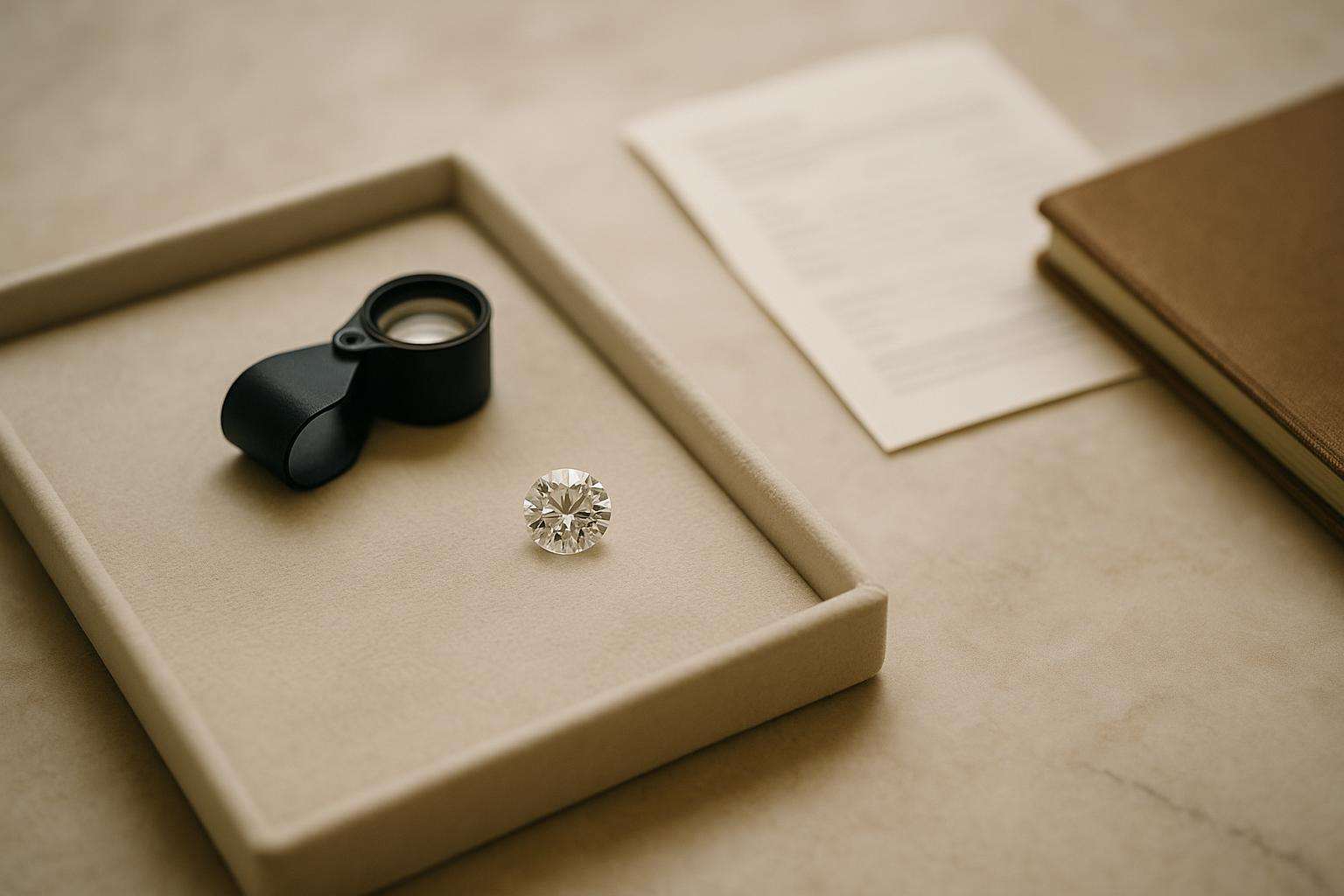
A trustworthy local jeweler holds current credentials from GIA, AGS, or Jewelers of America; sells diamonds with GIA or AGS reports; welcomes your questions about documentation; and puts every policy in writing. Any jeweler who resists independent verification, uses EGL or obscure-lab reports while implying equivalence to GIA, or applies high-pressure tactics is waving a red flag you should not ignore.
Buying an engagement ring from a local jeweler should feel like consulting a specialist, not negotiating with a salesperson. The problem is that "local jeweler" covers an enormous range of expertise and integrity — from a bench gemologist who has been grading diamonds for thirty years to a retail clerk who completed a weekend sales training. The credentials on the wall, the grading report in the box, and the questions you ask before you buy are the tools that separate one from the other.
This guide walks you through the three credentialing bodies that anchor the professional tier of the industry, the laboratory certificates that protect you versus the ones that can cost you thousands, and the specific questions a genuinely knowledgeable jeweler will answer without hesitation. If you are still deciding whether local is the right channel at all, the companion piece on online versus in-store buying covers the full trade-off.
Which Jeweler Credentials Actually Mean Something?
Three organizations credential jewelers at a level worth recognizing. They are not equivalent — each represents a different emphasis and a different bar — but any one of them is meaningful evidence that the professional across the counter has invested in their craft beyond basic retail training.
GIA: The Graduate Gemologist Standard
The Gemological Institute of America (GIA), founded in 1931, is the world's most widely recognized source of gemological education and diamond grading standards. When a jeweler holds a GIA Graduate Gemologist (GG) designation, they have completed a structured curriculum covering diamond grading, colored-stone identification, gem valuation, and practical loupe skills — the full technical foundation for evaluating what you are buying. GIA also offers the Graduate Diamonds and Applied Jewelry Arts programs; each represents a meaningful investment in education. You can verify a staff member's credentials directly with GIA.
Critically, GIA's grading reports for diamonds are the buyer's primary documentary protection. When a diamond carries a GIA grading report, every aspect of the 4Cs — cut grade, color grade, clarity grade, and carat weight — has been evaluated by trained graders under controlled conditions, cross-checked by multiple analysts, and recorded against a report number that is verifiable online. For diamonds graded since approximately 2008, GIA also laser-inscribes that report number on the stone's girdle, visible under a 10x loupe, so the certificate can be matched to the specific stone in front of you.
AGS: Annual Recertification and the CGA Designation
The American Gem Society (AGS), established in 1934, operates as a trade membership and credentialing organization with one feature that is rare in any professional field: a mandatory annual recertification exam. All AGS titleholders must pass a written recertification each year to maintain their standing. AGS credentials progress from Registered Jeweler (RJ) through Certified Gemologist (CG) to Certified Gemologist Appraiser (CGA), with each level representing deeper expertise in gemology and, at the CGA level, formal training in jewelry appraisal and valuation methodology. According to AGS, only approximately one in twenty jewelers meets membership criteria.
One important clarification for buyers: in 2022–2023, AGS Laboratories — the grading lab division — merged with GIA, and GIA now issues diamond reports using AGS light-performance methodology. This merger affected the lab only; the AGS trade association and its jeweler credentialing program continue to operate independently. An AGS-credentialed jeweler is still a meaningful designation; you can verify current standing through the AGS "Find a Jeweler" directory.
The CGA designation is especially valuable if you are bringing a family stone for a custom reset or if you need a formal appraisal for insurance purposes. A Certified Gemologist Appraiser has specific training in producing appraisals that satisfy insurance underwriters' requirements — training that a general retail salesperson does not have.
Jewelers of America: Trade Membership and the Code of Professional Practices
Jewelers of America (JA), founded in 1906, is the national retail trade association for fine jewelry businesses. JA membership is not a gemological credential in the same sense as GIA or AGS — it does not require a knowledge exam — but it requires an annual commitment to JA's Code of Professional Practices, which mandates honesty, transparency in all transactions, compliance with applicable laws including FTC disclosure rules, and alignment with Responsible Jewellery Council principles. JA membership covers more than 8,000 retail storefronts across the United States. JA also offers nationally recognized certification programs in sales and bench craft through its education arm.
Think of JA membership as an ethical floor: it does not certify expertise, but it does represent a public, verifiable commitment to professional conduct. A jeweler who is both JA-member and GIA-credentialed has cleared both bars.
What Do Diamond Lab Reports Actually Guarantee — and Which Labs Should Raise a Red Flag?
A grading report is only as reliable as the laboratory that issued it. The diamond market contains a wide range of grading labs, and they are not equivalent in their standards, methodology, or consistency.
The Two Laboratories Worth Trusting Unconditionally
GIA and AGS Laboratories (now absorbed into GIA) are the industry benchmarks for diamond grading consistency. GIA grades are produced through a multi-grader consensus process under standardized lighting conditions; the methodology is published and peer-reviewed. When a diamond's color is graded G and clarity is graded VS2 on a GIA report, those grades reflect a consistent, documented standard. IGI (International Gemological Institute) is broadly accepted at major online retailers like Blue Nile and James Allen and has increased its consistency in recent years, though industry practitioners generally still consider GIA the tighter standard for natural diamonds.
Labs That Should Prompt Caution
The labs that have drawn consistent criticism from professional gemologists are EGL (European Gemological Laboratory) in its various national branches, and lesser-known commercial labs such as GGL. The specific concern is grade inflation: industry gemologists have found that a diamond graded VS2/G by some EGL branches may test as SI1/I — or lower — under GIA standards. A two-to-three-grade difference in color and clarity is not cosmetic. On a one-carat diamond in the G/VS2 range, that difference can represent $3,000 to $8,000 in actual market value. The stone is not misrepresented in an illegal sense — the EGL report is a real report — but the buyer pays G/VS2 prices for a stone that the market prices as I/SI1.
The FTC's Guides for the Jewelry Industry require that any representation about a diamond's quality characteristics must be accurate and not misleading. A jeweler who presents an EGL-graded stone as equivalent in quality to a GIA-graded stone at the same grade level without disclosing the difference in grading standards is in murky regulatory territory at best. The practical defense: ask which lab issued the report before any price is discussed, verify the report number on the lab's official website, and — if the stone carries a non-GIA report — ask the jeweler what the GIA equivalent grade would be. A knowledgeable, honest jeweler will answer that question directly.
| Lab | Grade Consistency | Report Verifiable Online? | Buyer Recommendation |
|---|---|---|---|
| GIA | Industry gold standard | Yes — gia.edu/report-check | Accept with confidence |
| IGI | Broadly accepted; slightly less strict than GIA on naturals | Yes — igi.world | Acceptable; verify online |
| EGL (any branch) | Historically inconsistent; grades often run 2–3 levels generous vs. GIA | Varies by branch | Caution; request GIA re-grade if purchasing |
| GGL / obscure labs | No public methodology; unverifiable consistency | Often no | Do not accept as equivalent to GIA |
Red Flags: What a Trustworthy Jeweler Will Never Do
In more than a decade at the bench and in conversations with buyers who have had bad experiences, the same patterns appear when something has gone wrong. Here is the concrete list.
Red Flags in Documentation
- Refusing to show documentation before a sale is agreed. A grading report should be available to inspect at any point. There is no legitimate reason to withhold it.
- Presenting a photocopy rather than the original report. GIA and AGS reports have security features. Ask to see the original. Photocopies can conceal alterations.
- Implying that a lesser-lab certificate is equivalent to GIA without disclosing the grading difference. This is the most financially damaging red flag in the list.
- Discouraging you from verifying the report online. "We don't do that here" is not an acceptable answer when GIA Report Check is a free public tool.
Red Flags in Sales Behavior
- Price anchoring within the same conversation. A jeweler who opens at $8,000 and immediately drops to $5,200 "just for you today" is using a manufactured discount. Real pricing does not work this way.
- Urgency pressure. "This stone won't be here tomorrow" is a sales tactic, not a fact about the diamond market. Diamonds are not that scarce.
- No written return policy or warranty. Any legitimate jeweler provides a written policy. Walk away from verbal-only assurances.
- Deflecting negative reviews without resolution. Check Google, Yelp, and the Better Business Bureau before visiting. A pattern of unresolved complaints about grading misrepresentation or repair damage is a serious warning sign.
Red Flags in Repairs and Heirloom Work
If you are bringing a family stone for resetting — a more vulnerable transaction because the stone carries irreplaceable sentimental value — additional caution is warranted. A trustworthy bench jeweler will provide a written liability contract specifying their coverage if the stone is damaged during removal. Any jeweler who immediately suggests melting the original metal without presenting redesign alternatives is redirecting a decision that should originate with you. Ask specifically: does the jeweler carry in-shop insurance covering your piece while it is in their possession? If the answer is unclear or evasive, take your stone elsewhere.
The Questions to Ask Before You Buy Anything
These seven questions are not antagonistic — they are the natural questions a serious buyer should raise, and a skilled, honest jeweler will answer every one of them without hesitation. Resistance, evasion, or deflection on any of these is information.
- "What are your gemological credentials?" You want to hear GIA Graduate Gemologist, AGS Certified Gemologist, or equivalent. Ask to see the certificate if it is not displayed.
- "Which laboratory graded this diamond, and may I look up the report right now?" You want GIA or IGI. You want to run the report number on the lab's website while you are in the store.
- "Is the report number laser-inscribed on the girdle?" For GIA reports issued after approximately 2008, yes. Ask the jeweler to show you under a loupe.
- "What is your return policy, and can I have it in writing?" Thirty days is a reasonable minimum. Custom and engraved pieces are frequently final sale — know before you commit.
- "Do you have a written warranty on the setting?" A minimum of one year against prong failure or stone loss due to manufacturing defect is standard at reputable shops.
- "Does your bench jeweler work on-site, or is repair work sent out?" On-site bench capability is a proxy for genuine craft investment. Work sent to a third-party bench adds time and introduces an additional chain of custody for your stone.
- "If I want to have this stone independently appraised before purchase, will you hold it for me?" A jeweler confident in their merchandise will say yes. This is particularly important for heirloom resets and high-value purchases.
If you are in the process of deciding whether to buy locally at all, the full decision framework — including when online retailers offer a genuine price advantage — is covered in the Where to Buy guide for the complete picture.
How to Find a Credentialed Jeweler in Your Area
Three directories are the most reliable starting points.
The AGS "Find a Jeweler" directory lists AGS titleholders by location and displays their specific credential and current recertification status. Because AGS requires annual renewal, a listed jeweler's standing is current, not historical.
The Jewelers of America "Find a Jeweler" tool covers JA member stores across the United States and is searchable by zip code. It confirms that the store has agreed to JA's Code of Professional Practices.
GIA's alumni directory is not publicly searchable in the same way, but many GIA Graduate Gemologists display their credentials prominently on their websites and Google Business profiles. Searching "GIA Graduate Gemologist [city]" is a reasonable starting point, followed by cross-checking the credential with GIA directly.
Once you have a shortlist, supplement the directories with recent Google and Yelp reviews, paying specific attention to reviews that mention grading documentation, repair work, and staff knowledge rather than just the aesthetic of the store. A shop with beautiful cases and mediocre gemological expertise is a poor combination for a high-stakes purchase.
Credential verification is the beginning of the vetting process, not the end. The questions you ask in person — and the transparency with which they are answered — remain your most reliable guide to whether a particular jeweler deserves your trust and your business.
Frequently asked
What is the most important credential to look for in a jeweler?
A GIA Graduate Gemologist (GG) designation is widely considered the gold standard. It requires completing the Gemological Institute of America's rigorous coursework in diamond grading, colored-stone identification, and gem valuation. For buyers purchasing a diamond, pairing a GIA-credentialed jeweler with a GIA grading report on the stone itself provides the strongest consumer protection available. The Where to Buy hub covers how this fits into the broader buying decision.
Is a GIA certificate the same as a jeweler being GIA certified?
No — and the distinction matters. A GIA grading report (often called a GIA certificate) is issued for a specific diamond and documents its 4Cs — cut, color, clarity, and carat weight. A GIA-credentialed jeweler is a person who has completed GIA education programs such as the Graduate Gemologist or Graduate Diamonds degree. You want both: a jeweler educated by GIA and a grading report from GIA for the stone you are purchasing. One does not substitute for the other.
What lab certificates should raise a red flag?
Be cautious about diamonds graded by EGL (European Gemological Laboratory) or lesser-known labs such as GGL if the jeweler implies these are equivalent to GIA or AGS. Industry gemologists consistently find that EGL grades can run two to three color or clarity levels more generous than GIA would assign the same stone — meaning a stone sold as VS2/G by EGL might test as SI1/I under GIA standards. That difference is not cosmetic; it translates directly into price. Always ask which laboratory issued the report and verify the report number on the lab's official website before purchasing.
What does AGS recertification mean and why does it matter?
The American Gem Society (AGS) requires all titleholders — Registered Jeweler, Certified Gemologist, and Certified Gemologist Appraiser — to pass an annual written recertification exam to maintain their standing. This annual renewal requirement is rare in any trade profession and means an AGS title is an active, maintained credential rather than a one-time achievement. When a jeweler displays an AGS title, you can verify their current standing through the AGS directory. Note: in 2022–2023, AGS Laboratories (the grading lab division) merged with GIA, but the AGS trade association and its credentialing program continue to operate independently.
What questions should I always ask a local jeweler before buying?
Five questions every trustworthy jeweler will welcome without hesitation: (1) What are your gemological credentials, and may I see documentation? (2) Which laboratory issued this diamond's grading report, and can I look it up online right now? (3) What is your return policy, and is it in writing? (4) Do you have a written warranty covering the setting for at least one year? (5) If I need a resize or repair later, will your in-house bench jeweler handle it, or is it sent out? A jeweler who hesitates on any of these — or who steers you away from independent verification — is a jeweler to walk away from.
How do I verify a GIA report is authentic?
Go directly to GIA Report Check at gia.edu and enter the report number printed on the certificate. GIA will return the stone's documented grades. For diamonds graded since approximately 2008, GIA also laser-inscribes the report number on the stone's girdle — a jeweler can show you this inscription under a loupe or microscope. If the on-paper grades differ from the GIA database, do not proceed with the purchase and consider filing a complaint with the FTC.