Where to Buy
Custom Engagement Ring Cost: Process, Timeline & What You'll Pay
A custom ring doesn't have to cost more than a ready-made one — but only if you understand what drives the price at every stage of the build.
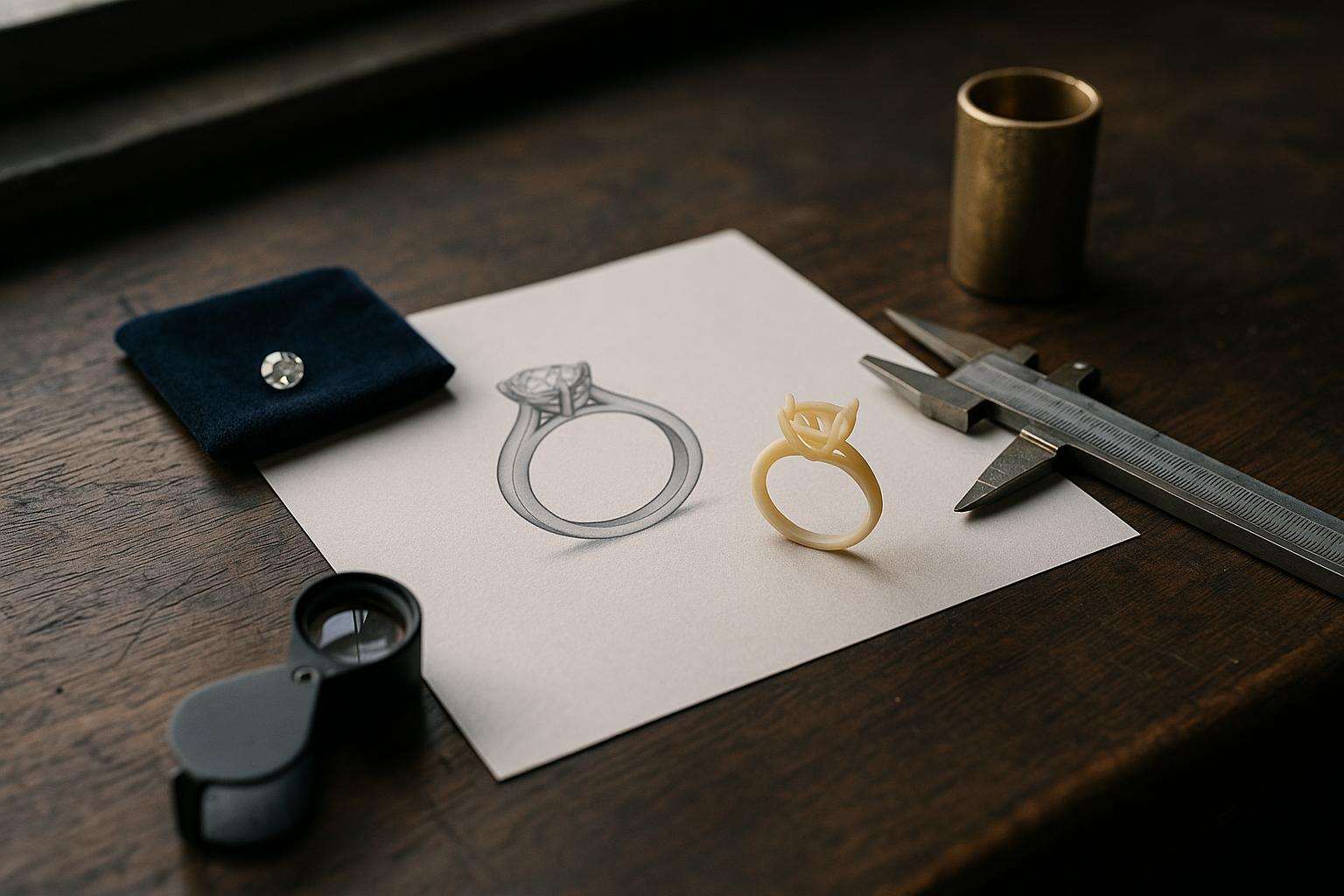
A custom engagement ring is not automatically more expensive than one purchased off the shelf. Materials — stone and metal — drive 70–80% of the price in both cases. What custom adds is a six-phase design process (roughly four to eight weeks), a CAD rendering and physical prototype you can evaluate before casting, and a ring that fits one person's taste precisely. Design fees of $250–$750 are typically credited toward the final purchase. The center stone is still the dominant cost variable; choosing a lab-grown diamond can cut that line item by 50–70% and free real budget for design complexity.
Does a Custom Ring Actually Cost More Than Ready-Made?
It is the most persistent myth in the engagement ring market: custom means expensive. Walk into a national chain and that assumption is quietly reinforced by the showroom setting, the glass cases, the sales associate who steers you toward the price board. In practice, the math does not bear it out.
A ready-made engagement ring at a retail jeweler carries built-in overhead: showroom rent, staff payroll, national advertising, and the capital cost of financing standing inventory. Those costs are embedded in the retail price, which commonly runs 200–300% above the jeweler's cost at chain retailers. A custom ring built to order by an independent jeweler eliminates most of that overhead. What you pay for instead is skilled design and bench labor — and that labor is a much smaller fraction of the total than most buyers expect.
According to industry pricing data compiled in 2026, a custom 14K gold solitaire with a 0.75-carat diamond runs roughly $3,000–$5,000 — the same price band as a comparable quality off-the-shelf ring from a credentialed independent jeweler. Diamond Watcher's 2026 analysis notes that demand for custom designs has risen approximately 47% over the five years to 2025, partly because buyers who have done the math understand this dynamic.
Where custom genuinely commands a premium is at the design complexity end of the spectrum: asymmetric settings, mixed-metal construction, extensive hand-set micro-pavé, or a geometric profile requiring significant bench time. These pieces cost more to produce than a mass-manufactured equivalent — not because custom is inherently expensive, but because the design itself demands more skilled hours.
| Ring Type | Custom (independent jeweler) | Ready-Made (comparable quality) |
|---|---|---|
| 14K gold solitaire, lab-grown 1 ct | $3,500–$5,500 | $3,200–$5,000 |
| 14K gold solitaire, natural 0.75 ct | $3,000–$5,000 | $3,500–$5,500 |
| Three-stone, natural 1.5 ct total weight | $7,000–$12,000 | $8,000–$14,000 |
| Platinum pavé halo, natural 1 ct | $10,000–$18,000 | $12,000–$20,000+ |
| Complex bespoke (mixed metals, asymmetric) | $15,000–$30,000+ | Rarely available at equivalent complexity |
One additional variable worth knowing: The Knot's 2025 Jewelry and Engagement Study, based on more than 10,000 couples surveyed, found the average engagement ring cost was $4,600 — down from $5,200 the previous year, largely driven by the surge in lab-grown diamond adoption. Sixty-one percent of couples chose a lab-grown center stone in 2025, up from roughly 18% in 2020. That shift is directly relevant to the custom market: lab-grown diamonds of equivalent 4Cs specifications run 50–70% less than natural equivalents, which means a buyer can commission a genuinely complex custom design and still land within a moderate budget.
What Are the Six Phases of Custom Ring Design?
Understanding the workflow is important for two reasons: it tells you where your money actually goes, and it tells you where the leverage points are if you want to control cost or timeline.
Phase 1 — Consultation
The process begins with a structured design consultation, typically one to two hours. You discuss style references (bring images — Pinterest saves, magazine clippings, photos of jewelry you already own and love), lifestyle factors (an active person needs different prong geometry than someone who works at a desk), metal preferences, and budget. If you are incorporating an heirloom stone, it should come to this meeting for an initial inspection. The outcome is an agreed design direction: stone shape, setting family (solitaire, halo, three-stone), metal, and any non-negotiable details.
Phase 2 — CAD Design and Approval
For any design with meaningful complexity, the jeweler moves from hand sketches into CAD (computer-aided design) — typically Rhinoceros 3D or Matrix software. The CAD model is a photorealistic three-dimensional rendering of the ring that can be rotated, sectioned, and examined from every angle. This is the most important phase to engage with carefully. The prong geometry, band profile, setting height, and stone-to-metal proportions are all established here; changes at this stage cost nothing. The same change after casting costs real gold.
A standard round of revisions is included in the design fee at most studios. Significant redesigns — changing the setting family entirely, switching from yellow gold to platinum — may incur an additional revision charge of $50–$150. Buchroeders Jewelers' process guide notes that buyers who bring clear visual references to the consultation reduce revision rounds substantially.
Phase 3 — Stone Selection
Stone selection happens in parallel with or immediately after CAD approval. The jeweler either presents stones from their own inventory or sources loose diamonds and gemstones to your specifications. Evaluate each stone in natural light if possible — incandescent jewelry-case lighting is flattering to a fault. For any natural diamond of 0.40 carats or larger, insist on a GIA grading report, verifiable online via the GIA Report Check tool at gia.edu. The report's laser-inscribed girdle number should match the certificate. For lab-grown diamonds, IGI continues to issue traditional 4Cs letter grades (GIA moved to a simplified descriptor system for lab-grown stones in 2025); either certification is widely accepted. Understanding the 4Cs before this conversation will help you evaluate the trade-offs — a well-cut G-color SI1 can outperform a poorly-cut D-color VVS2 in real-world brilliance.
Phase 4 — Wax or Resin Prototype
The approved CAD file drives either a 3D-printed resin or a CNC-milled wax prototype — a physical, to-scale model of the ring. This step is underappreciated. Try it on. Check the setting height against your lifestyle (a very tall cathedral solitaire will catch on everything if you work with your hands). Confirm the band width looks proportionate on your finger. The wax prototype is the last practical moment for design changes; alterations after this point incur re-casting costs. If anything about the prototype concerns you, say so.
Phase 5 — Casting, Setting, and Polish
The approved wax enters production. In the lost-wax casting process, the wax model is encased in investment (a plaster-like material), the wax is burned out in a kiln, and molten metal is injected into the resulting void. After casting, the raw ring is cleaned, filed, and refined by a bench jeweler. Stones are hand-set — the most skill-intensive step in the entire process. For white gold, a rhodium-plating bath follows final polish to produce that mirror-bright white finish (rhodium plating will wear over time and typically needs refreshing every one to three years at a cost of $50–$100).
Phase 6 — Final Inspection and Handover
A thorough inspection under a jeweler's loupe checks casting integrity (porosity, incomplete fill), setting security (each prong checked for height and firmness), and surface finish. Any reputable studio will not release a ring that does not pass this check. Ask to see the inspection yourself — a jeweler who hands you a loupe without hesitation is a jeweler worth trusting. At handover, you should receive the stone's grading report, any warranty documentation, care instructions, and a receipt detailed enough to serve as a preliminary insurance document.
How Much Does Each Phase Cost, and Where Can You Save?
The design fee covers phases 1–4 and runs $250–$750 at most independent studios, with Bay Area and New York jewelers sitting toward the upper end and smaller-market studios toward the lower. Most studios credit this fee against the final purchase price if you commission the ring with them. Think of it as a reservation of skilled time, not a penalty for asking questions.
The production cost — metal, casting, bench labor, and setting — is where the real dollars live. A rough breakdown for a mid-complexity 14K gold solitaire engagement ring:
- Center stone: $1,500–$6,000+ (the dominant variable; lab-grown cuts this dramatically)
- Metal — 14K gold band: $400–$900 depending on weight and current gold spot price
- Platinum band (if applicable): $1,000–$2,500 — platinum is denser and the material itself costs more per gram
- Casting and finishing labor: $300–$800
- Stone setting labor: $150–$400 for a single stone solitaire; more for pavé or multi-stone
- CAD/design fee: $250–$750 (often credited back)
The most impactful cost lever in the entire equation is the center stone. Choosing a lab-grown diamond — which carries identical optical, chemical, and physical properties to a natural diamond, as confirmed by the FTC's updated guidance — can reduce that line item by 50–70%. A natural round brilliant of 1 carat at G/VS2 runs roughly $5,000–$7,000 in 2026; a lab-grown equivalent of the same 4Cs runs $1,500–$2,500. That difference funds significant design complexity at no net budget increase.
The second meaningful lever is stone shape. Fancy shapes — oval, pear, marquise, elongated cushion — are priced below round brilliants of equivalent carat weight because round cuts command a premium for their consistent light-return and mass-market demand. An oval at the same carat weight and quality grade runs 15–25% less than a round; a marquise, 20–35% less. The tradeoffs between each shape are worth understanding before committing to a center stone.
A standard payment schedule at most custom studios: a project deposit of $200–$500 at design approval; a 75% deposit when the piece enters production; the final 25% at handover. Confirm this structure in writing before any money changes hands.
How to Choose a Jeweler for a Custom Commission
The single most important qualification to look for is GIA credentials — either a Graduate Gemologist (GG) or Graduate Diamonds (GD) designation earned through the Gemological Institute of America. GIA-credentialed bench jewelers have completed structured coursework in stone grading, precious metals, and fabrication, and are trained to the standard most buyers assume all jewelers meet (many do not). The American Gem Society (AGS) credential — Certified Gemologist (CG) or Certified Gemologist Appraiser (CGA) — represents a comparable level of demonstrated expertise, with annual recertification required to maintain standing.
Beyond credentials, ask to see examples of past custom work, particularly rings with a similar design profile to what you have in mind. Ask whether they produce a CAD rendering and physical prototype as standard — any studio that skips the prototype phase is removing your last chance to evaluate proportion and fit before metal is committed. Ask for a written scope of work before paying any deposit: it should specify the stone's 4Cs and grading report number, the metal and karat, the design description, the payment schedule, the production timeline, and the return or revision policy.
For buyers considering a local independent jeweler, the AGS's "Find a Jeweler" directory and Jewelers of America's member search are reliable starting points for credentialed studios in your area. Note that as of mid-2026, James Allen's standalone website has been folded into Blue Nile as a proprietary collection following the Signet-driven consolidation; buyers who previously used James Allen's 360-degree diamond viewer for custom stone selection should direct that workflow to Blue Nile's platform or to super-ideal specialists like Whiteflash for the highest-tier cut-quality requirements.
One underused option: if you own an heirloom diamond — a grandmother's engagement stone, a family ring that no longer fits anyone — incorporating it into a new custom setting eliminates the center stone cost entirely. The stone needs a professional inspection for structural integrity first, and you may want a GIA report if one does not exist, but the economics are compelling. Design and fabrication for a new bespoke setting around an existing stone typically run $1,500–$5,000 depending on metal and complexity — a fraction of a full ring purchase. Once your ring is complete, insuring it through a standalone policy like BriteCo or Jewelers Mutual costs roughly 1–2% of appraised value annually and is well worth scheduling in the same week you take delivery.
Frequently asked
How much does a custom engagement ring cost in 2026?
The most common range for a custom engagement ring in 2026 is $3,000 to $15,000, with the majority of couples landing between $5,000 and $10,000. Entry-level custom rings — simple solitaire in 14K gold with a lab-grown diamond of approximately 1 carat — typically fall between $3,500 and $5,500. Mid-range natural-diamond custom rings with 1 to 1.5 carats and some design complexity run $7,000 to $12,000. High-end builds in platinum with accent stones and intricate hand-set pavé can exceed $20,000. The center stone alone accounts for roughly 60–80% of the total, so the metal choice and design complexity have a proportionally smaller impact than most buyers expect. See what each budget tier realistically buys.
Is a custom engagement ring more expensive than a ready-made one?
Not necessarily — and in many cases a custom ring comes out to the same price or less. Here is why: a ready-made ring carries the overhead of showroom inventory, national advertising, and retail markup that can reach 200–300% over the jeweler's cost. A custom ring built to order by an independent jeweler eliminates much of that overhead. The materials — stone plus metal — determine the majority of the price in both scenarios. Design labor and CAD fees typically add $250–$750, but many jewelers credit that fee back if you proceed with the commission. Where custom genuinely costs more is in highly intricate designs: asymmetric settings, mixed-metal construction, extensive micro-pavé work, or non-standard profiles that require significant bench time add real dollars that a mass-produced equivalent does not incur.
How long does a custom engagement ring take to make?
The standard timeline from initial consultation to finished, hallmarked ring is four to eight weeks. Simple designs — a classic solitaire or three-stone with a straightforward setting — can be completed at the lower end of that window. Intricate designs with extensive accent stonework, mixed metals, or a hard-to-source center stone can push to ten to twelve weeks. Rush production (two to three weeks) is available at most studios for a surcharge, but compressing the design phase increases the risk of a result that does not fully match your vision. Most jewelers recommend building in a two-to-three-week buffer beyond the stated lead time, particularly if a holiday or milestone date is the target. Plan to start at minimum ten weeks before your proposal date to allow for design revisions without pressure.
What is CAD in jewelry design, and why does it matter for a custom ring?
CAD stands for computer-aided design. In jewelry, it refers to three-dimensional digital modeling software — typically Rhinoceros 3D or Matrix — that lets a jeweler build a photorealistic rendering of a ring before any metal is committed. The critical advantage is that revisions in digital space are free; the same change in gold or platinum costs real money. A good CAD render shows the exact proportions of the band, the height and style of the prongs, how the setting sits against the finger, and how accent stones are distributed. After the CAD is approved, the file drives either a wax or resin prototype via 3D print or CNC milling — a physical model the buyer can hold and try on before casting. Simple designs (classic solitaires, standard three-stone settings) sometimes do not require full CAD; the goldsmith works from sketches directly to wax. Complex designs almost always benefit from the digital phase.
What does the custom engagement ring design fee cover?
Design fees at independent jewelers typically run $250–$750, varying by studio location and design complexity. The fee generally covers: the initial design consultation; hand sketches or mood-board review; one CAD modeling session with a standard round of revisions; and the resin or wax prototype. Some studios charge separately for each additional revision round (typically $50–$150 per round); others include two rounds in the base fee. Importantly, most jewelers credit the design fee toward the final purchase price if you commission the ring with them. Studios in major urban markets — New York, San Francisco, Los Angeles — tend to sit at the higher end of this range. The fee is a legitimate cost of skilled labor and should be treated as such, not negotiated aggressively; a jeweler who waives it entirely without condition is often absorbing that cost by trimming the time spent on your design.
Should the center diamond for a custom ring come with a GIA certificate?
Yes, for any natural diamond of 0.40 carats or larger, a GIA grading report is the benchmark standard of proof. The GIA report documents the 4Cs — cut, color, clarity, and carat weight — using grading methodology recognized globally as the most rigorous in the industry. For round brilliant diamonds, it includes a cut grade; for fancy shapes, it includes a clarity plot. Many GIA-graded diamonds also carry a laser inscription of the report number on the girdle, allowing you to match stone to certificate after setting. For lab-grown diamonds submitted in 2025 and later, GIA moved to a simplified descriptor system ("Premium" or "Standard") rather than full 4Cs grades — IGI continues to issue traditional letter grades for lab-grown stones and is widely accepted for that category. The GIA Report Check tool at gia.edu lets you verify any report number before purchase.
Can I use a family diamond in a custom ring, and how does that affect cost?
Yes — incorporating an heirloom or family-owned stone into a new custom setting is one of the most cost-effective paths to a bespoke ring, because you pay design and fabrication fees only; the center stone cost — typically 60–80% of a ring's total price — is eliminated. The process begins with a professional inspection of the stone under magnification to check for chips, inclusions near the girdle that could worsen during removal, or prior repairs. If the stone lacks a grading report, you may wish to have it certified by GIA (the stone must be unset for a full report). From there, the process follows the standard six-phase custom workflow: consultation, CAD, prototype, casting, setting, and final inspection. A simple re-setting into a pre-existing style starts at roughly $50–$175 in labor; a fully bespoke new shank in your chosen metal with accent stones typically starts around $1,500–$3,000 depending on design complexity and metal weight.