Where to Buy
Vintage Engagement Ring Styles: Victorian to Mid-Century
A jeweler's guide to the five defining eras, their signature old-cut diamonds, how to authenticate what you're buying, and the dealers worth trusting.
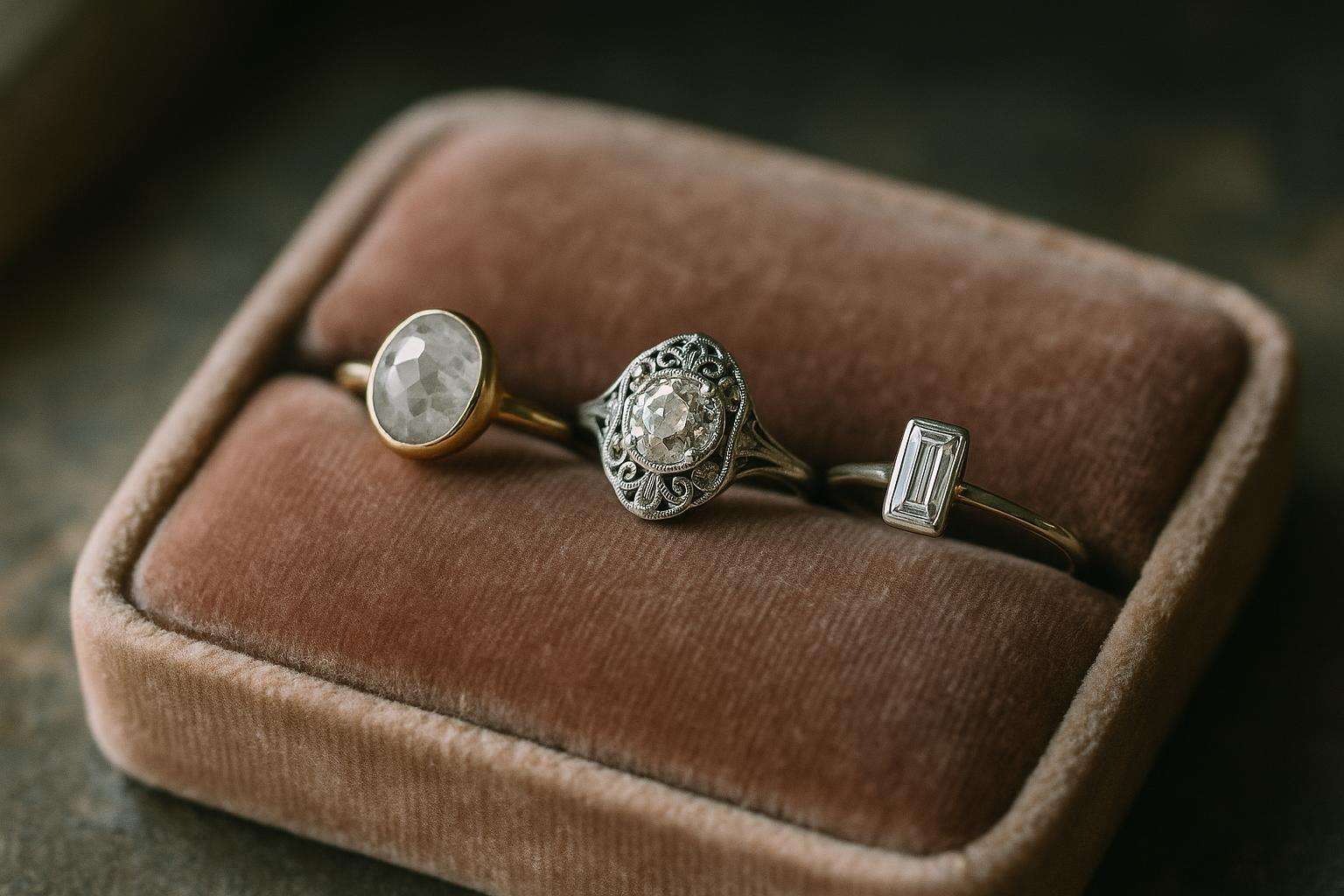
Genuine antique and vintage engagement rings span five distinct historical eras — Victorian, Edwardian, Art Deco, Retro, and Mid-Century — each defined by the metals, cutting technology, and cultural forces of its time. Old mine cut and old European cut diamonds are the signature stones of these periods, prized for a warm, candlelit glow that modern brilliants cannot replicate. Authentication requires reading multiple physical markers in convergence: hallmarks, stone cut, construction technique, and patina. The most trusted specialist dealers — Lang Antiques, EraGem, and Erstwhile Jewelry — independently authenticate and appraise every piece before listing.
What Are the Main Vintage Engagement Ring Eras, and How Do I Recognize Each One?
Five historical periods account for the vast majority of genuine antique and vintage engagement rings on the market today. Learning to read their markers reliably is the single most useful skill a vintage-ring buyer can develop — because period labels applied by sellers are not always accurate, but the physical evidence the ring carries does not lie.
Victorian (1837–1901)
Queen Victoria's 64-year reign is long enough to contain three distinct design sub-periods. The Romantic Period (1837–1861) produced deeply sentimental rings: serpent motifs symbolizing eternal love (popularized by Prince Albert's serpent engagement gift to Victoria), clasped hands, flowers, and acrostic rings whose stone initials spelled words like "DEAREST." Yellow gold was standard; rose-cut diamonds and colored gemstones were common. The Grand or Mourning Period (1861–1885) followed Albert's death and shifted to darker, heavier work — garnet, onyx, and jet alongside gold. The Aesthetic Period (1885–1901) lightened the mood with more intricate metalwork and the first widespread centering of diamonds as the primary stone.
Physical tells: yellow or rose gold (18K or 22K, often slightly warmer and rosier than modern alloys), rose-cut diamonds, closed-back settings on earlier pieces, sentimental motifs. Lang Antiques maintains one of the most comprehensive Victorian engagement ring collections in the United States, with examples from all three sub-periods catalogued and authenticated by in-house specialists.
Edwardian (1901–1915)
King Edward VII's culturally lavish reign introduced platinum as the standard metal for fine engagement rings — the first time platinum was used at scale in Western jewelry. Platinum's tensile strength allowed jewelers to construct extremely fine, lace-like filigree that would have been structurally impossible in gold. The period is sometimes called the "garland era" for its flowing floral and bow motifs. Old European cut diamonds were the stone of choice, producing a soft romantic glow suited to gaslight and early electric light. Milgrain edging — rows of tiny beaded metal along setting borders — became a hallmark of Edwardian work and remains one of the most reliable dating indicators a buyer can look for.
EraGem, founded in 2006 and based in downtown Bellevue, WA, specifically highlights Edwardian platinum filigree as a distinct collecting category and independently appraises every piece before listing. Their 60-day money-back guarantee is unusually generous for the vintage market.
Art Deco (circa 1920–1935)
Art Deco rings are the era most in demand among estate jewelry buyers today — and for good reason. Bold geometric lines, bilateral symmetry, and architectural references drawn from skyscrapers and industrial machinery replaced the flowing naturalism of Edwardian work. Platinum and white gold dominated; step-cut stones — emerald cuts and Asscher cuts — reinforced the geometric aesthetic, while baguette-cut side stones became ubiquitous. Old European cut diamonds remained the center-stone standard, though transitional cuts began appearing as cutting technology evolved.
Authentic Art Deco platinum rings with old European cut centers currently list from approximately $2,000–$4,000 at the entry level for simpler pieces, rising to $7,000–$12,000 for center-stone examples in documented period platinum settings. Signed or exceptional pieces can reach significantly higher. Erstwhile Jewelry (589 Fifth Ave, New York City), a fifth-generation specialist, notes that Art Deco rings approaching or exceeding 100 years old face consistent upward price pressure simply because supply can only diminish.
Retro (circa 1935–1950)
The U.S. War Production Board banned non-military use of platinum during World War II, forcing jewelers back to yellow and rose gold. Rose gold — approximately 75% gold alloyed with 22.5% copper — surged in this period. Designs became bolder and more sculptural, drawing on Hollywood glamour: padlock motifs, chains, scrollwork, and large floral forms appeared alongside illusion settings that made center stones appear larger on wartime budgets. Transitional-cut diamonds, bridging old European and modern brilliant proportions, appear frequently in Retro pieces. Surviving examples are relatively scarce; many rings were melted for gold content during and after the war, making well-preserved Retro pieces harder to find than their age suggests.
Mid-Century (1950s–1960s)
Post-war prosperity and the space age produced a decisive shift toward simplicity and precision. The round brilliant cut — developed through the 1940s and refined into its standardized 57- or 58-facet form by the 1950s — became dominant, engineered for maximum light return under fluorescent and incandescent lighting in suburban homes. Diamond solitaires and the matched "wedding set" (engagement ring plus coordinating band) made their major commercial debut. White gold replaced platinum as the white-metal standard, partly due to cost and partly due to platinum's wartime association with scarcity. The signature motif of this period: a round or emerald-cut center diamond flanked by baguette-cut side stones in a white gold or platinum setting.
A practical note on period boundaries: jewelers of any era worked without the historical labels applied later. A ring purchased as "Art Deco" may incorporate Edwardian construction techniques; a 1940s ring may contain an earlier-cut diamond. Physical markers — cut type, metal color, construction method, and hallmark evidence — are more reliable guides than the selling label alone.
What Are Old Mine, Old European, and Rose Cuts — and How Do They Compare to a Modern Brilliant?
Diamond cutting has changed more than most buyers realize. The three antique cuts most commonly encountered in estate rings were each optimized for lighting conditions and hand-tool capabilities that no longer exist. Understanding how they differ — and why that difference matters — is essential for evaluating a vintage stone fairly.
| Cut | Era | Shape | Culet | Key Visual Character | GIA Cut Grade? |
|---|---|---|---|---|---|
| Old Mine Cut | Georgian–Victorian (c. 1700s–1890s) | Soft cushion, never perfectly round | Large, open — visible face-up as a dark circle | Bold spectral fire; large, dramatic flashes | No — noted descriptively |
| Old European Cut | Late Victorian–Art Deco (c. 1890s–1935) | Round | Open, smaller than old mine | Warm romantic glow; especially beautiful in natural light | No — proportions outside modern scale |
| Rose Cut | Georgian–Victorian (c. 1500s–1900) | Flat base, domed top | None (no pavilion) | Soft, diffused glow; visually large for carat weight | No |
| Modern Round Brilliant | 1950s–present | Perfectly round | None (pointed, microscopic) | Maximum white-light brilliance; crisp, uniform sparkle | Yes (Excellent through Poor) |
Old Mine Cut
The old mine cut dates from the early 18th century and was the dominant form through the Victorian era. It has 58 facets — the same count as the modern round brilliant — but its proportions are entirely different: a soft cushion shape, smaller table facet, higher crown, shorter lower-half facets, and a large open culet visible as a circle when viewed face-up. These proportions were shaped by hand, guided by eye, by individual craftsmen. The result is a stone with visible character: large, bold flashes of spectral color (fire) rather than the continuous white brightness of modern cuts. GIA notes that old mine cuts display less brilliance but more fire than modern brilliants — the light return is colored and dramatic rather than white and uniform.
One authentication marker: rock an old mine cut slowly under a single light source and look for the kozibe effect — a ring of light circling through the stone's interior, produced by the specific angular relationship between crown and pavilion facets. This is distinctive to antique brilliant-cut stones and one of the most reliable indicators of an authentic hand-cut piece.
Old European Cut
The old European cut is rounder than the old mine cut and can be understood as its immediate predecessor to the modern brilliant — but it retains the higher crown, smaller table, and open culet that mark it as pre-industrial cutting. Old European cuts produce a warm glow rather than the cold, crisp sparkle of a modern stone — behavior that shows especially well in natural light and candlelight. This is the stone you will find in the majority of authentic Edwardian and Art Deco rings.
A critical point for buyers: GIA does not assign a cut grade to old European cut diamonds because their proportions lie outside the scale designed for modern round brilliants. A GIA report on an authentic old European cut may show "Fair" or "Good" for certain symmetry measurements — not because the stone is poorly cut, but because it was cut for a different aesthetic and a different light source. Do not interpret that notation as a quality flaw.
Rose Cut
The rose cut traces to the 1500s, making it the oldest of the three forms. Its profile is immediately distinctive: a completely flat base with no pavilion, and a dome of triangular facets rising to a single apex. Because there is no pavilion to reflect light back up through the stone, rose cuts produce a soft, diffused glow rather than brilliance or fire. They are typically shallow, making them visually large relative to their carat weight — a significant visual advantage. Rose cuts appear throughout Georgian and Victorian jewelry, often in closed-back settings of silver over gold.
Pricing Reality
As a broad rule, old European cuts have historically been priced around 15–20% below a modern round brilliant of comparable color and clarity per carat — though this gap has been closing steadily as collector demand grows and antique supply remains fixed. The most critical pricing factor: lab-grown diamond pricing pressure, which has compressed values for modern brilliant-cut stones by 50–80% from peak in some categories, does not apply to hand-cut antique stones. Old mine cuts and old European cuts are irreproducible at scale; each surviving intact example becomes more scarce, not less, over time. That authentication value has become an explicit part of their market pricing in 2025–2026.
For anyone considering an antique diamond as a center stone, it is also worth reading our guide to the diamond 4Cs — GIA's color and clarity grades remain reliable and meaningful on antique stones even where the cut grade does not apply.
How Do I Authenticate an Antique Engagement Ring Before Buying?
Authentication of an antique ring is a structured process that combines physical evidence from the ring itself with expert evaluation. No single indicator is conclusive; reliable authentication relies on the convergence of multiple independent markers. Here is the sequence a knowledgeable buyer follows.
Step 1: Locate and Read Hallmarks
Hallmarks are typically stamped on the inside of the shank (band), often on the gallery beneath the stone or on the inside of the head. A 10x jeweler's loupe under focused light is the standard tool. British hallmarks are among the most systematically documented: a complete British mark includes a sponsor's mark (maker's initials in a shaped cartouche), a metal purity mark (a lion passant for sterling silver, a crown plus karat numeral for Victorian-era gold), an assay office symbol (anchor for Birmingham, leopard's head for London, three-towered castle for Edinburgh), and a date letter. Date letters have been recorded in the UK hallmarking system since 1478; each assay office used its own letter cycle and shield shape, cycling through the alphabet roughly every 25 years. The Chester assay office closed in 1962, so a Chester mark definitively places the piece before that year.
American rings of the same period typically carry only karat stamps (10K, 14K, 18K) without a date-letter system, making American antiques harder to date by hallmark alone. Continental European systems vary: France used an eagle's head for 18K gold; Italy used a star with numeric codes; numerical purity stamps (750 for 18K gold, 585 for 14K, 950 for platinum) are broadly consistent across European systems. Reference resources recommended by practitioners include Jackson's Hallmarks for British marks, the online database at 925-1000.com for maker's mark research, and Lang Antiques' Antique Jewelry University for historical context.
Step 2: Assess the Stone Cut as a Dating Indicator
Cut type is one of the most reliable period markers because certain cuts were physically impossible before specific tool technologies existed. An old mine cut places the stone no later than the early 1900s; an old European cut indicates late Victorian through Art Deco; a transitional cut narrows to the 1930s–1940s; a modern round brilliant with precisely calibrated facets is post-1950 at the earliest. A modern brilliant in a ring presented as pre-1930 is a strong indicator that the original stone has been replaced — which affects both authenticity and value significantly.
Step 3: Examine Construction Technique
Hand-filing marks are visible under 10x to 20x magnification on genuinely hand-fabricated pieces. Authentic solder joints from period work show subtle color variation, visible seams, and occasionally tiny bubbles not present in modern laser-welded joints. Prong work in pre-1920 rings was typically hand-cut; machine symmetry is a sign of later manufacture. Natural patina — consistent warm aging of the metal surface — develops over decades and is difficult to fake convincingly; uniform brightness on a ring claimed to be 100 years old warrants closer examination.
Step 4: Commission a Professional Appraisal
For any ring where authenticity matters financially or sentimentally, a written appraisal from a credentialed specialist is the appropriate final step. The American Gem Society's Certified Gemologist Appraiser (CGA) designation is the highest appraiser credential the AGS offers, requiring advanced training, a graduate gemology diploma, annual recertification testing, and demonstrated adherence to AGS appraisal standards. Non-destructive X-ray fluorescence (XRF) analysis can confirm metal composition without altering the piece — useful for verifying that gold content matches the stated karat and is consistent with period alloy recipes. Appraisal costs for a single ring typically run $100–$250 from a credentialed specialist, a small cost relative to the information it provides.
A genuine antique ring rarely comes with a new GIA grading certificate — the original stone was cut before modern grading systems existed. What it should have, from any reputable dealer, is a written appraisal from a credentialed specialist noting the estimated period, stone cut identification, and metal analysis. Those four disclosures together are the baseline standard of a trustworthy transaction. Our broader guide to ring appraisals covers the process in full detail.
Which Dealers Are Worth Trusting for Genuine Antique and Vintage Rings?
The vintage and antique engagement ring market was valued at approximately $4.2 billion in 2024 and is projected to grow at a 5.5% compound annual rate through 2033, driven partly by the sustainability appeal of pre-owned jewelry and partly by buyers who want a stone that cannot be replicated as a lab-grown diamond. That growing demand has attracted both exceptional dealers and opportunistic ones. Here is a vetted shortlist based on independent authentication practices, return policies, and track record.
For Genuine Antique and Vintage Rings
- Lang Antiques (langantiques.com) — San Francisco, 309 Sutter Street, in continuous operation since 1969. Lang is widely regarded as the most thorough scholarly resource for period jewelry in the United States, maintaining the free Antique Jewelry University educational archive alongside their commercial inventory. Staff includes certified gemologists with specialist period knowledge. First ring sizing is complimentary; new acquisitions are posted weekly online. Open Tuesday through Saturday at their Union Square store.
- EraGem (eragem.com) — Founded 2006, based in downtown Bellevue, WA (12000 NE 8th St). EraGem specializes in Victorian through Mid-Century pieces; most are independently appraised before listing. Their 60-day money-back return policy is unusually generous for the vintage market. By-appointment showroom; online sales worldwide with 466K Instagram followers and active new arrivals weekly.
- Erstwhile Jewelry (erstwhilejewelry.com) — 589 Fifth Avenue, New York City. A fifth-generation specialist in genuine antique and vintage rings. They draw a clear distinction: antique is over 100 years old (Georgian, Victorian, Edwardian); vintage is at least 50 years old (Art Deco, Retro, Mid-Century). Erstwhile also creates custom settings using authentic antique diamonds for buyers who want period stones in a new configuration. Virtual appointments available for out-of-city buyers; free shipping and returns.
- Estate Diamond Jewelry (estatediamondjewelry.com) — New York City, active dealer with a strong online presence and detailed editorial content on period cuts and eras.
- 1stDibs (1stdibs.com) — An online marketplace aggregating listings from vetted estate dealers worldwide. Useful for price discovery and comparison across period types before committing to a purchase; entry-level Art Deco platinum pieces start around $2,000, with center-stone Edwardian and Art Deco examples ranging $4,000–$12,000 for typical pieces.
For Vintage-Inspired New Rings
If you love the aesthetic of Art Deco or Edwardian design but want a new ring with a modern GIA-certified stone and a manufacturer's warranty, vintage-inspired new rings are a well-served category. Blue Nile and James Allen both carry extensive Edwardian-style filigree and Art Deco geometric settings with modern certified stones. The trade-off: a new ring depreciates like any new product (immediate resale value typically 20–50% below purchase price), whereas a genuine antique has already absorbed its original depreciation and benefits from fixed, declining supply.
One final practical note: whether you are buying from a specialist dealer or a marketplace, the four disclosures that separate a trustworthy transaction from a speculative one are consistent — documented hallmarks, a written appraisal with estimated period, stone cut identification, and metal analysis. A dealer who cannot produce all four on request is one you should approach cautiously.
Frequently asked
What is the difference between antique and vintage engagement rings?
In estate-jewelry trade usage, antique means the piece is 100 or more years old — so any ring made before approximately 1926 qualifies today. Vintage is less standardized but most specialist dealers apply it to pieces at least 50 years old; some use 20 years as the floor. Vintage-inspired is a retail marketing term for new rings designed with historical aesthetic elements — filigree, milgrain, floral motifs — but manufactured recently. The distinction matters for price, investment behavior, and where to shop: genuine antiques are priced against a secondary market without new-retail markup stacked in, while vintage-inspired new rings depreciate like any other new product.
What is an old European cut diamond, and how does it differ from a modern brilliant?
An old European cut was the dominant diamond cut from roughly the 1890s through the Art Deco period (1935). It is round but departs significantly from modern proportions: higher crown, smaller table facet, and an open culet — a tiny flat facet at the stone's base that appears as a small dark circle when viewed face-up. These proportions were cut by hand or with early mechanical aids, optimized for gaslight and candlelight rather than the overhead fluorescent and LED lighting of modern homes. The result is a warm, romantic glow with large flashes of spectral color rather than the crisp white brilliance of a contemporary stone. Importantly, GIA does not assign a cut grade to old European cuts — their proportions lie outside the scale designed for modern brilliants — so a "Fair" symmetry notation on a GIA report is normal and expected, not a quality warning.
How can I tell if an antique ring is genuinely old rather than a reproduction?
Authentication relies on the convergence of multiple independent markers, not one single indicator. Start by locating hallmarks inside the shank under a 10x loupe — British pieces carry a date-letter system traceable to specific years and assay offices. Assess the stone cut: an old mine cut or old European cut in a ring claimed to be pre-1930 is a strong positive indicator; a modern round brilliant with precisely calibrated 57 or 58 facets would raise a red flag. Examine construction technique at 10x–20x: hand-filing marks, irregular solder joints with slight color variation, and hand-cut prong work are consistent with genuine period work. Natural patina develops consistently over decades; unusual brightness on a ring claimed to be 100 years old warrants scrutiny. For any purchase where authenticity affects value, commission a written appraisal from an AGS Certified Gemologist Appraiser.
Are Art Deco engagement rings a good investment?
No engagement ring should be purchased primarily as an investment — you wear it, it carries meaning, and liquidity in the estate market is never guaranteed. That said, genuine Art Deco platinum rings with old European cut diamonds have demonstrated stronger resale fundamentals than modern retail rings. The key reasons: antiques have already absorbed their original retail depreciation (sometimes 100 years ago), their supply is fixed and can only decline, and lab-grown diamond pricing pressure — which has compressed values for modern rings by 50–80% in some categories — does not apply to hand-cut antique stones. Authenticated Art Deco pieces in platinum, with documented period construction and unaltered stones, tend to hold value better than comparable modern pieces. Condition and originality are critical: an unresized, unrepaired ring commands the strongest premium.
Where is the best place to buy a genuine antique engagement ring?
For authenticated genuine antiques, the most reliable specialist dealers in the U.S. include Lang Antiques (langantiques.com, San Francisco, in operation since 1969), EraGem (eragem.com, Bellevue, WA, founded 2006, 60-day returns), and Erstwhile Jewelry (erstwhilejewelry.com, NYC Diamond District, fifth-generation specialists). All three independently authenticate and appraise pieces before listing. 1stDibs aggregates listings from vetted dealers worldwide and is useful for price comparison. For vintage-inspired new rings with period aesthetics, Blue Nile and James Allen both carry strong Edwardian and Art Deco-inspired settings with modern certified stones. The key disclosure to request from any seller: documented hallmarks, written appraisal with estimated period, stone cut identification, and metal analysis.
Can a genuine antique engagement ring be worn every day?
Yes — an antique ring that has survived 80 to 150 years of use is itself evidence of structural durability. That said, older prong work and thinner Edwardian filigree require more attentive care than modern rings. Have prongs inspected by a jeweler experienced with antique work at least annually; do not rely on a chain jeweler unfamiliar with period construction techniques. Avoid ultrasonic cleaners on older closed-back settings and on any ring with rose-cut or old mine cut stones, whose open culets can trap cleaning solution. A plain warm soak in mild dish soap with a soft brush, followed by thorough rinsing, is safe for most metal types. Budget $50–$100 per year for a professional clean and inspection — this extends prong life significantly and catches stone movement before it becomes loss.