Celebrity Rings
Carolyn Bessette-Kennedy's Engagement Ring: The Sapphire Eternity Band Explained
JFK Jr. proposed with a platinum diamond-and-sapphire eternity band inspired by Jackie Kennedy's 'swimming ring' — here is the full story behind one of the most quietly iconic engagement rings in American history.
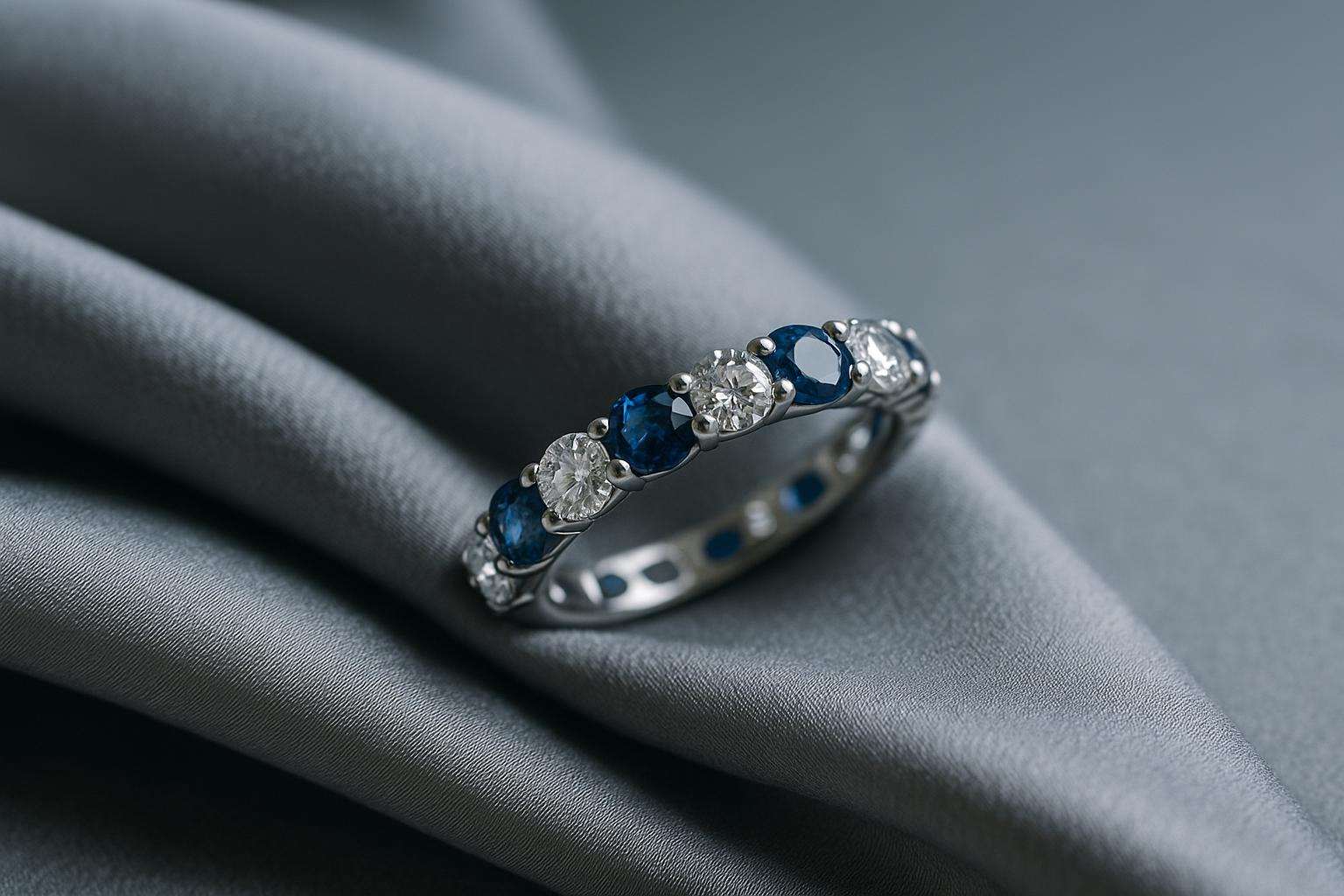
Carolyn Bessette-Kennedy's engagement ring was a platinum eternity band set with alternating round diamonds and blue sapphires — sourced through diamond merchant Maurice Tempelsman, modeled on a band Jackie Kennedy called her "swimming ring," and connected by some historians to the Tiffany & Co. Schlumberger Sixteen Stone design tradition. JFK Jr. proposed with it on Martha's Vineyard in the summer of 1995. The ring's quiet refusal to follow solitaire convention made it as much a statement of Bessette's aesthetic values as it was a declaration of love — and it remains one of the most culturally resonant engagement rings in American history.
What made the ring so unusual for its time?
In the mid-1990s, the engagement ring landscape in the United States was dominated by a single grammar: a round brilliant diamond, elevated on a simple solitaire setting, in gold or platinum. De Beers had spent decades and hundreds of millions of dollars making that grammar feel not just conventional but inevitable. The largest diamond you could afford, on the cleanest setting you could find, announcing itself on arrival. Carolyn Bessette received something entirely different.
The ring JFK Jr. proposed with was a platinum eternity band set with alternating round brilliant diamonds and blue sapphires. No center stone. No solitaire elevation. No single dominant gem. Instead, a continuous circle of alternating stones that ran the full circumference of the band, pressing flat against the finger, becoming part of the hand rather than rising above it. Eternity bands were not unknown in 1995, but they were given as anniversary rings or wedding bands — the idea of proposing with one was genuinely uncommon. As a style choice, it was quietly radical.
That radicalism was entirely in keeping with who Bessette was. A former publicist for Calvin Klein, she had spent her professional life in the orbit of the designer most associated with American minimalism — pared-down cuts, neutral palettes, an insistence that the absence of ornamentation was itself a form of authority. Her personal wardrobe followed suit: crisp white button-downs, well-cut neutral coats, minimal jewelry. She was operating in an era of maximalist celebrity fashion, and she dressed as though it were happening somewhere else entirely.
The ring matched her. Rather than announcing an engagement, it became part of the person wearing it.
Where did the ring come from, and who chose the sapphires?
The story of the ring's origin connects JFK Jr.'s proposal directly to the legacy of his mother. According to Carolyn's close friend Carole Radziwill — who was married to JFK Jr.'s cousin Anthony Radziwill and described the ring in her 2005 memoir What Remains — Bessette told her the eternity band was a copy of a ring Jackie Kennedy referred to as her swimming ring. Jackie, Radziwill understood, wore this particular band on casual occasions, including literally swimming — a ring she loved precisely because it was wearable, modest, and unencumbered by the fragility of a high-set stone.
The exact identity of Jackie's swimming ring has never been definitively established. Historians have proposed two main candidates. The first is the Tiffany & Co. Schlumberger Sixteen Stone ring, conceived by designer Jean Schlumberger in 1959 — a platinum and 18-karat gold band with sixteen round brilliant diamonds framed by signature gold X motifs, which Jackie was photographed wearing during a 1966 trip to Hawaii. The second is a band from Van Cleef & Arpels, which some accounts suggest President Kennedy commissioned as a 10th wedding anniversary gift. Both theories remain unverified.
What is documented is the mechanism by which the ring reached JFK Jr. The gemstones were sourced through Maurice Tempelsman, the Belgian diamond merchant who had been Jackie Kennedy's companion from the late 1970s until her death in May 1994 — and who therefore had both the intimate knowledge of Jackie's jewelry preferences and the professional expertise to find the right stones. Rosemarie Terenzio, Kennedy's longtime personal assistant, recounted in her memoir Fairy Tale Interrupted that she unknowingly collected a package from Tempelsman's office and left it sitting in a plastic bag on Kennedy's desk, never imagining it held the ring. This logistical detail grounds the ring's origin firmly in fact: it was not purchased off the shelf but assembled through a deliberate, considered process.
The sapphires were almost certainly chosen by Kennedy himself rather than specified by Tempelsman. Sapphires were not the birthstone of Bessette, Kennedy, or his mother. The most widely offered explanation is that Kennedy chose them because they matched Carolyn's notably striking blue eyes — an interpretation that gives the ring a private, personal dimension beyond the Jackie tribute.
What is the Tiffany Schlumberger Sixteen Stone ring, and how does it connect?
Jean Schlumberger (1907–1987) was one of the most gifted jewelry designers of the 20th century. He joined Tiffany & Co. in 1956 at the invitation of chairman Walter Hoving and spent three decades creating pieces that fused natural forms — flora, fauna, organic textures — with extraordinary technical precision. His clients included Bunny Mellon, Babe Paley, Audrey Hepburn, Elizabeth Taylor, and Jackie Kennedy, for whom President Kennedy purchased a Schlumberger Berry Clip in rubies and gold to celebrate the birth of John Jr.
The Sixteen Stone ring, conceived in 1959, is among Schlumberger's most enduring designs. Its cross-stitch motif — sixteen round brilliant diamonds in alternating platinum settings and 18-karat gold X frames — was inspired by his family's roots in the French textile industry. Tiffany describes it as originally conceived as a wedding band, a symbol of love's sustaining forces. The ring remains in production today and is priced at approximately $15,600 for the classic platinum-and-yellow-gold version with 1.14 carats of diamonds.
| Attribute | Details |
|---|---|
| Designer | Jean Schlumberger for Tiffany & Co. (designed 1959) |
| Construction | Platinum X-settings with 18k yellow (or rose) gold band |
| Stones | 16 round brilliant diamonds, approx. 1.14 ct total weight |
| Current retail price (Tiffany) | From approx. $15,600 (platinum/yellow gold/diamond variant) |
| Pre-owned secondary market | $9,800–$15,600+ (1stDibs, Gray & Sons, Beladora) |
| Notable historic owner | Jackie Kennedy (photographed wearing it, Hawaii, 1966) |
| Connection to Carolyn Bessette | Possible model for Jackie's "swimming ring" that inspired CBK's engagement band |
Whether or not Bessette's ring was literally patterned on a Sixteen Stone, the aesthetic lineage is clear: a continuous band of paired stones in precious metal, worn close to the hand, belonging to a tradition of fine jewelry that prizes discretion over display. Authentic vintage Schlumberger pieces are available through specialist dealers including Lang Antiques and 1stDibs, and genuine Schlumberger rings surface regularly on the secondary market.
How did the ring become an icon?
Carolyn Bessette was not famous before she became attached to one of the most famous men in America. She was a publicist. She managed other people's images. But from the moment she and JFK Jr. began appearing together in public — navigating the paparazzi gauntlets outside their Tribeca loft, entering events under a scrum of cameras — it became apparent that she possessed something rarer than fame: an absolute visual certainty. She knew exactly who she was and dressed accordingly.
The ring was part of that certainty. When the New York Post ran a close-up photograph of it the Friday before Labor Day weekend in 1995, sparking the first wave of public speculation about their engagement, the ring itself communicated something. It was not the ring of someone performing wealth or status. It was the ring of someone who had made an aesthetic decision and was comfortable with it. A flat eternity band, blue sapphires, platinum. Nothing to prove.
Bessette and Kennedy married on September 21, 1996, in a secret ceremony at the First African Baptist Church on Cumberland Island, Georgia — a ceremony so well-guarded that only 40 guests attended and the press had no knowledge of it until it was done. Her wedding dress, designed by a then-unknown Narciso Rodriguez, became one of the most discussed garments of the decade: a bias-cut silk crepe gown that fit like a second skin, entirely without ornament, making no concession to the puffed-sleeve bridal conventions of the era.
Both the ring and the dress said the same thing: I am not going to give you what you expect.
On July 16, 1999, Kennedy piloted a Piper Saratoga into thick fog off Martha's Vineyard. He was not instrument-rated, and in conditions where visual landmarks were gone, he lost spatial orientation. The plane spiraled into the Atlantic Ocean. Kennedy was 38. Carolyn was 33. Her sister Lauren Bessette, who was also on the flight, was 34. The National Transportation Safety Board concluded the probable cause was pilot spatial disorientation. The three were cremated, and their ashes were scattered at sea by their families the following day.
Bessette's cultural legacy has grown rather than diminished in the years since her death. In 2024, three of her personal coats sold at Sotheby's for a combined $177,000 — testament to the enduring market for objects that once belonged to someone whose taste was that singular. A 2026 television series retelling her relationship with Kennedy introduced her to an entirely new generation, producing a wave of renewed interest in her style and biography. As fashion moved in the mid-2020s toward what publications began calling "quiet luxury" and "old money aesthetics," Bessette-Kennedy's influence became a reference point so frequently cited it crossed from cultural footnote into something closer to a design standard.
The ring participates in that legacy. An eternity band was not fashionable for proposals in 1995. It is arguably more fashionable now — appreciated precisely for the same reasons Bessette wore it: its refusal of hierarchy, its integration with the hand, its commitment to material quality over spectacle.
How can you get the look today?
A sapphire-and-diamond eternity band has never been more attainable. The style Bessette made famous now exists at virtually every price tier.
At the luxury end, a custom platinum full-eternity band with natural blue sapphires and round brilliant diamonds in VS2/H quality, set to match Bessette's approximate proportions, will typically cost between $8,000 and $25,000 depending on total carat weight and craftsmanship. Work with a local bench jeweler or a custom studio with demonstrated experience in fine eternity settings — the setting quality matters significantly with a band that is examined from every angle.
At mid-range, James Allen and Jared both offer half-eternity bands in 14-karat white gold with alternating natural diamonds and blue sapphires in the $800 to $3,500 range. Ring Concierge offers customizable full-eternity bands with stone-selection flexibility. With Clarity's eternity collection allows you to specify cut, metal, and color stone type online with realistic preview rendering.
At the budget-accessible end, Kay Jewelers carries lab-grown diamond and genuine sapphire alternating eternity bands under $500. For a version that leans toward the emerald-cut sapphire interpretation, several Etsy studios produce alternating step-cut sapphire and round diamond bands in sterling silver or 10-karat white gold for under $300.
For buyers specifically interested in an authentic vintage eternity band from Bessette's era — an object with genuine period provenance rather than a contemporary reproduction — specialist dealers including Erstwhile Jewelry in New York's Diamond District and EraGem in Bellevue, Washington, both carry authenticated 1980s and 1990s eternity bands in platinum and white gold. These pieces were made by craftspeople working in the same tradition as the ring Tempelsman sourced, and buying one is the closest you can get to Bessette's original without commissioning a custom replica.
Whatever the budget, the buying framework for this look is consistent: prioritize the band width and setting quality over stone size, choose platinum or white gold to keep the metal neutral, and ensure the sapphires are natural or lab-grown stones with GIA or comparable certification rather than simulants. The ring's power has always been in its materials, its proportions, and what those proportions refuse to say. The look rewards restraint at every price point. Our colored gemstone rings guide covers sapphire quality, origin, and grading in detail to help you evaluate stones with confidence.
Frequently asked
What was Carolyn Bessette-Kennedy's engagement ring?
Carolyn Bessette-Kennedy's engagement ring was a platinum eternity band set with alternating round brilliant diamonds and blue sapphires. Unlike the traditional solitaire engagement rings that dominated the mid-1990s, the ring featured no single center stone — every stone in the band carried equal visual weight around the full circumference. The design was personally meaningful: according to Bessette's close friend Carole Radziwill, writing in her 2005 memoir What Remains, Bessette described the ring as a copy of a ring Jackie Kennedy called her "swimming ring" — a band Jackie wore on casual occasions including swimming. The gemstones were sourced through Maurice Tempelsman, a Belgian diamond merchant who had been a close companion of Jackie Kennedy until her death in 1994. JFK Jr.'s assistant Rosemarie Terenzio recounted in her memoir Fairy Tale Interrupted that she unknowingly collected the ring package from Tempelsman's office, unaware of what it contained.
When and how did JFK Jr. propose to Carolyn Bessette?
John F. Kennedy Jr. proposed to Carolyn Bessette during the Fourth of July weekend in 1995 while on Martha's Vineyard. According to Terenzio, Kennedy went into a speech about how everything is better with a partner — not just fishing, but life. Bessette did not immediately accept. Multiple accounts, including Kennedy's friend Robert Littell in The Men We Became, note that she made him wait weeks before saying yes, primarily because she understood the enormous media scrutiny that a public engagement to JFK Jr. would bring. The couple never formally confirmed their engagement publicly, yet the ring and their plans were ultimately an open secret among their close circle. They married on September 21, 1996, in a secret ceremony attended by only 40 guests at the First African Baptist Church on Cumberland Island, Georgia. Narciso Rodriguez, then an unknown designer, created Bessette's silk crepe wedding gown.
What is the connection between Carolyn Bessette's ring and Jean Schlumberger?
The connection is indirect but historically resonant. Jean Schlumberger (1907–1987) was a legendary jewelry designer who joined Tiffany & Co. in 1956 and created some of the 20th century's most celebrated fine jewelry, including the Sixteen Stone ring — a platinum and 18-karat gold band set with sixteen round brilliant diamonds framed by gold X motifs, conceived in 1959. Jackie Kennedy wore Schlumberger pieces throughout her life, including a Sixteen Stone ring photographed on her finger during a 1966 Hawaii trip. The ring some historians believe was Jackie's "swimming ring" — the direct inspiration for Bessette's eternity band — may have been a Sixteen Stone or a similar Schlumberger commission. Other theories identify the swimming ring as a Van Cleef & Arpels piece given as a 10th anniversary gift. What is not in doubt is that JFK Jr. modeled Bessette's platinum band on a ring his mother loved enough to wear swimming — and that the Schlumberger lineage is one credible thread in that story. The Tiffany Sixteen Stone ring retails today for approximately $15,600 and above.
How much is Carolyn Bessette-Kennedy's engagement ring worth today?
The original ring has never appeared at public auction, and no independent appraisal has been published. Jewelry specialists who have commented on the ring in press coverage estimate its current value at approximately $40,000 to $50,000, based on the likely specifications: a full platinum eternity band set with alternating round diamonds and sapphires of the quality appropriate to a gift curated by a professional diamond merchant. The value reflects both the fine materials and the ring's significant historical and cultural provenance — a provenance that has only grown with the renewed popular interest in Bessette-Kennedy's life and aesthetic in 2024 and 2025, including a Sotheby's auction in 2024 where three of her personal coats fetched $177,000. A comparable new eternity band — platinum, alternating round diamonds and blue sapphires of SI1/VS2 clarity and H/I color, sized standard — can be made for roughly $5,000 to $20,000 depending on total carat weight and stone quality.
Why did JFK Jr. choose a sapphire and diamond eternity band rather than a solitaire diamond?
The choice was almost certainly shaped by two intertwining considerations: personal tribute and aesthetic alignment. The personal tribute was to his mother Jackie, who wore a band she called her "swimming ring" — a piece she loved for its wearability and understated elegance. By commissioning a variation on that ring for Carolyn, Kennedy connected his proposal to one of the most important women in his life. The aesthetic alignment was equally apt: Carolyn Bessette was, by professional training and personal conviction, a minimalist. She had worked as a publicist for Calvin Klein, the designer most associated with pared-down American luxury, and her personal wardrobe was built on quiet authority — crisp white shirts, neutral turtlenecks, impeccably cut coats. A brilliant solitaire, the overwhelmingly dominant engagement ring choice of the 1990s, would have announced itself. The eternity band, by contrast, became part of her hand. As one stylist observed after her death, "An eternity band sits close to the hand so that it becomes part of the wearer, rather than something that announces itself." The sapphires added color without ostentation and may have been chosen, at least in part, to echo Bessette's striking blue eyes.
How can I find a ring similar to Carolyn Bessette-Kennedy's today?
Diamond-and-sapphire eternity bands are widely available at a range of price points. At the luxury end, custom jewelers can replicate the full-eternity platinum format — expect to spend $8,000 to $25,000 for a handset platinum band with natural sapphires and diamonds in VS2/H quality. National retailers including Jared and James Allen offer half-eternity versions in 14-karat white gold with alternating natural diamonds and blue sapphires in the $800 to $3,500 range. Ring Concierge and With Clarity both offer customizable eternity bands that allow you to specify stone type, metal, and setting width. For the closest match to Bessette's exact aesthetic — slim band, platinum, full-eternity set, alternating round stones — work with a local bench jeweler or an online custom studio such as Erstwhile Jewelry (which also carries authentic vintage eternity bands from the 1980s and 1990s). Kay Jewelers offers lab-grown diamond and sapphire versions for under $500 for those prioritizing budget. See our guide to buying vintage rings for more on sourcing authentic period pieces.