Diamonds & Stones
Princess-Cut Engagement Rings: The Complete Buying Guide
Square brilliant value, geometric sparkle, and one structural caveat every buyer needs to know before they shop.
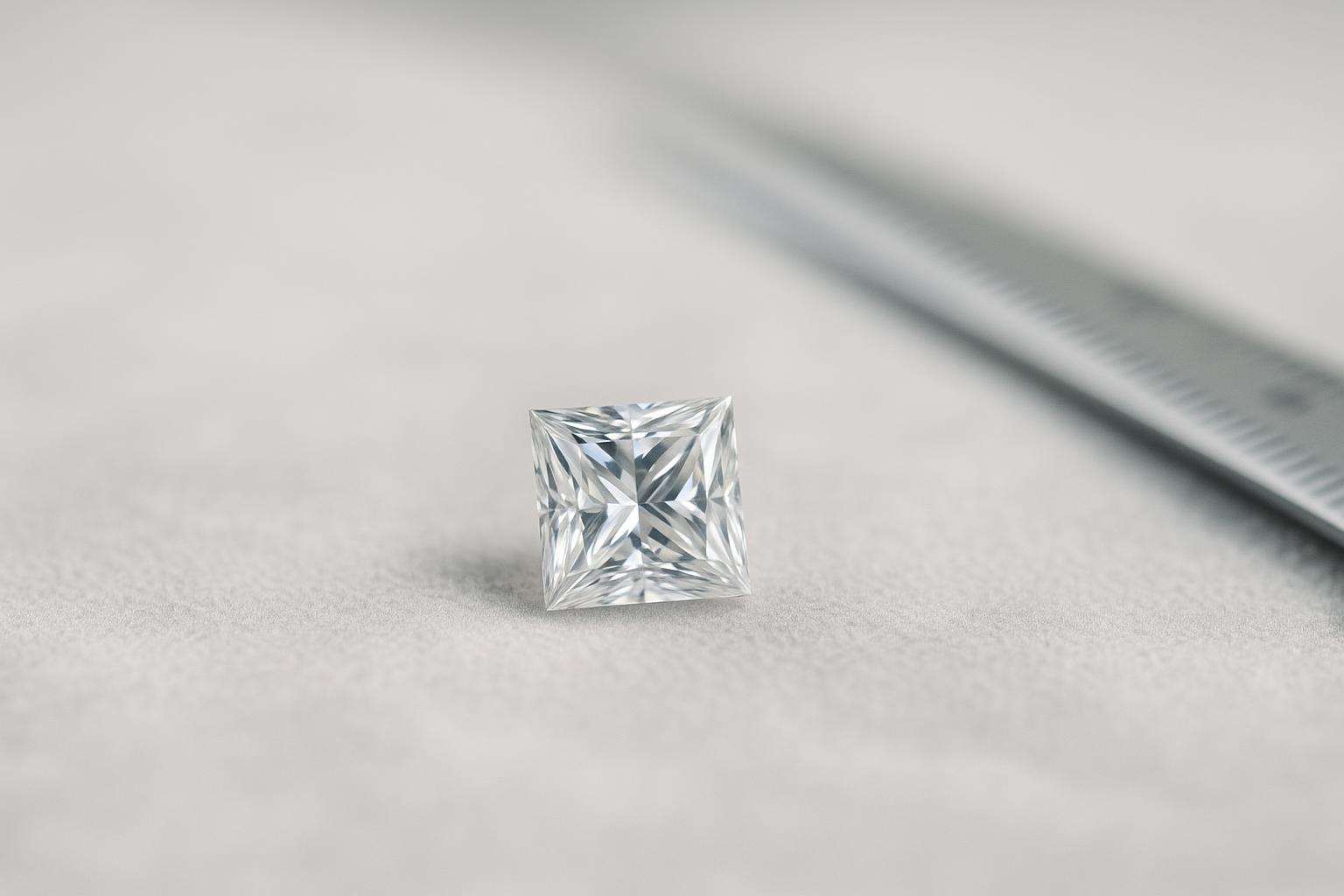
The princess cut is the only square diamond that delivers round-brilliant-grade sparkle, typically at 25–35% less per carat. Its trade-off is a face-up footprint that is noticeably smaller than a round or oval of identical weight, and four 90-degree corners that require V-prong or bezel protection to survive daily wear. Understand those two structural facts upfront, and the princess cut becomes one of the more straightforwardly rewarding shapes to shop.
In the mid-1980s, the princess cut appeared on jeweler's benches in New York and Los Angeles at roughly the same moment the round brilliant's dominance over American engagement ring fashion seemed unassailable. By the early 2000s, it had become the number-two engagement ring shape in the United States — a position it held for more than a decade. Today, the shape sits at approximately 8% of U.S. engagement ring sales according to The Knot's 2026 Real Weddings Study, ceding the second-place slot to the oval's surge, but it has not disappeared. If anything, the current market favors it: as more buyers chase ovals and marquises, the princess cut's pricing has stayed attractive, and its geometric character — sharp corners, flat crown, mathematical symmetry — speaks to a design aesthetic that softer brilliant shapes cannot replicate.
This guide covers every dimension of the shape honestly, from its invention and optical mechanics to its precise proportion targets, the one setting feature that is genuinely non-negotiable, and what a realistically specified 2026 princess-cut ring costs.
What Is a Princess Cut, and Where Did It Come From?
The technical name on any GIA or IGI certificate is Square Modified Brilliant. "Princess cut" is the trade name that stuck — a slang term, as the International Gem Society notes, the way "y'all" stands in for "all of you." The shape is a square outline with a pavilion facet arrangement adapted from the round brilliant, producing a similar scintillation pattern despite the geometric silhouette.
Its traceable history begins in 1961, when London-based cutter Arpad Nagy developed the "profile cut" — a square brilliant that never commercially gained the name he gave it. In 1971, South African cutter Basil Watermeyer patented the Barion cut, a hybrid of brilliant and step faceting that influenced subsequent square experiments. The modern princess cut emerged in 1980 when Israeli diamond cutters Betzalel Ambar, Ygal Perlman, and Israel Itzkowitz refined a square brilliant geometry they called the Quadrillion — the direct ancestor of what retailers now universally call the princess cut. Their innovation was a pavilion arrangement that delivered genuinely competitive light performance from a square outline, something earlier attempts had not achieved at commercial scale.
The facet count varies by cutting tradition: the most common princess cut has 57 to 58 facets, directly mirroring the round brilliant arrangement adapted for a square form. Some cutters execute a 76-facet variant with additional chevron rows on the pavilion, which creates a more fragmented, crushed-ice scintillation pattern rather than the broader flashes of the 57-facet standard. Neither is objectively superior; they produce different visual characters. The pavilion chevron pattern — two, three, or four rows — is a practical thing to check via video before purchasing, because it meaningfully affects how the stone looks when it moves.
How Does the Princess Cut Perform Optically — and What Does It Trade Away?
The honest answer to the princess cut's optical performance is: remarkably well, with one important caveat about face-up size.
A well-proportioned princess cut delivers sparkle genuinely comparable to a round brilliant. The facet arrangement returns white light, fire, and scintillation at levels that are competitive with rounds in motion — which is how most people view rings in real life. This is not marketing language; it reflects the fact that the pavilion facet geometry was specifically engineered in the 1980s to maximize light return from a square outline, building on the round brilliant's proven facet mathematics.
The caveat is face-up size. A 1.00-carat princess cut measures approximately 5.5 mm × 5.5 mm across the table — compared to roughly 6.5 mm in diameter for a 1.00-carat round brilliant. The square shape concentrates carat mass in depth rather than spreading it across the surface. In practical terms, a princess cut faces up smaller than a round of identical weight, and considerably smaller than elongated brilliant shapes like oval or marquise, which produce 8 to 15% more face-up surface area per carat. Our full diamond shapes comparison documents these face-up measurements for all ten common shapes side by side.
This face-up reality is not a reason to avoid the princess cut — it is a reason to buy it with accurate expectations. Buyers who choose the shape for its geometry rather than its size perception are rarely disappointed. Buyers who choose it primarily to "get more diamond" on a budget may find an oval or pear delivers better visual size for the same price per carat.
What Proportions Should a Princess Cut Diamond Have?
Because GIA does not issue an overall cut grade for princess cuts — that grade applies exclusively to round brilliants — buyers must evaluate proportions themselves. This is not difficult once you know what to target. The American Gem Society (AGS) does grade princess cuts, where a score of 0 is Ideal, and an AGS-graded stone removes much of the proportion guesswork. For GIA-only stones, use the following benchmark ranges:
| Proportion | Acceptable Range | Optimal Target | Why It Matters |
|---|---|---|---|
| Depth % | 68–75% | 69–72% | Below 68% causes light leakage; above 76% makes the stone dark and hides mass |
| Table % | 67–75% | 68–73% | Too small a table reduces brilliance; too large flattens fire and reduces contrast |
| Length-to-Width Ratio | 1.00–1.05 | 1.00–1.03 | Above 1.05 produces a visibly off-square rectangle; 1.00–1.02 delivers a balanced square face-up |
| Polish & Symmetry | Good minimum | Very Good or Excellent | Poor symmetry in a square shape is visible as uneven corner reflections; polish affects surface scintillation |
| Girdle Thickness at Corners | Thin–Medium | Medium minimum | Extremely thin girdle at corners increases chipping risk substantially |
These proportion ranges are drawn from Diamond Screener's princess-cut proportion guide and consensus recommendations from The Diamond Pro and Beyond4Cs, all current as of 2026. They apply equally to natural and lab-grown princess cuts — the physical cutting geometry is identical regardless of diamond origin.
One practical note on evaluating light performance without a cut grade: review the specific stone via 360-degree video at normal speed and in slow motion. A well-proportioned princess cut should show even, bright flashes across the entire table without dark or dead zones at the center. A lifeless center patch usually signals a depth or pavilion angle outside the optimal range.
Corner Protection: The One Setting Decision That Is Not Optional
The princess cut's four 90-degree corners are the shape's defining structural vulnerability. A sharp right-angle corner concentrates mechanical stress at a single point — precisely the geometry most prone to fracture on impact. Corner chipping is the most commonly reported physical damage in princess-cut diamonds; it happens from ordinary contact: catching the ring on a counter edge, hitting the hand against a hard surface, or snagging on heavy fabric.
The solution is V-prongs — metal prongs shaped to wrap around each corner rather than sitting flush against the stone's flat sides. Standard round prongs, used safely on rounds and ovals, leave a princess cut's 90-degree corners exposed to direct impact. V-prongs absorb that contact before it reaches the stone. This is a non-negotiable specification: any reputable jeweler or online retailer will offer V-prong heads as the standard setting for princess cuts. If a setting uses round or flat tab prongs on a princess-cut center stone, inspect carefully whether each corner is genuinely protected before purchasing.
Beyond V-prongs, these setting families work well with the shape:
- Four-prong V-prong solitaire: The classic choice. Clean, allows maximum light entry, shows the stone's square geometry with no visual interference. Best on thin to medium bands that do not compete with the stone's angular outline.
- Bezel setting: A continuous metal rim frames the entire diamond, including the corners. Offers maximum corner protection and suits active lifestyles. The trade-off is slightly reduced brilliance — the bezel limits light entry from the sides — but in a princess cut's geometric aesthetic, the metal frame often reads as intentional design rather than a concession.
- Halo setting: A ring of pavé or micro-pavé stones surrounds the princess center. Adds perceived size — the halo visually extends the stone's footprint — and provides an additional layer of physical protection around the perimeter. Well suited to buyers who want to maximize visual presence on the hand.
- Channel-set band: When side stones are set in a channel rather than on prongs, this pairing suits the princess cut's architectural lines and creates a symmetrical, geometric composition.
One additional caution: on every stone in the SI clarity range, ask to see a high-magnification image specifically of the four corners before purchasing. A feather or fracture inclusion at a corner concentrates chipping risk dramatically. This applies at VS2 as well for stones above 1.50 carats where the table is wide enough to make corner inclusions more readily visible to inspection.
What Does a Princess Cut Cost in 2026?
The princess cut's pricing advantage over rounds is real and consistent. At comparable grade specifications, princess cuts trade at approximately 25–35% below round brilliants per carat, according to current data from The Diamond Pro and the International Gem Society. The structural reason is straightforward: cutting a square brilliant from an octahedral rough crystal retains more usable weight than cutting a round, reducing material waste and production cost. That savings passes through to the buyer.
Using the same 1-carat J/SI1 benchmark from the grounding research across all shapes, a princess cut at Blue Nile prices approximately $2,370 — identical to the emerald cut in this tier and roughly 30% below the round brilliant at $3,390. A better-specified stone in the G/VS2 range, which is the practical quality floor for a main-stone princess cut in white metal, typically falls in the $2,200–$3,800 range at major online retailers. Setting costs for a four-prong V-head solitaire in 14k white gold add approximately $500–$1,200 depending on band style and metal weight.
Lab-grown princess cuts bring costs down substantially further. At Blue Nile in 2026, a 1.00-carat lab-grown princess cut with G–H color and VS2 clarity is available from approximately $620 to $1,400 — a 60–70% reduction versus equivalent natural stones. Lab-grown diamonds are physically and chemically identical to natural diamonds; they carry GIA or IGI certification and are not detectable as lab-grown without specialized equipment. The only meaningful difference is provenance and resale behavior. Our lab-grown vs. natural comparison covers that decision in full detail, including FTC disclosure requirements and resale data.
The buy-shy strategy applies to princess cuts exactly as it does to rounds. Price jumps at the 0.50, 1.00, 1.50, and 2.00-carat benchmarks are predictable and substantial — typically 10–17% at the 1.00-carat threshold. A 0.90–0.95-carat princess cut is physically indistinguishable from a 1.00-carat stone in a mounted ring. Given that the princess cut already faces up smaller than a round, the buy-shy strategy at, say, 0.93 carats versus 1.00 carats matters less aesthetically here than with an oval — but the savings are identical, and the money is better directed at quality or setting.
Where Does the Princess Cut Fit in 2026's Market?
The honest market picture is that the princess cut has lost the second-place ranking it held through most of the 2000s and 2010s. The Knot's 2026 Real Weddings Study, drawing on data from more than 10,000 couples married in 2025, places princess cuts at approximately 8% of engagement ring sales — a four-way tie with emerald, pear, and marquise. Rounds hold at 26%; ovals have surged to 25%. The Natural Diamond Council's data from 2,500 U.S. specialty jewelers shows a similar picture.
What drove the shift is the decade-long consumer migration toward elongated brilliant shapes — oval, pear, marquise — which offer both below-round pricing and above-round face-up spread. The princess cut, as noted above, does not offer that size-per-carat advantage. Against a 2026 backdrop where lab-grown diamonds have made 2-carat stones accessible on moderate budgets, the imperative to maximize face-up coverage has intensified, and that has favored elongated shapes.
None of that is a reason to avoid the princess cut — it is simply context. The broader 2026 trend toward geometric and square-adjacent shapes (Asscher, cushion, radiant) is a sympathetic backdrop for the princess cut's aesthetic. Buyers whose design preference runs to clean lines and modern geometry are choosing a shape that is, if anything, better priced today than it was at peak popularity. For a complete view of how all ten major shapes compare across face-up size, price, and style personality, see our full diamond shapes guide. And if the budget framework matters — it always does — our ring budget guide walks through what each spending tier realistically delivers in 2026, for every shape.
Frequently asked
How does a princess-cut diamond compare in size to a round brilliant of the same carat weight?
A 1.00-carat princess cut measures approximately 5.5 mm × 5.5 mm, compared with roughly 6.5 mm in diameter for a 1.00-carat round brilliant. That 18% difference in width means the princess cut faces up noticeably smaller on the finger at the same weight. The reason is geometry: the square shape concentrates carat mass in depth rather than spreading it across the surface, so you are paying for weight that hides beneath the stone rather than contributing to visible size. Elongated brilliant shapes — oval, marquise, pear — deliver 8 to 15% more face-up surface area than a round at the same weight. If apparent finger coverage matters most to you, the princess cut is the shape where the "low price per carat" advantage is most offset by the smaller footprint. That said, the square silhouette has its own aesthetic appeal — bold, architectural, and distinctly modern — that many buyers prefer precisely because it looks different from an oval or round.
Does the GIA assign a cut grade to princess-cut diamonds?
No. The GIA assigns an overall cut grade only to round brilliant diamonds. A GIA report for a princess cut lists the stone's proportions — table percentage, depth percentage, polish, and symmetry — but no single cut-grade field. This means buyers cannot rely on a quick certificate check the way they can for a round with an "Excellent" cut grade. The American Gem Society (AGS) does issue cut grades for princess cuts, where a score of 0 indicates Ideal. For stones graded only by GIA, the practical work-around is to evaluate proportions directly: target a table of 68–73%, a depth of 69–72%, and a length-to-width ratio of 1.00–1.03. Always review a high-resolution video of the specific stone — available at major online retailers including Blue Nile and James Allen — to confirm even light return and the absence of dark, lifeless zones at the center.
Why do princess-cut diamonds chip, and how do you prevent it?
The princess cut's four 90-degree corners are the shape's primary structural vulnerability. A sharp corner concentrates mechanical stress at a single point — the exact geometry most prone to fracture on impact. Corner chipping is the most common physical damage reported in princess-cut diamonds, and it typically occurs from ordinary incidents: catching the ring on a countertop, knocking the hand against a hard surface, or snagging on fabric. The solution is V-prongs — metal prongs shaped to wrap around each corner rather than sitting adjacent to it. Standard round prongs leave the corner exposed; V-prongs absorb direct contact before it reaches the diamond. A bezel setting offers equivalent or greater protection and is worth considering for active lifestyles. One additional caveat: avoid stones whose GIA certificate reports inclusions — particularly feathers or fractures — that reach the corner zone. A pre-existing flaw at a corner compresses the risk of chipping dramatically. Ask your retailer to show a high-magnification image of each corner specifically before purchasing.
What clarity grade do I need for a princess-cut diamond?
Princess cuts are more forgiving than step-cut shapes (emerald, Asscher) but stricter than rounds. Their brilliant facet arrangement does mask inclusions to a degree, but the dense, cross-hatched facet pattern can also draw a shadow to an off-center dark crystal. The practical guideline: VS2 is a safe choice for most 1.00-carat princess cuts; VS1 is advisable above 1.50 carats. SI1 is worth inspecting individually — roughly half of SI1 princess cuts at 1.00 carat are eye-clean, but the proportion drops as carat size increases and the table becomes wider. The one hard rule: never allow an SI1 or SI2 stone with an inclusion noted at or near a corner, because that flaw is precisely where chipping risk concentrates. Always inspect the actual stone via 360-degree video, not just the certificate grade, before committing to any SI-range clarity.
How much does a 1-carat princess-cut engagement ring cost in 2026?
Natural princess-cut diamonds at 1.00 carat range from roughly $1,600 to $11,000 depending on color, clarity, and cut proportions, according to The Diamond Pro's live 2026 price data. A well-specified mid-range stone — G color, VS2 clarity, Very Good or better symmetry and polish — typically falls in the $2,200–$3,800 window at major online retailers including Blue Nile and James Allen. That represents a savings of approximately 25–35% below an equivalent round brilliant, because the square cutting geometry retains more of the rough crystal and reduces material waste. Lab-grown princess cuts at 1.00 carat in the same quality range are available from approximately $620 to $1,400 at Blue Nile — a further 60–70% reduction versus natural. Setting costs for a solitaire with V-prongs in 14k white gold add roughly $500–$1,200. Total ring costs including setting therefore range from about $1,100 (lab-grown, simple setting) to $15,000+ (premium natural with elaborate metalwork).
Is the princess cut going out of style?
The princess cut has declined from its peak — it once held approximately 30% of the U.S. engagement ring market in the early 2010s and was firmly the number-two shape behind rounds. By 2026, The Knot's Real Weddings Study places it at roughly 8% market share, tied with emerald, pear, and marquise, while the oval has surged to 25% and rounds hold at 26%. So in strict market-share terms, yes — the princess cut has ceded its former dominance. But "declining market share" is different from "going out of style." The shape retains a distinct, modern, geometric character that ovals and rounds do not replicate. The broader 2026 trend toward geometric silhouettes and square-adjacent shapes (cushion, Asscher, radiant) is, if anything, a complementary backdrop. For buyers whose aesthetic is crisp, architectural, and modern, the princess cut remains as compelling as it ever was — and its 2026 pricing, with more competition from other fancy shapes compressing demand, makes it one of the better value positions in the current market.